
Logo

American Heart Association

  37
  0


Final ID: MP2439

A Focus for Improvement - Factors for Lab Adherence in a Pediatric Preventive Cardiology Program

Abstract Body (Do not enter title and authors here): Introduction/Background
While many symptoms of cardiovascular disease do not manifest until adulthood, the origins of increased cardiovascular risk can begin during childhood. Children with dyslipidemia are often referred to pediatric preventive cardiology clinics for evaluation. As part of the initial visit and workup, patients are asked to obtain fasting labs before appointments. However, many patients do not obtain their labs which delays appropriate diagnosis and management. This study aimed to determine factors associated with obtaining pre-visit labs in a large academic pediatric preventive cardiology program to ascertain interventions for improvement and implementation.

Questions/Hypothesis
We hypothesized that having prior diagnoses associated with cardiovascular risk, being on lipid lowering or antihypertensive medications, or having a family history of cardiovascular disease would be associated with increased odds of obtaining pre-visit labs.

Methods/Approach
We conducted a cross-sectional study of new patients to our pediatric preventive cardiology program between 1/2022-2/2025. Demographic, insurance, medication, diagnosis, family history, and visit provider data were collected. Descriptive analyses were performed. Univariable and multivariable logistic regression analyses were performed for factors associated with obtaining pre-visit labs.

Results/Data
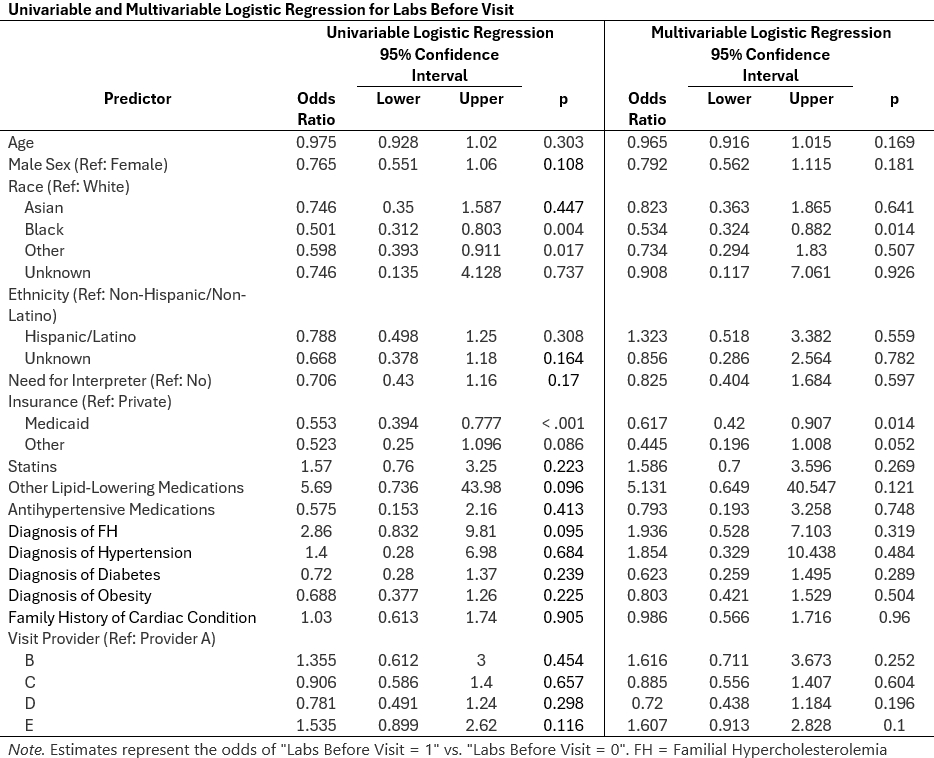
There were 669 patients included (Table 1 - 48.4% female, mean age 13.8, 62.2% White). 68.3% (454/669) obtained labs before their initial visit. Around half of patients had private health insurance. On univariable logistic regression (Table 2), Black race, “Other” race, and Medicaid insurance type were associated with lower odds of obtaining pre-visit labs (all p<0.05). On multivariable logistic regression, Black race and Medicaid insurance type remained significantly associated with lower odds of obtaining pre-visit labs (both p<0.05). Prior diagnoses, presence of lipid lowering or antihypertensive medication, and family history of cardiac conditions were not associated with obtaining pre-visit labs.

Conclusion(s)
Social factors like race and insurance status were the strongest drivers for obtaining pre-visit labs in our study. Prior diagnoses, medications, and family history of cardiac conditions did not influence obtaining pre-visit labs. These findings identify potential barriers that can be addressed to improve workup and management of youth with cardiovascular risk conditions.
  • Holsinger, Hunter  ( Nationwide Children's Hospital , Reynoldsburg , Ohio , United States )
  • Porterfield, Ronna  ( Nationwide Children's Hospital , Reynoldsburg , Ohio , United States )
  • Taylor, Makenna  ( Nationwide Children's Hospital , Reynoldsburg , Ohio , United States )
  • Dresbach, Bethany  ( Nationwide Children's Hospital , Reynoldsburg , Ohio , United States )
  • Seipel, Brittany  ( Nationwide Children's Hospital , Reynoldsburg , Ohio , United States )
  • Igwe, Chukwuemeka  ( Nationwide Children's Hospital , Reynoldsburg , Ohio , United States )
  • Alvarado, Chance  ( Nationwide Children's Hospital , Reynoldsburg , Ohio , United States )
  • Tran, Andrew  ( Nationwide Children's Hospital , Reynoldsburg , Ohio , United States )
  • Author Disclosures:
    Hunter Holsinger: No Answer | Ronna Porterfield: DO NOT have relevant financial relationships | Makenna Taylor: DO NOT have relevant financial relationships | Bethany Dresbach: No Answer | Brittany Seipel: No Answer | Chukwuemeka Igwe: DO NOT have relevant financial relationships | Chance Alvarado: DO NOT have relevant financial relationships | Andrew Tran: DO have relevant financial relationships ; Research Funding (PI or named investigator):Inozyme Pharma:Active (exists now)
Meeting Info:

Scientific Sessions 2025

2025

New Orleans, Louisiana

Session Info:

Social Determinants and Disparities in Cardiovascular Outcomes in pediatric and congenital heart disease

Monday, 11/10/2025 , 10:45AM - 11:55AM

Moderated Digital Poster Session

More abstracts on this topic:
4-Phenylbutyric Acid Reduces Endoplasmic Reticulum Retention and Partially Restores Function of LDLR p.D622N Mutation In Vitro: A Potential Therapy for Hypercholesterolemia

Wang Yongxiang, Zhang Piyi, Bai Ming, Zhang Zheng

A transformative LDL cholesterol–lowering in vivo CRISPR gene editing medicine that functionally upregulates LDLR in mice and non-human primates

Newmark Judith, Raghav Jimit, Jaskolka Michael, Diner Benjamin, Soman Vikram, Jinadasa Tushare, Apte Ameya, Wu Meng, Bottega Steve, Thakkar Mansi, Agosto Luis, Wrighton Paul, Majithia Deep, Jambard Shreya, Jansson-fritzberg Linnea, Jones Mark, Fletcher Jillian, Weiss Mckenzie, Kaye Emily, Steward Briana, Bochicchio James, Pietrasiewicz Stephen, Iovino Salvatore, Marco Rubio Eugenio, Trong Phan Huu, Chander Nisha, Kazemian Mohammadreza, Lam Kieu, Reid Steve, Dinsmore Michael, Teslovich Tanya, Xie Jenny, Gupta Anshul, Amin Parth, Burkly Linda, Thompson Morgan, Rizal Salu, Bilodeau Maxime, Dong Ruhong, Zhen Wei

More abstracts from these authors:
You have to be authorized to contact abstract author. Please, Login
Not Available