
Logo

American Heart Association

  13
  0


Final ID: MP2260

Prediction of Pregnancy-related Cardiovascular Outcomes Using Electrocardiogram-Derived Cardiorespiratory Fitness

Abstract Body (Do not enter title and authors here): Background: Early identification of women at high risk for pregnancy-related cardiovascular (CV) complications has the potential to significantly reduce maternal mortality. Peak VO2 is the gold-standard metric of cardiorespiratory fitness and has been shown to predict adverse outcomes in pregnant women, but ascertainment is costly and requires specialized equipment and expertise. We previously developed a deep learning model to accurately estimate peak VO2 from the resting 12-lead electrocardiogram (ECG). We sought to examine the association of deep learning ECG-predicted peak VO2 and incident pregnancy-related CV complications.

Methods: We ascertained ECG-estimated peak VO2 among individuals who underwent clinical 12-lead ECG testing between 1 year prior to pregnancy and 13 weeks of gestation in a multi-institutional electronic health record cohort of pregnant women. Age-adjusted logistic regression models were used to examine the association of ECG-estimated peak VO2 with subsequent pregnancy-related CV complications up to 1 year postpartum (maternal death, severe hypertensive disorders of pregnancy [HDP], and major adverse cardiac events [MACE]).

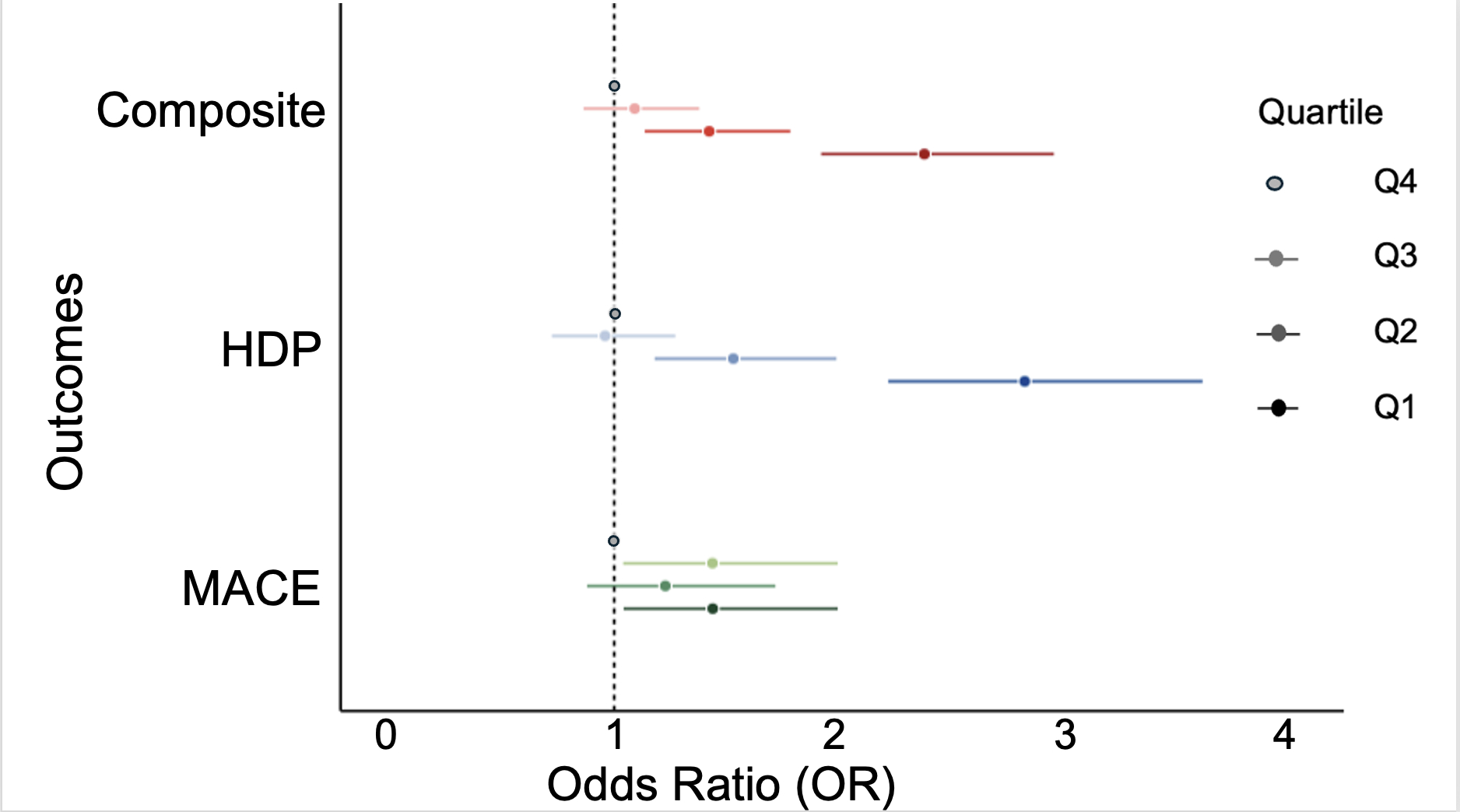
Results: Among 3650 pregnancies from 3437 women (mean age at delivery 33 ± 6 years), the median ECG-estimated VO2 was 26.5 mL/kg/min, and 26% experienced a pregnancy-related CV complication. Lower ECG-estimated peak VO2was associated with greater risk of a pregnancy-related CV complication (odds ratio [OR] 1.18 per 1-unit lower metabolic equivalent (MET = 3.5 kg/m2), 95% CI 1.15-1.23, p<0.001). Women in the lowest quartile of ECG-estimated peak VO2had nearly twice the odds of developing a pregnancy-related CV complication compared with the highest quartile (OR 2.36, 95% CI 1.91-2.93, p<0.001, Figure 1).

Conclusions: Lower estimated cardiorespiratory fitness from a validated deep learning model based on resting 12-lead ECG is strongly and independently associated with higher risk of pregnancy-related CV complications. Artificial intelligence-enabled analysis of ECGs performed routinely in antepartum care may enable scalable risk assessment for identifying high-risk pregnancies in routine clinical settings.
  • Brown, Logan  ( University of Michigan Medical School , Ann Arbor , Michigan , United States )
  • Lau, Emily  ( Massachusetts General Hospital , Boston , Massachusetts , United States )
  • Zhao, Yunong  ( Massachusetts General Hospital , Boston , Massachusetts , United States )
  • Dsouza, Valentina  ( The Broad Insititute of MIT and Harvard University , Cambridge , Massachusetts , United States )
  • Pace, Danielle  ( Massachusetts General Hospital , Boston , Massachusetts , United States )
  • Guseh, James  ( Massachusetts General Hospital , Boston , Massachusetts , United States )
  • Khurshid, Shaan  ( Massachusetts General Hospital , Boston , Massachusetts , United States )
  • Maddah, Mahnaz  ( The Broad Insititute of MIT and Harvard University , Cambridge , Massachusetts , United States )
  • Ellinor, Patrick  ( Massachusetts General Hospital , Boston , Massachusetts , United States )
  • Ho, Jennifer  ( Beth Isreal Deaconess Medical Center , Boston , Massachusetts , United States )
  • Author Disclosures:
    Logan Brown: DO NOT have relevant financial relationships | Emily Lau: DO have relevant financial relationships ; Consultant:SystoleHealth, Inc.:Active (exists now) ; Advisor:Amissa Health:Active (exists now) ; Advisor:Roon :Active (exists now) | Yunong Zhao: DO NOT have relevant financial relationships | Valentina Dsouza: DO NOT have relevant financial relationships | Danielle Pace: No Answer | James Guseh: No Answer | Shaan Khurshid: No Answer | Mahnaz Maddah: No Answer | Patrick Ellinor: No Answer | Jennifer Ho: DO have relevant financial relationships ; Individual Stocks/Stock Options:Pfizer:Active (exists now) ; Consultant:Lilly:Active (exists now)
Meeting Info:

Scientific Sessions 2025

2025

New Orleans, Louisiana

Session Info:

When Two Hearts Beat: Cardiovascular Health Before, During, and After Pregnancy

Monday, 11/10/2025 , 12:15PM - 01:25PM

Moderated Digital Poster Session

More abstracts on this topic:
Cardiovascular Health Modifies Genetic Risk for the Hypertensive Disorders of Pregnancy

Mathew Vineetha, Patel Aniruddh, Cho So Mi, Jowell Amanda, Pabon Maria, Silver Robert, Levine Lisa, Grobman William, Catov Janet, Haas David, Honigberg Michael, Khan Raiyan, Mcneil Rebecca, Yan Qi, Pe Er Itsik, Truong Buu, Natarajan Pradeep, Yee Lynn, Sharma Garima

Abnormal Calcium Regulation Leads to Pathological Cardiac Hypertrophy During Pregnancy in the GSNOR-Deficient Mouse Model of Preeclampsia

Dulce Raul, Balkan Wayne, Hare Joshua, Kulandavelu Shathiyah

More abstracts from these authors:
ECG deep learning model accurately predicts ischemic stroke risk

Mahajan Rahul, Pace Danielle, Friedman Sam, Dsouza Valentina, Anderson Christopher, Ho Jennifer, Ellinor Patrick, Maddah Mahnaz, Khurshid Shaan

Patterns and Correlates of Heart Rate Among US Adults in the All of Us Research Program

Nargesi Arash, Maddah Mahnaz, Dsouza Valentina, Shnitzer Dery Tal, Kadaifciu Andri, Cremer Rori, Jurgens Sean, Anderson Christopher, Friedman Sam, Ellinor Patrick

You have to be authorized to contact abstract author. Please, Login
Not Available