Abstract Body (Do not enter title and authors here): Background/Hypothesis: We previously reported that interleukin-18 (IL-18) mediates sickle cell cardiomyopathy (SCC), characterized by diastolic dysfunction, heart failure, and ventricular arrhythmias (VT). β-blockers such as propranolol are cardioprotective and reduce inflammation, but whether this benefit is derived from adrenergic signaling is unclear. We hypothesized that R-propranolol (enantiomer with 100-fold less adrenergic activity) may attenuate SCC via an adrenergic-independent pathway. Moreover, given propranolol induces lipid membrane remodeling, we further hypothesized that r-propranolol induces lipid synthesis and reduces membrane permeability resulting in reduced cardiac inflammation.
Methods: Human coronary artery endothelial cells (HCAECs) and humanized Townes sickle (SCD) mice (and controls) were treated for 24 hours with vehicle, r-propranolol, a known SREBP1 agonist (T0901317), and a known SREBP1 inhibitor (fatostatin). SREBP1 activity, subcellular localization, and IL-18 activation were assessed via immunofluorescence, western blotting, and RT-qPCR. Cardiac structure and function, electrophysiology, and histopathology were evaluated from in vivo and ex vivo testing to determine the therapeutic effects of R-propranolol (10uM, 7dd, IP).
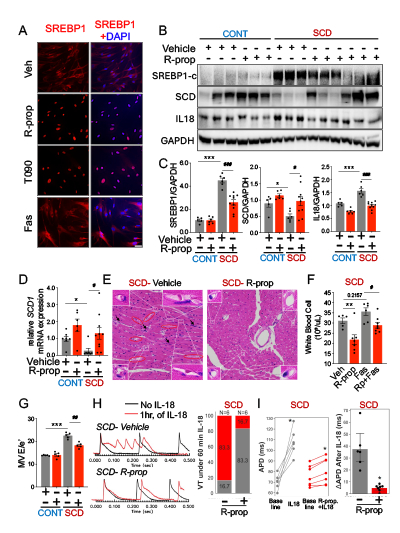
Results: In contrast to fatostatin, r-propranolol and T0901317 activated SREBP1 in HCAECs (Fig. 1A). Hearts from sickle mice exhibited increased IL-18 levels and reduced SREBP1 activity (reduced cleaved SREBP1 levels, increased stearoyl-CoA desaturase 1 or SCD1 levels- a known target for SREBP1) compared to control mice. Compared to vehicle, r-propranolol enhanced SREBP1 activity, reduced IL-18 levels, and cardiac inflammation (Figs. 1B-F) in both control and sickle mice which was attenuated by the concomitant use of fatostatin (data not shown). R-propranolol further improved diastolic dysfunction seen on echocardiography in vivo (Fig. 1G) and attenuated IL–18–induced action potential duration (APD) prolongation and VT ex vivo in sickle mice (Fig. 1H-I).
Conclusion: R-propranolol attenuates SCC via SREBP1 induction, resulting in reduced IL-18 activation and cardiac inflammation. These data mechanistically link SREBP1-mediated lipid synthesis to cardioprotection and support r-propranolol as a novel therapeutic for SCC with reduced adrenergic effects.
Jia, Yangfan
(
Indiana University
, Indianapolis , Indiana , United States )
Bronk, Peter
(
RIH and Brown Medical School
, Providence , Rhode Island , United States )
Chu, Aiai
(
Indiana University
, Indianapolis , Indiana , United States )
Kim, Tae Yun
(
RIH and Brown Medical School
, Providence , Rhode Island , United States )
Lu, Yichun
(
RIH and Brown Medical School
, Providence , Rhode Island , United States )
Javaheri, Ali
(
Washington University School of Medicine
, St. Louis , Missouri , United States )
Tang, Haiyang
(
State Key Laboratory of Respiratory Disease
, Guangzhou , Guangdong , China )
Choi, Bum-rak
(
RIH and Brown Medical School
, Providence , Rhode Island , United States )
Desai, Ankit
(
Indiana University
, Indianapolis , Indiana , United States )