
Acute and Chronic Phosphorylation of CaMKII on Coronary Microvascular/Endothelial Function
Abstract Body: Introduction: Coronary endothelial dysfunction plays a key role in the coronary heart disease in the setting of metabolic syndrome, such as hyperglycemia (HG) and diabetes. Phosphorylation of CaMKII may regulate coronary endothelial function in physiological and pathophysiological conditions. Small conductance calcium-activated-potassium (SK) channels are largely responsible for coronary arteriolar relaxation mediated by endothelium-dependent hyperpolarizing factors. Metabolic dysregulation of endothelial SK channel function contributes to diabetic endothelial dysfunction.
Hypothesis: We hypothesized that acute HG and chronic HG may differentially modulate coronary microvascular endothelial function.
Methods: The STZ-induced type 2 diabetic (T1DM), T2DM and age-matched control (WT) mice were used (n =5-6/group, male/female, 4-6 months old). For the acute hyperglycemia model, the coronary small arteries (70-120 μm in diameter) were isolated from the mouse heart of control. The vessel was then incubated with normoglycemia (5mmol/L) or high glucose (25 mmol/L) for 60 minutes. For the chronic hyperglycemia model, coronary small arteries were harvested from STZ-T1DM and T2DM mouse heart. In-vitro relaxation responses of precontracted vessels to endothelium-dependent vasodilators ADP were measured via vessel myography in the presence or absence of the selective CaMKII inhibitor KN93 or L-NAME. The protein expression of CaMKII-α, CaMKII-β, CaMKII-γ and CaMKII-δ in the diabetic and non-diabetic endothelial cells were measured via Western blotting.
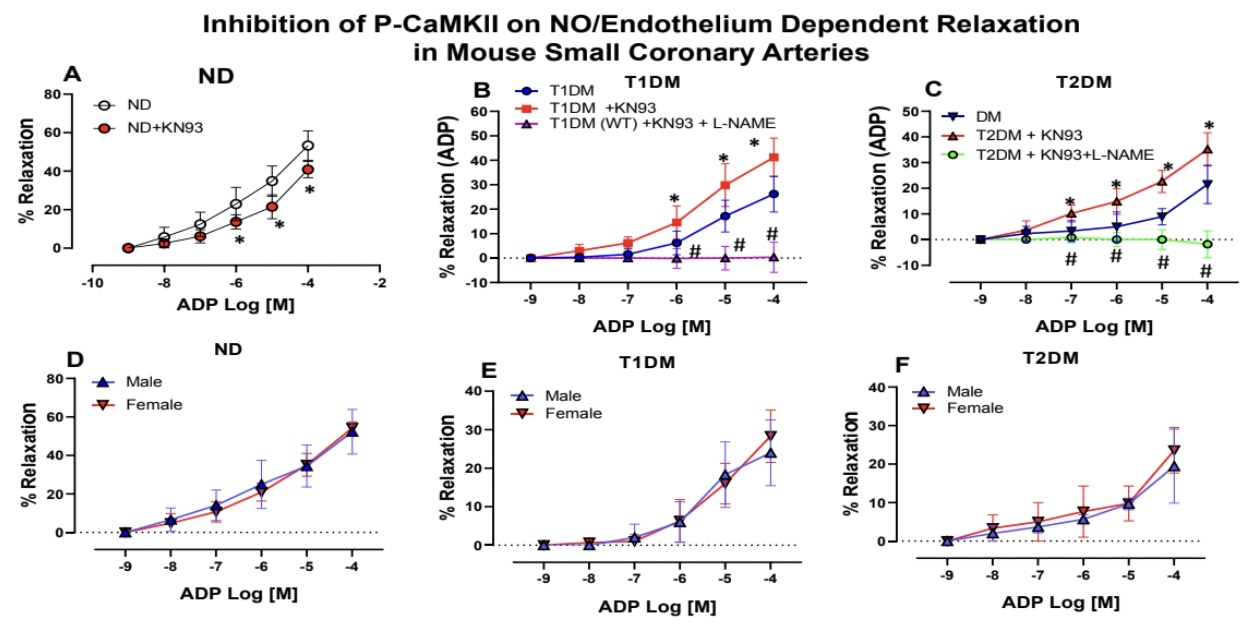
Results: Acute hyperglycemia significantly increased the coronary relaxation response to ADP; whereas this effect was blocked in the presence of KN93 or L-NAME. However, chronic hyperglycemia (T1DM) results in a significant decrease in the relaxation responses to ADP and this effect was reversed by inclusion of KN93. CaMKII-α, CaMKII-β, CaMKII-γ and CaMKII-δ were expressed in the mouse heart endothelial cells (MHECs). Expression of CaMKII-α and CaMKII-δ were significantly increased in diabetic MHECs.
Conclusions: Acute phosphorylation of CaMKII during acute hyperglycemia compensatively enhanced coronary endothelium-dependent relaxation function, whereas chronic phosphorylation of CaMKII during chronic diabetes/hyperglycemia impaired endothelium-dependent relaxation.
Iddrisu, Hanisah
( Brown University
, Providence
, Rhode Island
, United States
)
Xing, Hang
( Rhode Island hospital
, Providence
, Rhode Island
, United States
)
Shi, Guangbin
( Rhode Island Hospital
, Providence
, Rhode Island
, United States
)
Liu, Yuhong
( Rhode Island Hospital
, Providence
, Rhode Island
, United States
)
Feng, Jun
( Rhode Island Hospital
, Providence
, Rhode Island
, United States
)
Author Disclosures:
Hanisah Iddrisu:DO NOT have relevant financial relationships
| Hang Xing:DO NOT have relevant financial relationships
| guangbin shi:No Answer
| Yuhong Liu:No Answer
| Jun Feng:No Answer