
Logo

American Heart Association

  20
  0


Final ID: Su2014

ECG-SMART: A Clinician-Guided AI Dashboard for Occlusion Myocardial Infarction Detection in the Emergency Department

Abstract Body (Do not enter title and authors here): Artificial Intelligence (AI)-driven ECG methods are transforming clinical workflows, signaling a shift in ECG analysis research and clinical practice. Adoption in routine care remains limited—largely due to challenges with explainability and poor integration into existing workflows. Combining human expertise with AI has potential to enhance research translation to improve clinical decision-making and patient outcomes. We applied human-computer interaction principles to develop ECG-SMART, a clinician-facing AI dashboard designed to estimate the likelihood of occlusion myocardial infarction (OMI) while intuitively communicating the model’s reasoning.
We aimed to refine an ECG-SMART dashboard based on feedback from practicing clinicians through a series of qualitative focus groups (FG) and clinical usability sessions.
Guided by user-centered design principles, we conducted 2 rounds of virtual FGs moderated by a FG methodologist. We asked open-ended questions to elicit feedback from clinical end-users on the scope and presentation of information provided by the dashboard prototype. Round 1 consisted of 3 separate FG sessions (paramedics, ED physicians, and cardiologists) who reviewed the prototype. Feedback was used to derive a modified version of the dashboard. Round 2 combined FGs with all available clinicians who participated in Round 1 to further refine the dashboard. All FGs were recorded and transcribed. Transcripts were coded by 3 research team members to identify recurrent patterns until thematic saturation was reached. After resolution of coding discrepancies, codes coalesced into emerging themes resulting in clinician-recommended dashboard changes.
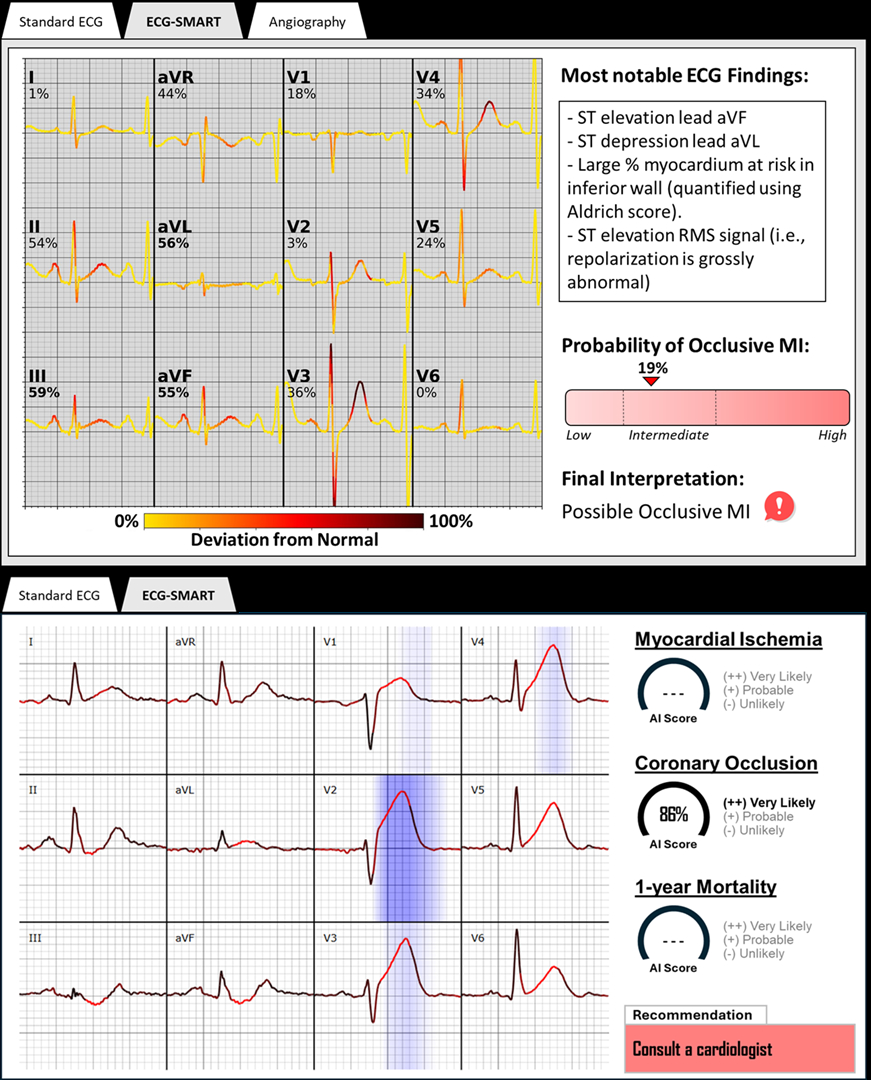
Twelve clinicians participated (mean age = 40 years, 25% female, mean clinical experience = 14 years). Five themes emerged: interpretation and clinical context, trust and explainability, AI recommendations and labels, risk stratification and AI scoring, and workflow and dashboard design. Dashboard design changes included, simplified color coding, improved OMI risk score display, enhanced AI prediction explainability and functionality, access to historical 12-lead ECGs, and revision of clinical action recommendation language. Figure 1 details the dashboard evolution.
Engaging multidisciplinary clinicians in the design and refinement of an intelligent AI-ECG dashboard bridges the gap between AI developers and target end-users, improving clinical utility and acceptability for widespread clinical implementation.
  • Helman, Stephanie  ( University of Pittsburgh , Pittsburgh , Pennsylvania , United States )
  • Gokahle, Tanmay  ( UNIVERSITY PITTSBURGH , Pittsburgh , Pennsylvania , United States )
  • Ji, Rui Qi  ( University of Toronto , Thornhill , Ontario , Canada )
  • Kraevsky, Karina  ( University of Pittsburgh , Pittsburgh , Pennsylvania , United States )
  • Riek, Nathan  ( University of Pittsburgh , Pittsburgh , Pennsylvania , United States )
  • Martin-gill, Christian  ( University of Pittsburgh , Pittsburgh , Pennsylvania , United States )
  • Callaway, Clifton  ( UNIVERSITY PITTSBURGH , Pittsburgh , Pennsylvania , United States )
  • Saba, Samir  ( University of Pittsburgh , Pittsburgh , Pennsylvania , United States )
  • Devito-dabbs, Annette  ( University of Pittsburgh , Pittsburgh , Pennsylvania , United States )
  • Zegre-hemsey, Jessica  ( UNC Chapel Hill , Chapel Hill , North Carolina , United States )
  • Grover, Joseph  ( UNC Chapel Hill , Chapel Hill , North Carolina , United States )
  • Author Disclosures:
    Stephanie Helman: DO NOT have relevant financial relationships | Tanmay Gokhale: DO NOT have relevant financial relationships | Rui Qi Ji: DO NOT have relevant financial relationships | Karina Kraevsky: DO NOT have relevant financial relationships | Nathan Riek: DO NOT have relevant financial relationships | Christian Martin-Gill: DO NOT have relevant financial relationships | Clifton Callaway: DO have relevant financial relationships ; Other (please indicate in the box next to the company name):Intellicardio (co-Founder):Active (exists now) ; Individual Stocks/Stock Options:Apple, Inc:Active (exists now) | Samir Saba: DO have relevant financial relationships ; Researcher:Abbott:Active (exists now) ; Researcher:Boston Scientific:Active (exists now) ; Advisor:Medtronic:Active (exists now) ; Advisor:Boston Scientific:Active (exists now) | Annette DeVito-Dabbs: DO NOT have relevant financial relationships | Jessica Zegre-Hemsey: DO NOT have relevant financial relationships | Joseph Grover: DO NOT have relevant financial relationships
Meeting Info:

Scientific Sessions 2025

2025

New Orleans, Louisiana

More abstracts on this topic:
Barriers in Acute Stroke Care for Patients with Limited English Proficiency

Trang Ivan, Ali Amir, Ganne Chaitanya, Perez Malagon Carlos David, Nguyen Thy, Sharrief Anjail

2-Deoxyuridine Associates with Recurrent Coronary Events

Pistritu Dan, Castano David, Liehn Elisa, Koh Cho Yeow, Gerszten Robert, Singaraja Roshni, Chan Mark, Shah Svati

More abstracts from these authors:
You have to be authorized to contact abstract author. Please, Login
Not Available