Association of motor limitations with mortality and cardiovascular events and moderation by physical activity: population based cohort study
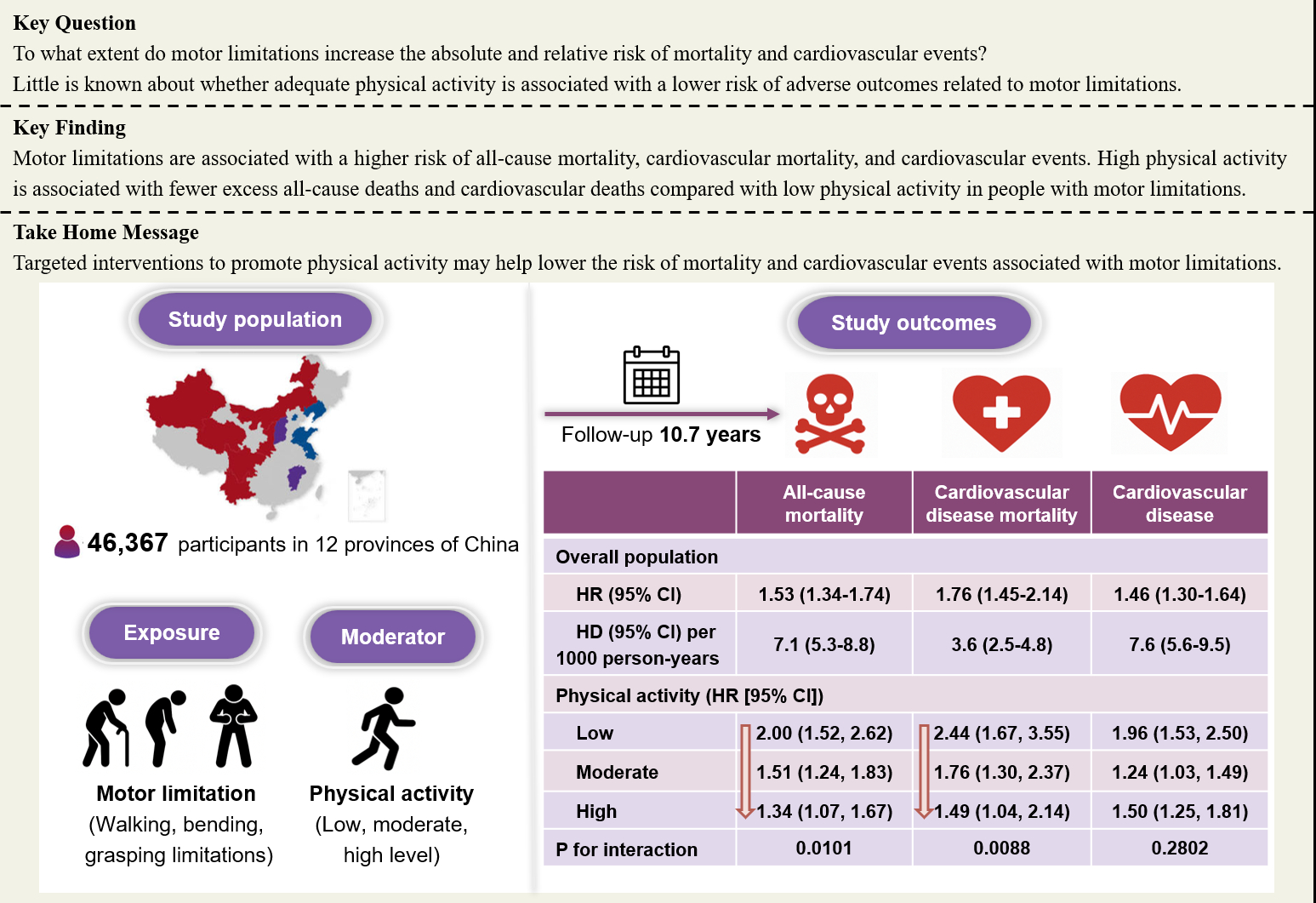
Abstract Body (Do not enter title and authors here): Objectives To examine the associations between motor limitations, mortality, and cardiovascular disease (CVD), as well as the role of physical activity in moderating these relationships in a longitudinal cohort in China. Methods We analyzed data from the Prospective Urban Rural Epidemiology (PURE)-China cohort study, which comprised adults aged 35-70 from 115 urban and rural communities across 12 provinces. Motor limitation was defined as self-reported difficulties in walking, grasping, or bending. Physical activity was categorized based on the International Physical Activity Questionnaire. The primary outcomes were all-cause mortality, CVD mortality, and CVD events. We used Cox frailty models and additive hazards regression models to assess the association between motor limitation and the primary outcomes. Results Between January 1, 2005, and December 31, 2009, 46,367 participants (mean age 51.1 ± 9.7 years; 27,129 [58.5%] women) were recruited, and followed-up for a median of 10.7 years (IQR 9.5-12.6 years). 2807 (6.1%) individuals were classified as having motor limitations at baseline. After adjustment of confounders, there was a significant association between motor limitation and all-cause mortality (hazard ratio [HR] 1.53 [95% CI 1.34-1.74]), CVD mortality (1.76 [1.45-2.14]), and incident CVD (1.46 [1.30-1.64]). Furthermore, motor limitation was associated with excess deaths (hazard difference [HD] 7.1 [95% CI 5.3-8.8] per 1000 person-years), excess CVD deaths (3.6 [2.5-4.8]), and excess incident CVD (7.6 [5.6-9.5]). Specifically, walking limitation demonstrated the strongest association with adverse outcomes and the highest excess events, compared to bending or grasping limitation. A rising trend in risk for all primary outcomes was observed with an increasing number of motor limitations (ptrend<0.001). Compared to low physical activity, those with moderate and high physical activity had lower risk of all-cause (HRs 2.00 vs. 1.51 and 1.34, pinteraction=0.010) and CVD (2.44 vs. 1.76 and 1.49, pinteraction=0.009) deaths related to motor limitation. Conclusions Individuals with motor limitations had higher risks of mortality and CVD, but the risks were lower in those with moderate or high physical activity. Therefore, targeted public health strategies should focus on promoting physical activity among those with and without motor limitations to help reduce their risk of adverse health outcomes.
Yan, Minghai
(
Fuwai Hospital
, Beijing , China )
Cai, Qiujing
(
Fuwai Hospital
, Beijing , China )
Joundi, Raed
(
Population Health Research Institute
, Hamilton , Alberta , Canada )
Liu, Zhiguang
(
Anzhen hospital
, Beijing , China )
Tse, Lap Ah
(
The Chinese University of Hongkong
, Hong Kong , China )
Rangarajan, Sumathy
(
Population Health Research Institute
, Hamilton , Alberta , Canada )
Ma, Yuanting
(
Dongguan street community health service center
, Xining , China )
Peng, Tao
(
Shunyi District Center for Disease Control and Prevention
, Beijing , China )
You, Kai
(
Shunyi District Center for Disease Control and Prevention
, Beijing , China )
Lan, Lei
(
Fuwai Hospital
, Beijing , China )
Hu, Bo
(
Fuwai Hospital
, Beijing , China )
Li, Wei
(
Fuwai Hospital
, Beijing , China )
Author Disclosures:
Minghai Yan:DO NOT have relevant financial relationships
| Lei Lan:No Answer
| Bo Hu:No Answer
| Wei Li:No Answer
| Qiujing Cai:No Answer
| Raed Joundi:No Answer
| Zhiguang Liu:No Answer
| Lap Ah TSE:No Answer
| Sumathy Rangarajan:DO NOT have relevant financial relationships
| Yuanting Ma:No Answer
| Tao Peng:No Answer
| Kai You:No Answer