EPI-Lifestyle Scientific Sessions 2026
/
Poster Session 1
/
Bidirectional reallocations of sedentary time, physical activity, and sleep in relation to risk of all-cause mortality and cardiovascular disease: an analysis of the Prospective Urban Rural Epidemiology (PURE)-China cohort study
American Heart Association
78
0
Final ID: TU210
Bidirectional reallocations of sedentary time, physical activity, and sleep in relation to risk of all-cause mortality and cardiovascular disease: an analysis of the Prospective Urban Rural Epidemiology (PURE)-China cohort study
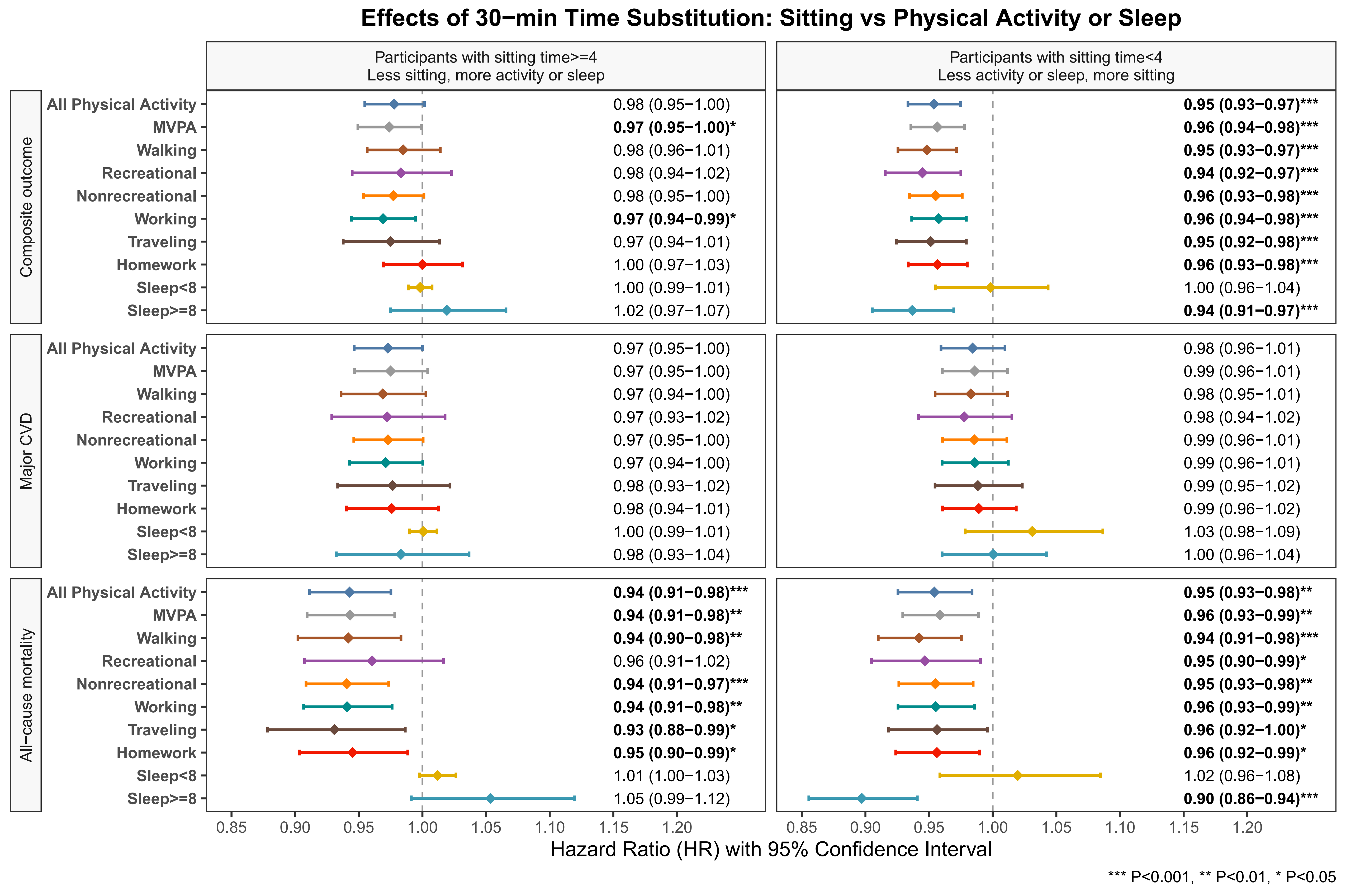
Abstract Body: Background: Although prolonged sedentary time is linked to adverse health outcomes, evidence regarding its dose–response relationship in the low-exposure ranges remains limited. Moreover, the effects of reallocating time between sedentary behavior, physical activity, and sleep on all-cause mortality and cardiovascular disease have not been comprehensively examined. To address these gaps, we evaluated bidirectional time reallocations among sedentary behavior, physical activity, and sleep in a Chinese cohort. Methods: We analyzed data from the PURE-China study, which recruited 47,931 participants aged 35 to 70 years from 115 communities across 12 provinces between 2005 and 2009 in China and followed up every three years Sitting time, physical activity, and sleep duration were assessed using validated questionnaires. The primary outcome was a composite of all-cause mortality and major cardiovascular events. Cox frailty models were used to examine the associations of sitting time with outcomes. Isotemporal substitution models were applied to estimate the bidirectional reallocations of time between sedentary behavior, physical activity, and sleep. Results: Among 41,733 participants with a median follow-up of 11.9 years, the mean age was 50.6 ± 9.7 years, and the median sitting time was 3.0 hours/day (IQR: 1.7–4.6). Sitting time showed a J-shaped association with the composite outcome, with the lowest risk observed at 2–4 h/day. Both low (<2 h/day) and high (≥6 h/day) levels of sitting were associated with increased risks of all-cause mortality and composite outcome. Among participants sitting ≥4 h/day, replacing 30 minutes of sitting with moderate-to-vigorous physical activity (MVPA) or work-related activity was associated with a 3–7% reduction in mortality risk. Conversely, among those sitting <4 h/day, reallocating time from physical activity or prolonged sleep to sitting time was associated with a 4%-10% reduction risk of mortality. Conclusions: Sedentary behavior shows context-dependent associations with health, where both low and high levels relate to higher risks. The “sitting paradox” observed in highly active individuals highlights the bidirectional effects of reallocating time between sitting, physical activity, and sleep. These findings underscore the need for more nuanced public health recommendations tailored to baseline activity and sedentary patterns.
Huang, Yilin
(
Fuwai Hospital
, Beijing , China )
Hao, Jun
(
The First Affiliated Hospital of Nanchang University
, Beijing , (None) , China )