Differences in metabolic, behavioural and psychosocial risk factors and mortality in women and men: nationwide population based cohort study
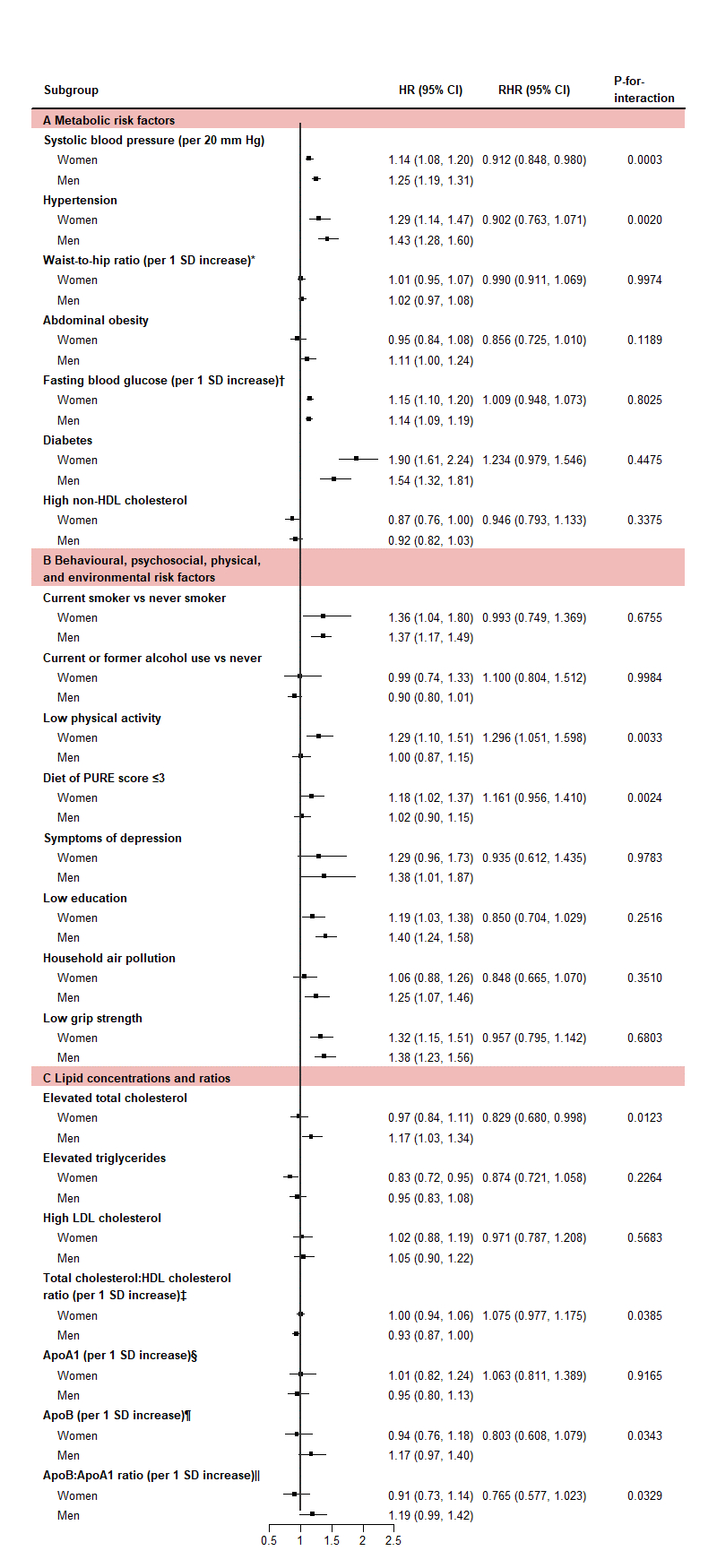
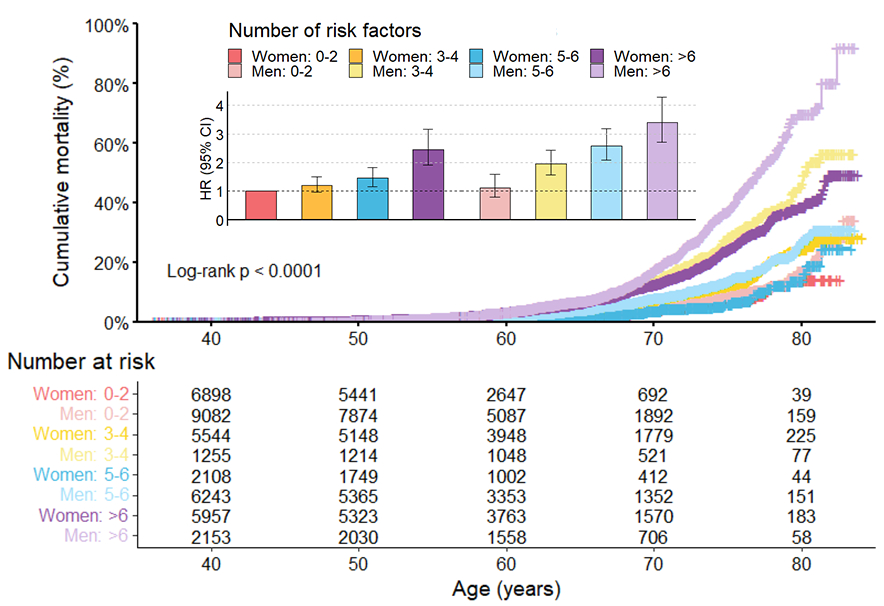
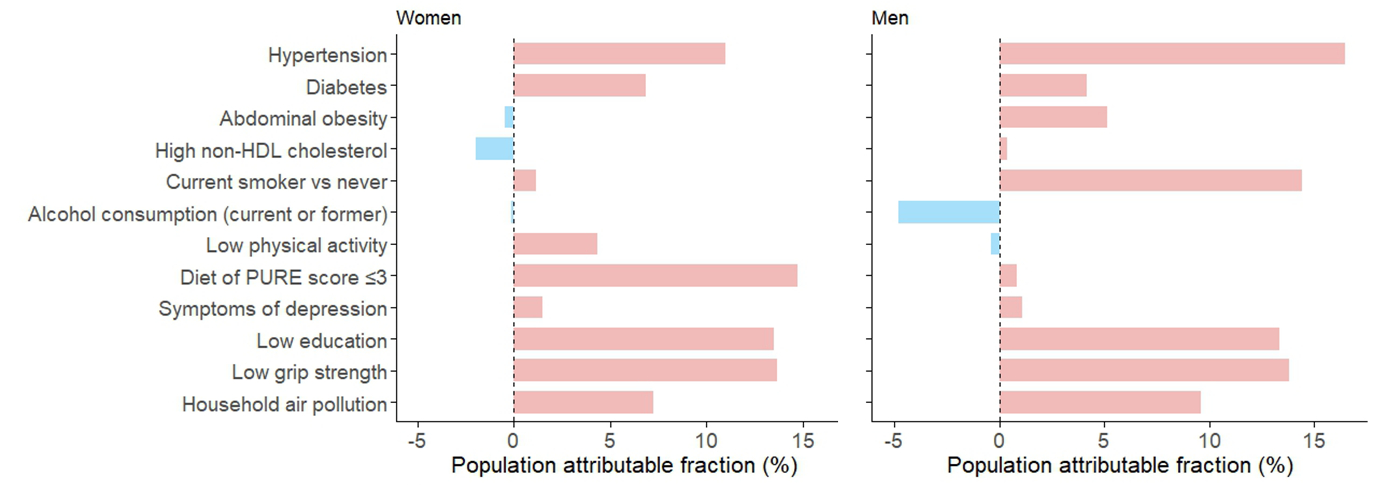
Abstract Body: Background Little is known about the interaction and joint associations of sex and modifiable risk factors with mortality, leaving critical gaps in understanding their contribution to population health outcomes. Methods The Prospective Urban Rural Epidemiology (PURE)-China cohort study recruited participants aged 35 to 70 years from 115 urban and rural communities across 12 provinces in China during 2005-2009, and followed up until Aug 30, 2021. Metabolic, behavioural, and psychosocial risk factors were assessed using standardized measures and questionnaires, with all-cause mortality serving as the primary outcome. Results Of 47,345 participants included in this analysis, 27,584 (58.3%) were women. After a median follow-up of 11.9 years (IQR 9.5-12.6), 1217 deaths were observed in women (age-standardised mortality 3.8 [95% CI 3.6-4.0] per 1000 person-years) and 1526 in men (6.1 [5.8-6.4] per 1000 person-years). Men exhibited higher prevalence of metabolic, behavioural, and psychosocial risk factors, although these differences diminished with age. Systolic blood pressure showed a stronger association with mortality in men (HR 1.25 [95% CI 1.19-1.31] per 20 mm Hg) than that among women (1.14 [1.08-1.20] per 20 mm Hg, Pinteraction<0.001), as was the case for hypertension. Conversely, women with low physical activity (<600 metabolic equivalents×minutes per week or <150 minutes per week of moderate intensity physical activity) (1.29 [1.10-1.51] vs. 1.00 [0.87-1.15], Pinteraction=0.003) and a PURE diet score ≤3 (1.18 [1.02-1.37] vs. 1.02 [0.90-1.15], Pinteraction=0.002) were associated with higher risks of mortality than that among men. Men with ≥7 risk factors had a significantly greater risk of mortality compared to women with 0-2 risk factors (3.40 [2.71-4.27]). Metabolic risk factors accounted for a higher excessive mortality in men (PAF 26.2% vs. 15.4% in women), whereas behavioural and psychosocial factors contributed more in women (35.1% vs. 24.5% in men). Conclusions These findings underscore that metabolic risk factors, particularly systolic blood pressure, are key drivers of mortality in men, while behavioural and psychosocial factors, including physical inactivity and poor diet, are more influential in women. Targeted interventions addressing these sex-specific risk factors could significantly reduce mortality and enhance health equity in the Chinese population.
Yan, Minghai
(
National Clinical Research Center for Cardiovascular Diseases, Fuwai Hospital, National Center for Cardiovascular Diseases, Peking Union Medical College and Chinese Academy of Medical Sciences
, Beijing , Beijing , China )
Liu, Zhiguang
(
Beijing Anzhen Hospital, Capital Medical University
, Beijing , Beijing , China )
Hu, Bo
(
National Clinical Research Center for Cardiovascular Diseases, Fuwai Hospital, National Center for Cardiovascular Diseases, Peking Union Medical College and Chinese Academy of Medical Sciences
, Beijing , Beijing , China )
Li, Wei
(
National Clinical Research Center for Cardiovascular Diseases, Fuwai Hospital, National Center for Cardiovascular Diseases, Peking Union Medical College and Chinese Academy of Medical Sciences
, Beijing , Beijing , China )