Logo

American Heart Association

  18
  0


Final ID: MP2337

Deep Learning-Based Retinal Biomarker Captures Cardiovascular Risk in Hypertensive Abnormal Dippers Beyond Conventional Metrics

Abstract Body (Do not enter title and authors here):
Introduction
Among hypertensive subtypes, abnormal dippers — including non-dippers and risers — are characterized by blunted nocturnal blood pressure (BP) declines and are associated with poor prognosis. However, limited data exist on their relationship with deep learning-derived retinal biomarkers for cardiovascular risk.

Hypothesis
We hypothesized that hypertensive individuals with abnormal dipping patterns would have a higher risk of cardiovascular disease (CVD) than normal dippers and that a retinal deep learning-based CVD risk score (Dr.Noon CVD score) would reflect higher cardiovascular burden from nocturnal hypertension compared to traditional risk markers.

Goals
This study aimed to compare carotid intima-media thickness (CIMT), coronary artery calcification (CAC), and a deep learning-based retinal biomarker between normal and abnormal dippers.

Methods
We analyzed 901 hypertensive patients from a 10-year prospective cohort at Severance Hospital, categorizing them as normal (>10% nocturnal drop, N = 463) or abnormal dippers (<10%, N = 438). Group comparisons of clinical variables were performed using chi-squared or nonparametric tests. CVD incidence was assessed by survival analysis. CIMT, CAC, and Dr.Noon CVD scores were compared using Wilcoxon rank-sum tests. Multivariate analyses adjusted for age, gender, and BMI.

Results
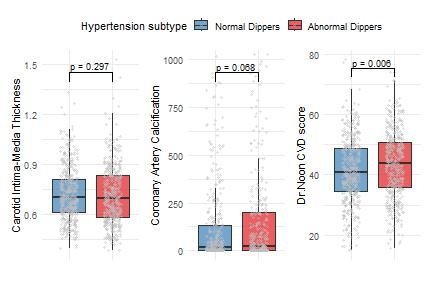
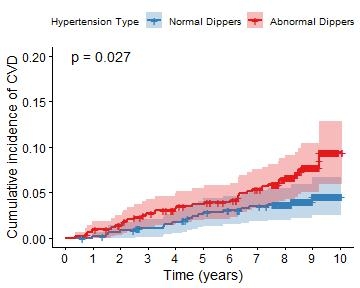
Over 10 years, abnormal dippers had a higher cumulative incidence (p = 0.027) and adjusted hazard ratio of CVD events (HR 1.93, 95% CI 1.09-3.39). Age, gender, and BMI did not differ between groups (p > 0.05). Daytime BP was higher in normal dippers (135/82 vs. 132/80 mmHg; p < 0.006), while nighttime BP was higher in abnormal dippers (113/69 vs. 128/76 mmHg; p < 0.001). CIMT did not differ (p = 0.297), and CAC showed a borderline difference (p = 0.068). The Dr.Noon CVD score was higher in abnormal dippers (p = 0.006). In multivariate linear regression, abnormal dippers had a 2.08-point higher Dr.Noon CVD score compared to normal dippers (p < 0.001). Each one-year increase in age was associated with a 0.59-point increase (p < 0.001), suggesting abnormal dipping is comparable to around three years of aging regarding CVD risk.

Conclusion
Abnormal nocturnal BP patterns are associated with elevated cardiovascular risk. Traditional risk markers did not fully capture this difference, whereas the deep learning-based retinal biomarker reflected the increased risk, likely due to its sensitivity to microvascular changes from nocturnal hypertension.
  • Park, Junseok  ( Mediwhale , Seoul , Korea (the Republic of) )
  • Na, Jin Oh  ( Korea University Guro Hospital and Korea University College of Medicine , Seoul , Korea (the Republic of) )
  • Park, Sungha  ( Yonsei University College of Medicine , Seoul , Korea (the Republic of) )
  • Thakur, Sahil  ( Mediwhale , Seoul , Korea (the Republic of) )
  • Cho, Jungkyung  ( Mediwhale , Seoul , Korea (the Republic of) )
  • Nam, Dongjin  ( Mediwhale , Seoul , Korea (the Republic of) )
  • Park, Tae Hyun  ( Mediwhale , Seoul , Korea (the Republic of) )
  • Seo, Jaewon  ( Mediwhale , Seoul , Korea (the Republic of) )
  • Nusinovici, Simon  ( Mediwhale , Seoul , Korea (the Republic of) )
  • Rukmini, A.v.  ( Mediwhale , Seoul , Korea (the Republic of) )
  • Rim, Tyler  ( Mediwhale , Seoul , Korea (the Republic of) )
  • Author Disclosures:
    Junseok Park: DO have relevant financial relationships ; Employee:Mediwhale:Past (completed) | Jin Oh Na: No Answer | Sungha Park: No Answer | Sahil Thakur: No Answer | Jungkyung Cho: No Answer | Dongjin Nam: No Answer | Tae Hyun Park: No Answer | Jaewon Seo: No Answer | Simon Nusinovici: No Answer | A.V. Rukmini: No Answer | Tyler RIM: DO have relevant financial relationships ; Employee:Mediwhale:Active (exists now) ; Individual Stocks/Stock Options:Mediwhale:Active (exists now)
Meeting Info:

Scientific Sessions 2025

2025

New Orleans, Louisiana

Session Info:

AI-Powered Multimodal Imaging and ECG for Disease-Specific Diagnostics

Monday, 11/10/2025 , 12:15PM - 01:25PM

Moderated Digital Poster Session

More abstracts on this topic:
A Deep Learning Topic Analysis Approach for Enhancing Risk Assessment in Heart Failure Using Unstructured Clinical Notes

Adejumo Philip, Pedroso Aline, Khera Rohan

A cerebrovascular longitudinal atlas: different rates of morphological change in aneurysm patients associated with hypertension and diabetes

Chien Aichi, Salamon Noriko, Vinuela Fernando, Szeder Viktor, Colby Geoffrey, Jahan Reza, Boyle Noel, Villablanca Juan, Duckwiler Gary

More abstracts from these authors:
Vascular Imaging for ASCVD Risk Stratification: Predictive Value of Carotid Plaque, Coronary Artery Calcium, and Retinal Biomarker (Dr.Noon CVD)

Cho Jungkyung, Lee Chan Joo, Chun Kyeong-hyeon, Park Sung Ha, Park Junseok, Nam Dongjin, Thakur Sahil, Rukmini A.v., Park Tae Hyun, Seo Jaewon, Nusinovici Simon, Rim Tyler Hyungtaek

Retinal Vascular and Renal Biomarkers Predict Systemic Cardiovascular and Kidney Disease in the Brazilian Multilabel Ophthalmological Dataset (BRSET)

Thakur Sahil, Seo Jaewon, Park Tae Hyun, Kim Hyeonmin, Arora Vinay, Nusinovici Simon, Rim Tyler, Rastogi Sparsh, Modi Khushboo, Rukmini A.v., Kim Sunwoong, Seo Wonyoung, Park Junseok, Nam Dongjin, Cho Jungkyung

You have to be authorized to contact abstract author. Please, Login
Not Available