Predictive Utility of Genomics, Inflammation, Cholesterol, and Lipoprotein(a) in Assessing Coronary Artery Disease Risk Across Age and Sex
Abstract Body (Do not enter title and authors here): Background: Coronary artery disease (CAD) polygenic risk score (PRS), low-density lipoprotein cholesterol (LDL-C), lipoprotein(a) [Lp(a)], and high-sensitivity C-reactive protein (hs-CRP) are blood-based biomarkers that predict CAD. We studied their predictive utility for incident CAD across age and sex.
Methods: We studied 215,295 UK Biobank participants aged 40-69 years, free from CAD, not on lipid-lowering therapy, and with hs-CRP, Lp(a), LDL-C, and CAD PRS data. Multivariable Cox models were used to estimate age and sex-specific hazard ratios (HR) of individual and additive effects of the biomarkers on incident CAD. We evaluated the risk of CAD by the number of elevated biomarkers. Model performance was evaluated by calculating the Net reclassification index and C-statistics of a four-biomarker-based model compared to Pooled Cohort Equations (PCE).
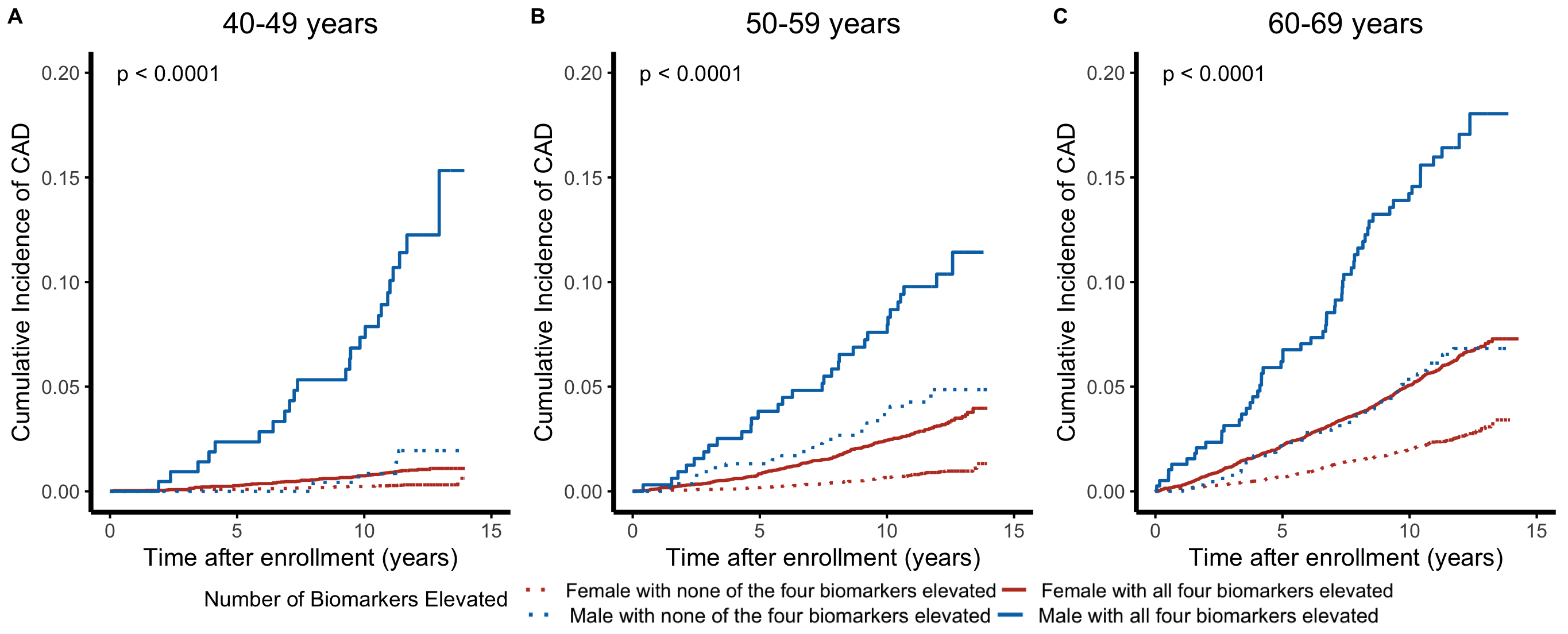
Results: 94,416 males (mean age 55.88±8.19 years, 88.3% white) and 121,279 females (mean age 55.96±7.81 years, 87.8% white) were followed for a median of 12 years. 4,721 (5%) males and 2426 (2%) females developed CAD. Each biomarker was strongly associated with incident CAD, with effect differences by sex and age. Hs-CRP conferred greater HR per SD in female (1.29; 95%CI 1.25-1.34) compared to male (1.25; 95%CI 1.22-1.29) [p-interaction = 0.03] while CAD PRS conferred greater HR per SD in males (1.49; 95% CI 1.45-1.54) than females (1.37; 95% CI 1.31-1.44) [p-interaction=0.0004]. No significant sex differences were observed in the association of LDL-C and Lp(a) with CAD. LDL-C, hs-CRP, and CAD PRS, but not Lp(a), conferred higher HR at a younger age (p<0.0001). The number of elevated biomarkers (none to four) strongly stratified CAD risk – HR of 4.65 (95%CI 3.90-5.54) when all biomarkers are elevated compared to none(Figure). A combined model of all biomarkers with PCE yielded a C-statistic of 0.753, a net reclassification index of 35.4% vs. PCE alone (C-statistic 0.735). Performance was highest among the 40-45 age group and declined with increasing age. Of all biomarkers, CAD PRS exhibited the highest population attributable risk at all ages, which was highest in the 40-49 age group (Male: 27.55%, 95%CI 25.52–29.58; Female: 17.83%, 95%CI 14.27–21.40).
Conclusions: CAD PRS, LDL-C, hs-CRP, and Lp(a) show independent and age and sex specific associations with CAD, with higher predictive power in younger ages. A single measurement of all four biomarkers may improve risk prediction in both sexes across middle age.
Farah, Raysha
(
Harvard Medical School
, Boston , Massachusetts , United States )
Kim, Min Seo
(
Broad Institute of MIT and Harvard
, Cambridge , Massachusetts , United States )
Truong, Buu
(
Broad Institute of MIT and Harvard
, Cambridge , Massachusetts , United States )
Sui, Yang
(
Broad Institute of MIT and Harvard
, Cambridge , Massachusetts , United States )
Cho, So Mi Jemma
(
Broad Institute of MIT and Harvard
, Cambridge , Massachusetts , United States )
Urbut, Sarah
(
Massachusetts General Hospital
, Boston , Massachusetts , United States )
Ridker, Paul
(
BRIGHAM WOMENS HOSPITAL
, Boston , Massachusetts , United States )
Patel, Aniruddh
(
Massachusetts General Hospital
, Boston , Massachusetts , United States )
Natarajan, Pradeep
(
Massachusetts General Hospital
, Boston , Massachusetts , United States )
Fahed, Akl
(
Massachusetts General Hospital
, Boston , Massachusetts , United States )
Author Disclosures:
Raysha Farah:DO NOT have relevant financial relationships
| Akl Fahed:No Answer
| Min Seo Kim:No Answer
| Buu Truong:DO NOT have relevant financial relationships
| Yang Sui:No Answer
| So Mi Jemma Cho:No Answer
| Sarah Urbut:DO NOT have relevant financial relationships
| Paul Ridker:DO have relevant financial relationships
;
Research Funding (PI or named investigator):Kowa, Novartis, Pfizer, NovoNordisk:Active (exists now)
; Advisor:Uppton, Bitteroot Bio, Angiowave, Peter Munk University of Toronto, Leducq Foundation:Active (exists now)
; Consultant:Novartis, Novo Nordisk, Agepha, Ardelyx, Arrowhead, AstraZeneca, CSK Behring, Civi Biopharm, GSK, Eil Lilly, New Amsterdam, CardioTherapeutics, Caristo, Tourmaline Bio:Active (exists now)
| Aniruddh Patel:No Answer
| Pradeep Natarajan:DO have relevant financial relationships
;
Researcher:Amgen, Genentech / Roche:Active (exists now)
; Other (please indicate in the box next to the company name):Vertex Pharmaceuticals (spousal employment):Active (exists now)
; Ownership Interest:Bolt, Candela, Mercury, MyOme, Parameter Health, Preciseli, TenSixteen Bio:Active (exists now)
; Consultant:Allelica, CRISPR Therapeutics, Genentech/Roche, HeartFlow, Magnet Biomedicine:Past (completed)
; Consultant:AstraZeneca, Blackstone Life Sciences, Bristol Myers Squibb, Eli Lilly & Co, Esperion Therapeutics, Foresite Capital, Foresite Labs, GV, Merck, Novartis, Novo Nordisk, TenSixteen Bio, Tourmaline Bio:Active (exists now)
; Researcher:Allelica, Novartis:Past (completed)