Lipoprotein(a) is a Prognostic Marker of Extracoronary Atherosclerotic Vascular Disease Progression
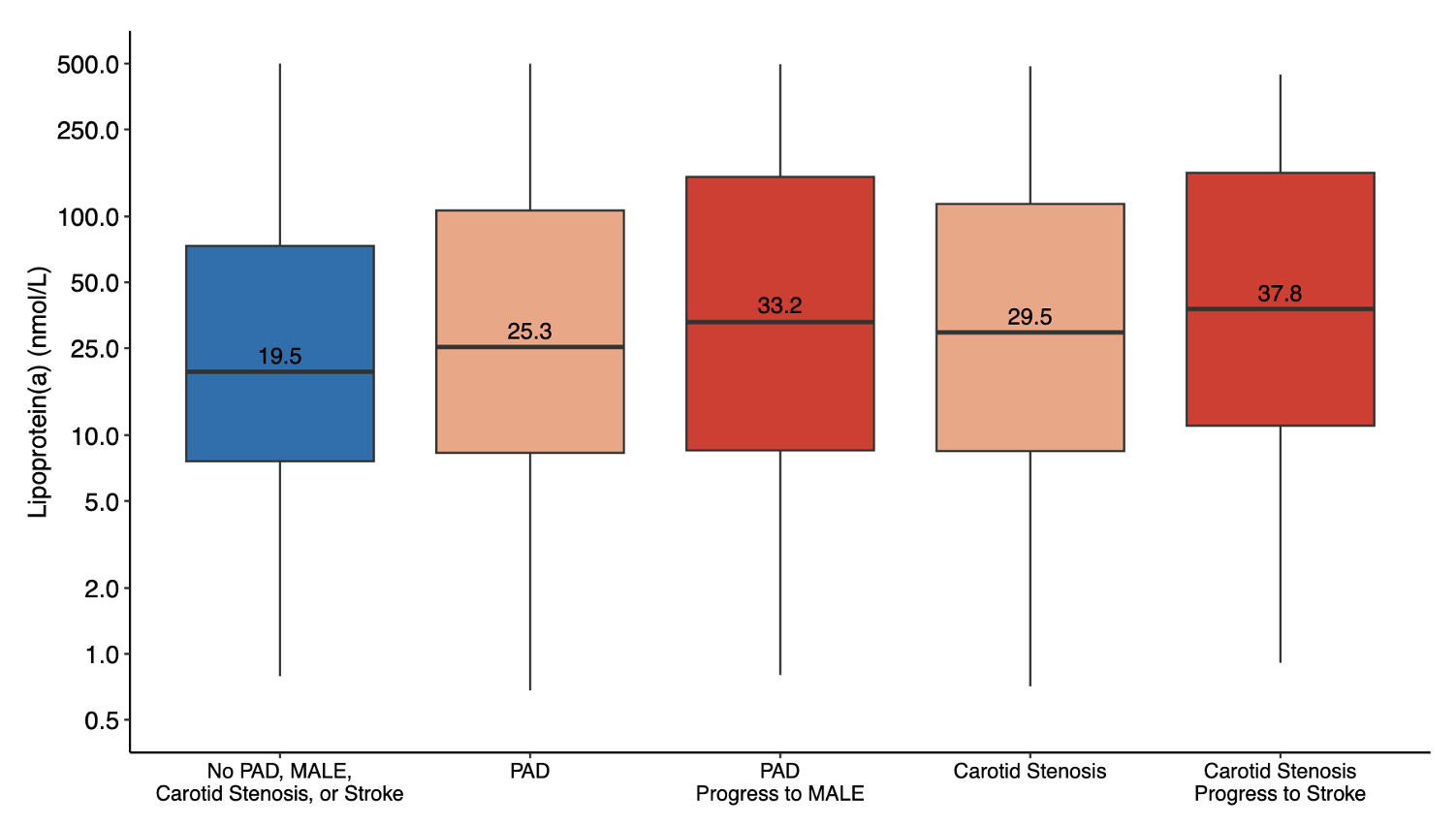
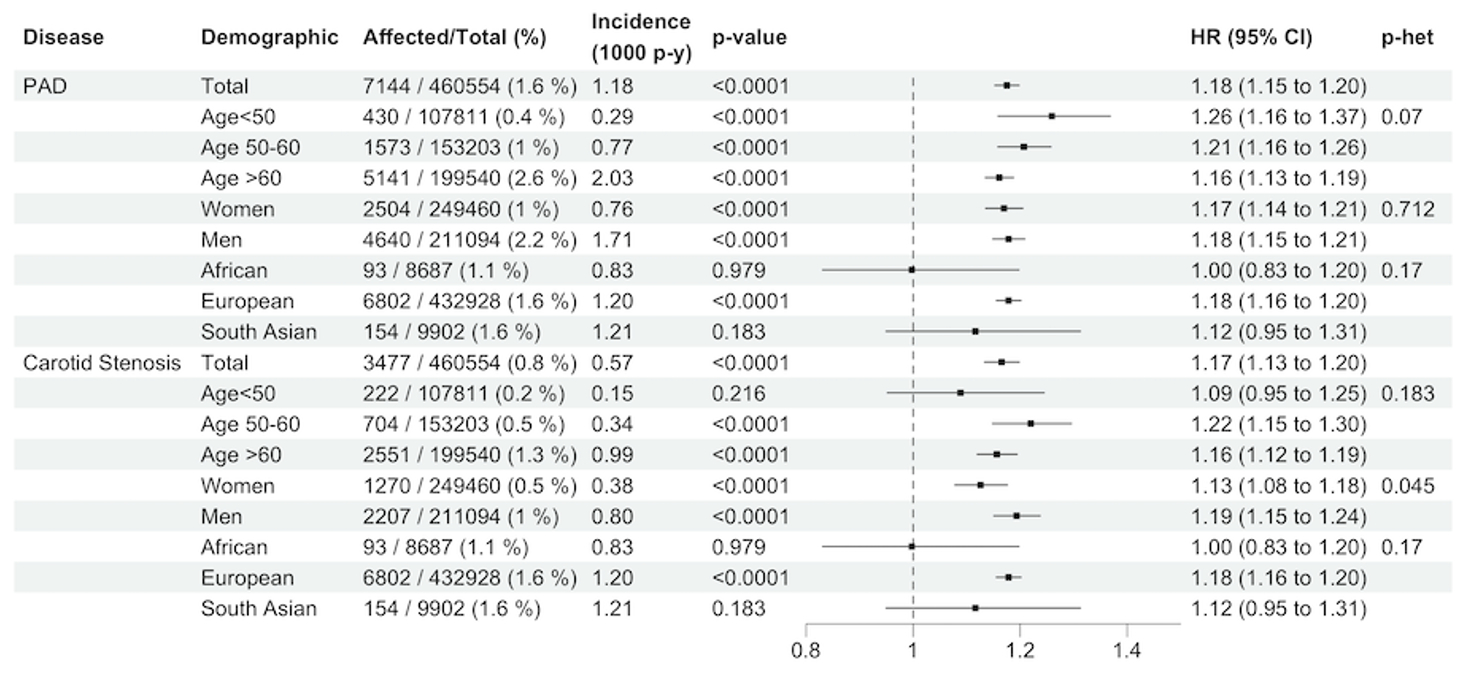
Abstract Body (Do not enter title and authors here): Background: Despite current treatment strategies for atherosclerotic vascular disease focusing on lifestyle modification and lowering cholesterol, a significant residual risk of major atherosclerotic complication remains, prompting investigation into lipoprotein(a) [Lp(a)] as a potential predictive biomarker. The objective of this study was to determine the utility of Lp(a) in identifying patients at high risk of incident extracoronary atherosclerotic vascular disease and complications. Methods: Data from 460,544 participants in the UK Biobank with prospectively measured Lp(a) concentrations were included in this analysis. Cox proportional hazards regressions modeled the associations of Lp(a) concentrations with incident peripheral arterial disease (PAD) and incident carotid artery stenosis, and progression to the first major adverse limb event (MALE) and the first stroke, respectively. Results: Of the study participants, the median [IQR] age at study enrollment was 58 [51 – 64] years, 54.2% were male, 94.4% European, 5.5% had diabetes, and 10.5% were smokers over a median follow-up time of 13.6 [12.9 – 14.4] years. Among participants with prevalent PAD and carotid stenosis at enrollment, 196 (2.7%) and 67 (1.9%) progressed to the first incidence of MALE and stroke, respectively. Median Lp(a) concentrations were significantly different in those without atherosclerotic vascular disease at 19.5 nmol/L [7.6-73.5] compared to incident PAD at 25.3 nmol/L [8.3-107.3], progression to MALE at 33.3 nmol/L [8.7-158.2], incident carotid stenosis at 29.5 nmol/L [8.5-116.3], and carotid stenosis progression to stroke at 37.8 nmol/L [11.1-158.3] (Figure 1). The risk estimate per 75 nmol/L Lp(a) for incident PAD (HR 1.18, 95% CI 1.15-1.20, p-value<0.0001) was similar to incident carotid stenosis (HR 1.17, 95% CI 1.13-1.20, p-value<0.0001) (Figure 2). Among participants with PAD, those with high Lp(a) concentrations were at 1.57 times the risk of developing MALE than participants with normal Lp(a) concentrations (95% CI 1.14-2.16, p-value=0.006). Among participants with carotid stenosis, participants had 1.40 times the risk of developing an ischemic stroke with high Lp(a) concentrations, although this was not significant (95% CI 0.81-2.40, p-value=0.228). Conclusion: High concentrations of Lp(a) are associated with both incident extracoronary atherosclerotic vascular disease and progression to major complications.
Bellomo, Tiffany
(
Massachusetts General Hospital
, Boston , Massachusetts , United States )
Bramel, Emily
(
The Broad Institute
, Cambridge , Massachusetts , United States )
Lee, Jiwoo
(
Broad Institute of MIT and Harvard
, Lexiton , Massachusetts , United States )
Urbut, Sarah
(
The Broad Institute
, Cambridge , Massachusetts , United States )
Flores, Alyssa Monica
(
Massachusetts General Hospital
, Boston , Massachusetts , United States )
Koyama, Satoshi
(
Broad Institute
, Cambridge , Massachusetts , United States )
Truong, Buu
(
The Broad Institute
, Cambridge , Massachusetts , United States )
Haidermota, Sara
(
Massachusetts General Hospital
, Boston , Massachusetts , United States )
Eagleton, Matthew
(
Massachusetts General Hospital
, Boston , Massachusetts , United States )
Natarajan, Pradeep
(
Massachusetts General Hospital
, Boston , Massachusetts , United States )
Patel, Aniruddh
(
The Broad Institute
, Cambridge , Massachusetts , United States )
Author Disclosures:
Tiffany Bellomo:DO NOT have relevant financial relationships
| Pradeep Natarajan:DO have relevant financial relationships
;
Researcher:Amgen, Genentech / Roche:Active (exists now)
; Other (please indicate in the box next to the company name):Vertex Pharmaceuticals (spousal employment):Active (exists now)
; Ownership Interest:Bolt, Candela, Mercury, MyOme, Parameter Health, Preciseli, TenSixteen Bio:Active (exists now)
; Consultant:Allelica, CRISPR Therapeutics, Genentech/Roche, HeartFlow, Magnet Biomedicine:Past (completed)
; Consultant:AstraZeneca, Blackstone Life Sciences, Bristol Myers Squibb, Eli Lilly & Co, Esperion Therapeutics, Foresite Capital, Foresite Labs, GV, Merck, Novartis, Novo Nordisk, TenSixteen Bio, Tourmaline Bio:Active (exists now)
; Researcher:Allelica, Novartis:Past (completed)
| Aniruddh Patel:No Answer
| Emily Bramel:No Answer
| Jiwoo Lee:DO NOT have relevant financial relationships
| Sarah Urbut:DO NOT have relevant financial relationships
| Alyssa Monica Flores:DO NOT have relevant financial relationships
| Satoshi Koyama:DO NOT have relevant financial relationships
| Buu Truong:DO NOT have relevant financial relationships
| Sara Haidermota:No Answer
| Matthew Eagleton:No Answer