
Logo

American Heart Association

  19
  0


Final ID: Mo3056

TNFR Pathway-Related Proteins are Associated with Recurrent Coronary Artery Disease Events

Abstract Body (Do not enter title and authors here): Background: Despite optimization of coronary artery disease (CAD) related factors with lifestyle modifications and medications, complications of CAD are the leading cause of death worldwide among adults. The objective of this study was to characterize the proteomic profile and enriched pathways associated with recurrent CAD events to better understand drivers and mechanisms underlying residual CAD risk.
Methods: This retrospective analysis included 1,256 participants from the prospective UK Biobank (UKB) with baseline Olink plasma proteomic measures and CAD at enrollment. Cox proportional hazards regression modeled the association between proteins measured and recurrent CAD events in follow-up.
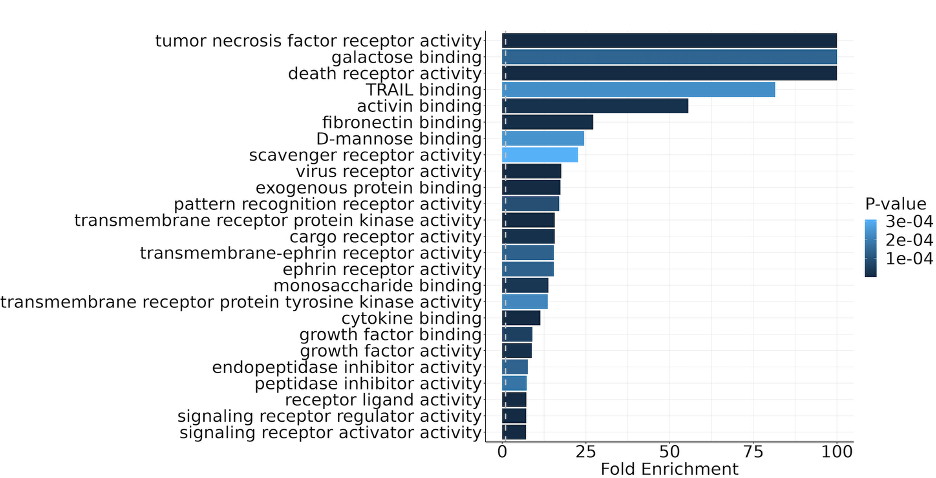
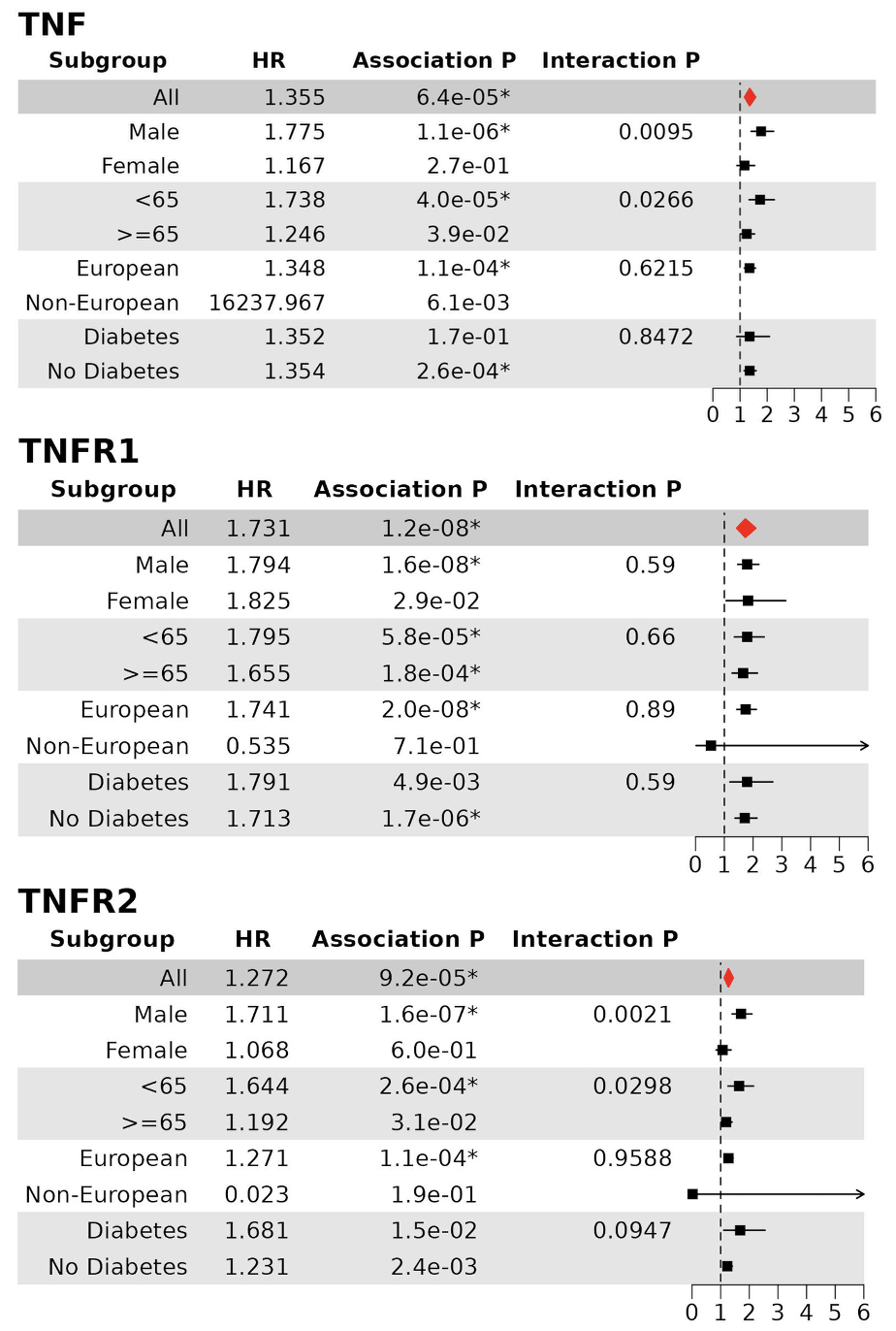
Results: Participants had a mean age of 62.46 years (SD 5.86) at enrollment; 236 (18.79%) were female, and 817 (65.05%) had recurrent CAD over 11.40 [interquartile range 8.00-14.69] years of follow-up. Among the 1,463 proteins tested, 102 proteins at experiment-wide significance (Bonferroni p-value < 3.42×10⁻⁵) were independently associated with recurrent CAD events. Molecular functions were significantly enriched for tumor necrosis factor receptor (TNFR) activity by 100-fold (p-value = 6.37×10⁻¹⁰) (Figure 1). Of the 8 proteins related to TNF annotated by the Gene Ontology database, TNF-alpha had a risk estimate of 1.36 (95% CI 1.17-1.57, p-value = 6.38×10⁻⁵), a superfamily of TNFR1 (TNFRSF1A) had a risk estimate of 1.73 (95% CI 1.43-2.09, p-value = 1.23×10⁻⁸), and a superfamily of TNFR2 (TNFRSF1B) had a risk estimate of 1.27 (95% CI 1.13-1.44, p-value = 9.15×10⁻⁵) for recurrent CAD (Figure 2). When stratified by clinical subgroups, there was a significant attenuation of the risk estimate for recurrent CAD in older compared to younger patients for TNF-alpha (1.25 vs 1.74, p-interaction = 0.027) and TNFR2 (1.19 vs 1.64, p-interaction = 0.030). There was also a higher risk of recurrent CAD in males compared to females for TNF-alpha (1.78 vs 1.17, p-interaction = 0.010) and TNFR2 (1.71 vs 1.07, p-interaction = 0.002).
Conclusion: Recurrent CAD event rates are high and associated with several plasma proteins. Pathway enrichment analyses prioritized TNFR-related proteins. Further research should explore their role in reducing CAD risk.
  • Bellomo, Tiffany  ( Massachusetts General Hospital , Boston , Massachusetts , United States )
  • Patel, Aniruddh  ( Broad Institute , Cambridge , Massachusetts , United States )
  • Natarajan, Pradeep  ( Massachusetts General Hospital , Boston , Massachusetts , United States )
  • Lee, Jiwoo  ( Broad Institute of MIT and Harvard , Lexington , Massachusetts , United States )
  • Halford, Jennifer  ( Massachusetts General Hospital , Boston , Massachusetts , United States )
  • Cho, So Mi Jemma  ( Broad Institute , Cambridge , Massachusetts , United States )
  • Koyama, Satoshi  ( Broad Institute , Cambridge , Massachusetts , United States )
  • Haidermota, Sara  ( Broad Institute , Cambridge , Massachusetts , United States )
  • Ruan, Yunfeng  ( Broad Institute , Cambridge , Massachusetts , United States )
  • Urbut, Sarah  ( Massachusetts General Hospital , Boston , Massachusetts , United States )
  • Truong, Buu  ( Broad Institute , Cambridge , Massachusetts , United States )
  • Author Disclosures:
    Tiffany Bellomo: DO NOT have relevant financial relationships | Aniruddh Patel: No Answer | Pradeep Natarajan: DO have relevant financial relationships ; Researcher:Amgen, Genentech / Roche:Active (exists now) ; Other (please indicate in the box next to the company name):Vertex Pharmaceuticals (spousal employment):Active (exists now) ; Ownership Interest:Bolt, Candela, Mercury, MyOme, Parameter Health, Preciseli, TenSixteen Bio:Active (exists now) ; Consultant:Allelica, CRISPR Therapeutics, Genentech/Roche, HeartFlow, Magnet Biomedicine:Past (completed) ; Consultant:AstraZeneca, Blackstone Life Sciences, Bristol Myers Squibb, Eli Lilly & Co, Esperion Therapeutics, Foresite Capital, Foresite Labs, GV, Merck, Novartis, Novo Nordisk, TenSixteen Bio, Tourmaline Bio:Active (exists now) ; Researcher:Allelica, Novartis:Past (completed) | Jiwoo Lee: DO NOT have relevant financial relationships | Jennifer Halford: DO NOT have relevant financial relationships | So Mi Jemma Cho: No Answer | Satoshi Koyama: DO NOT have relevant financial relationships | Sara Haidermota: No Answer | Yunfeng Ruan: No Answer | Sarah Urbut: DO NOT have relevant financial relationships | Buu Truong: DO NOT have relevant financial relationships
Meeting Info:

Scientific Sessions 2025

2025

New Orleans, Louisiana

Session Info:

Novel Biomarkers, Indices & Blood-Pressure Targets in Stable CAD

Monday, 11/10/2025 , 01:00PM - 02:00PM

Abstract Poster Board Session

More abstracts on this topic:
A Machine Learning-Based Novel Risk Score Model for Spontaneous Coronary Artery Dissection

Agrawal Ankit, Arockiam Aro Daniela, Bhagat Umesh, Haroun Elio, Majid Muhammad, Wang Tom Kai Ming

Apolipoprotein A-I Proteoforms, Cardiometabolic Status, and Coronary Heart Disease: Insights from the Dallas Heart Study

Gangwar Anamika, Des Soye Benjamin, Saldanha Suzanne, Jaiswal Shailesh, Patel Parthvi Bharatkumar, Shah Amil, Pandey Ambarish, Wilkins John, Rohatgi Anand

More abstracts from these authors:

Predictive Utility of Genomics, Inflammation, Cholesterol, and Lipoprotein(a) in Assessing Coronary Artery Disease Risk Across Age and Sex

Farah Raysha, Fahed Akl, Kim Min Seo, Truong Buu, Sui Yang, Cho So Mi Jemma, Urbut Sarah, Ridker Paul, Patel Aniruddh, Natarajan Pradeep

Lipoprotein(a) is a Prognostic Marker of Extracoronary Atherosclerotic Vascular Disease Progression

Bellomo Tiffany, Natarajan Pradeep, Patel Aniruddh, Bramel Emily, Lee Jiwoo, Urbut Sarah, Flores Alyssa Monica, Koyama Satoshi, Truong Buu, Haidermota Sara, Eagleton Matthew

You have to be authorized to contact abstract author. Please, Login
Not Available