
Logo

American Heart Association

  21
  0


Final ID: 4355972

Simulation Guided Aortic Valve Tracking and Strain Analysis in 4D Echocardiography

Abstract Body (Do not enter title and authors here):
Background: Accurate tracking of the aortic valve in 4D transesophageal echocardiography (TEE) and subsequent leaflet strain measurement remain a challenge due to limited imaging temporal resolution. Conventional intensity-based image registration techniques often fail to capture the rapid nonlinear deformation of valve leaflets across cardiac phases. The objective of this work is to present an image analysis framework that temporally augments 4D TEE with finite element modeling (FEM) to reconstruct patient-specific valve motion and quantify leaflet strain in both trileaflet and bicuspid aortic valves.

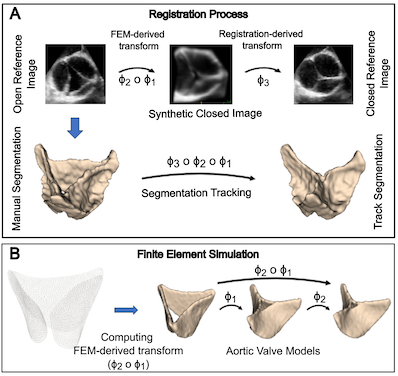
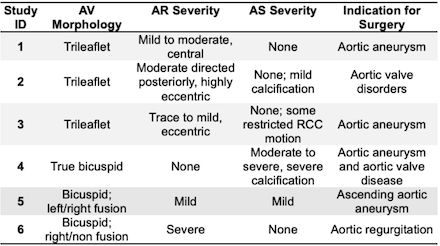
Methods: We propose a hybrid framework that integrates FEM with deformable image registration to achieve leaflet tracking in 4D TEE sequences (Fig 1). First, the aortic valve is manually segmented in a mid-systolic “reference” (open) frame. A shell representation of the segmented leaflets is created and integrated with FEM to simulate valve closure. A final mid-diastolic segmentation of the leaflets is obtained by applying the following transformations to the mid-systolic reference segmentation: (1) the FEM-recovered transformations of valve closure and (2) the registration-derived transformation between an FEM-derived synthetic mid-diastolic image and the real mid-diastolic image. The proposed method was tested on six patients with varying aortic valve abnormalities (Table 1), and leaflet strains were computed.

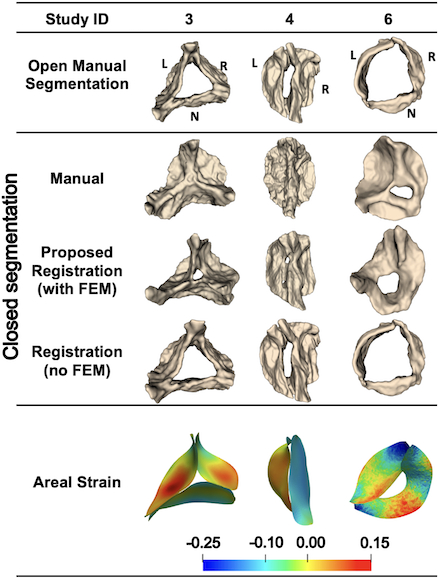
Results: The proposed method significantly improved segmentation tracking accuracy compared to conventional registration. The mean distance between the tracked closed-state segmentation and manual ground truth for six patients was 1.67 ± 0.49 mm using our hybrid approach, versus 3.19 ± 1.17 mm with conventional registration (no FEM). Strain maps showed physiologically consistent patterns with elevated strain near coaptation lines. Notably, patient 4, with severe calcification, exhibited the lowest strain. Representative results are shown in Figure 2.

Conclusions: These findings confirm that biomechanically generated intermediate frames enhance registration accuracy and patient-specific geometric fidelity of the aortic valve, enabling strain analysis. The approach has the potential to inform our understanding of diverse valve mechanics and facilitate translational application to the assessment of structural heart disease.
  • Nakhaei, Mohsen  ( Children Hospital of Philadelphia , Philadelphia , Pennsylvania , United States )
  • Wu, Wensi  ( Children Hospital of Philadelphia , Philadelphia , Pennsylvania , United States )
  • Amin, Silvani  ( University of Pennsylvania , Philadelphia , Pennsylvania , United States )
  • Herz, Christian  ( Children's Hospital of Philadelphia , Philadelphia , Pennsylvania , United States )
  • Yushkevich, Natalie  ( University of Pennsylvania , Philadelphia , Pennsylvania , United States )
  • Al Ghofaily, Lourdes  ( University of Pennsylvania , Philadelphia , Pennsylvania , United States )
  • Desai, Nimesh  ( University of Pennsylvania , Philadelphia , Pennsylvania , United States )
  • Bavaria, Joseph  ( Jefferson Health , Philadelphia , Pennsylvania , United States )
  • Jolley, Matthew  ( Children's Hospital of Philadelphia , Philadelphia , Pennsylvania , United States )
  • Pouch, Alison  ( University of Pennsylvania , Philadelphia , Pennsylvania , United States )
  • Author Disclosures:
    Mohsen Nakhaei: DO NOT have relevant financial relationships | Wensi Wu: DO NOT have relevant financial relationships | Silvani Amin: DO NOT have relevant financial relationships | Christian Herz: No Answer | Natalie Yushkevich: DO NOT have relevant financial relationships | Lourdes Al Ghofaily: No Answer | Nimesh Desai: No Answer | Joseph Bavaria: No Answer | Matthew Jolley: No Answer | Alison Pouch: DO NOT have relevant financial relationships
Meeting Info:

Scientific Sessions 2025

2025

New Orleans, Louisiana

Session Info:

From Molecules to Mechanics: Top Translational Advances in Valvular Heart Disease

Saturday, 11/08/2025 , 09:45AM - 11:00AM

Abstract Oral Session

More abstracts on this topic:
Cardiac CT versus transesophageal and transthoracic echocardiography for intra-cardiac thrombus detection in ischemic stroke: A systematic review and meta-analysis of 43 studies

Ghozy Sherief, Liu Michael, Kobeissi Hassan, Abbas Alzhraa S., Kadirvel Ram, Rabinstein Alejandro, Kallmes David, Nasr Deena

A Diagnostic Pitfall: Subclavian Stenosis Mimicking Severe Aortic Stenosis on Echocardiography"

Ezaldin Shady, Abdelsalam Mahmoud, Elsayed Omar, Lee Marciano

More abstracts from these authors:
Patient-Specific Ascending Aortic Wall Shear Stress and Strain Analysis from 4D CT

Lobo Tricia, Wu Wensi, Litt Harold, Freas Melanie, Goldfinger Shir, Ferrari Victor, Bavaria Joseph, Desai Nimesh, Pouch Alison

Fully Automatic Quantification of the Aortic Root in 4D Transesophageal Echocardiography

Amin Silvani, Bavaria Joseph, Desai Nimesh, Pouch Alison, Chan Trevor, Tran Nathanael, Al Ghofaily Lourdes, Cheung Albert, Yushkevich Natalie, Hao Jilei, Jolley Matthew, Woo Y Joseph

You have to be authorized to contact abstract author. Please, Login
Not Available