
Logo

American Heart Association

  22
  0


Final ID: MP1287

Patient-Specific Ascending Aortic Wall Shear Stress and Strain Analysis from 4D CT

Abstract Body (Do not enter title and authors here): Introduction

Hemodynamics and wall biomechanics jointly drive ascending-aortic remodeling in bicuspid aortic valve (BAV) disease, yet most in silico studies model only flow or strain. Manual segmentations yield noisy meshes, impeding strain and computational fluid dynamics (CFD) analyses. We present an end-to-end framework integrating patient-specific CFD and dynamic strain mapping via our Bayesian remeshing algorithm, preserving geometry and eliminating manual mesh edits.

Objective

Develop and validate an end-to-end approach to automate mesh generation, quantify surface strain, and enable strain mapping and patient-specific CFD in ascending aortas of normal and bicuspid aortic valves.

Methods

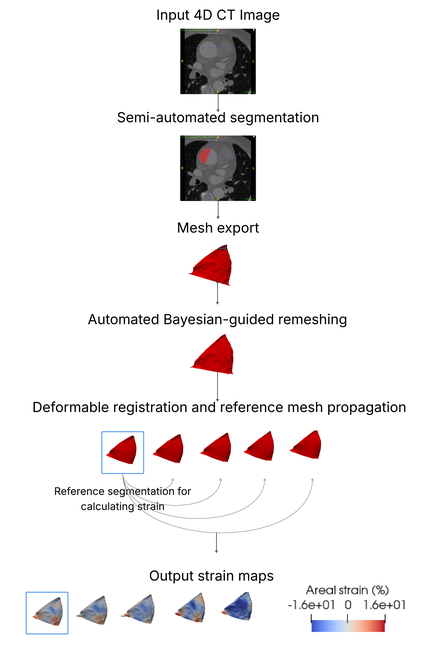
We retrospectively analyzed 12 ECG-gated 4D CT datasets from 11 adults in a BAV study. Two observers performed semi-automated segmentation in ITK-SNAP using manual annotation, random forest voxel classification, and contour evolution; interobserver agreement—Dice coefficient, mean surface distance (MSD)—is reported as median [IQR]. Segmentations were converted to surface meshes and remeshed via a Bayesian adaptive algorithm. A reference mesh was propagated across cardiac phases using deformable registration; registration accuracy was assessed by MSD against meshes from manual segmentations. Areal strain was computed as fractional area change from end-diastole (Figure 1). Transient-dynamic CFD was performed on three patients to simulate flow and wall shear stress (WSS); aortic growth, reported in Figure 2, was derived from follow-up CT-based maximum diameters.

Results

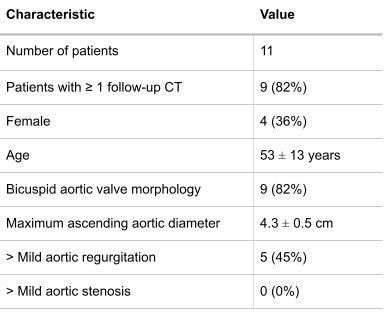
Table 1 summarizes patient characteristics. Manual segmentations showed strong interobserver agreement (Dice 0.96 [0.95–0.99]; MSD 0.45 mm [0.17–0.70]). Propagated meshes had a median MSD of 0.42 mm [IQR 0.34–0.74] (n = 24) against manual references. Peak areal strain ranged 7–23%, and WSS 2–6 Pa.

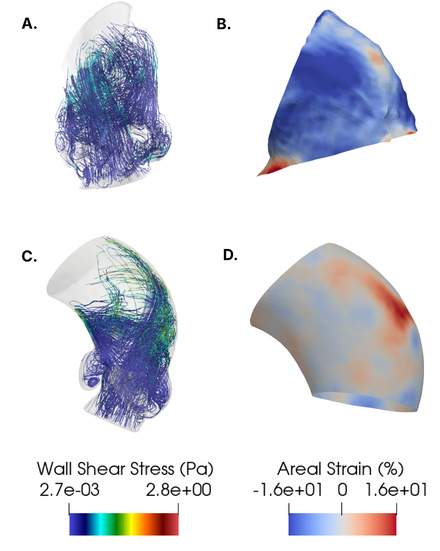
Figure 2 shows strain and WSS maps for two representative BAV cases. In these cases, lower peak WSS/velocity coincided with faster radial growth over subsequent scans, mirroring inverse WSS-growth trends seen in larger BAV cohorts.

Conclusions

Our 4D CT workflow produces spatially aligned WSS and areal-strain maps, without manual mesh edits. Preliminary results suggest higher peak WSS may be negatively associated with aortic growth rate, consistent with prior studies. This proof-of-concept demonstrates technical feasibility and motivates further study of WSS-strain interaction as a predictor of BAV aortic remodeling.
  • Lobo, Tricia  ( University of Pennsylvania , Philadelphia , Pennsylvania , United States )
  • Wu, Wensi  ( University of Pennsylvania , Philadelphia , Pennsylvania , United States )
  • Litt, Harold  ( University of Pennsylvania , Philadelphia , Pennsylvania , United States )
  • Freas, Melanie  ( University of Pennsylvania , Philadelphia , Pennsylvania , United States )
  • Goldfinger, Shir  ( University of Pennsylvania , Philadelphia , Pennsylvania , United States )
  • Ferrari, Victor  ( University of Pennsylvania , Philadelphia , Pennsylvania , United States )
  • Bavaria, Joseph  ( Thomas Jefferson University , Philadelphia , Pennsylvania , United States )
  • Desai, Nimesh  ( University of Pennsylvania , Philadelphia , Pennsylvania , United States )
  • Pouch, Alison  ( University of Pennsylvania , Philadelphia , Pennsylvania , United States )
  • Author Disclosures:
    Tricia Lobo: DO NOT have relevant financial relationships | Wensi Wu: DO NOT have relevant financial relationships | Harold Litt: DO have relevant financial relationships ; Individual Stocks/Stock Options:Mycardium LLC:Active (exists now) ; Research Funding (PI or named investigator):Heartflow:Active (exists now) ; Research Funding (PI or named investigator):Siemens Healthineers:Active (exists now) ; Research Funding (PI or named investigator):Canon Healthcare:Active (exists now) ; Individual Stocks/Stock Options:Guilford St Labs LLC:Active (exists now) | Melanie Freas: DO NOT have relevant financial relationships | Shir Goldfinger: DO NOT have relevant financial relationships | Victor Ferrari: No Answer | Joseph Bavaria: No Answer | Nimesh Desai: No Answer | Alison Pouch: DO NOT have relevant financial relationships
Meeting Info:

Scientific Sessions 2025

2025

New Orleans, Louisiana

Session Info:

Beyond the Pixels: Using Quantitative and Computational Advances to Optimize Value in CV Imaging

Sunday, 11/09/2025 , 11:50AM - 01:05PM

Moderated Digital Poster Session

More abstracts on this topic:
A Rare Case of Epicardial Cavernous Hemangioma with Coexisting Severe Mitral Regurgitation

Abdallah Ala, Sutton Jenna, Houshmand Nazanin, Gupta Neelesh, Ahsan Chowdhury

Circadian Variation In Collateral Status: The HERMES Collaboration

Tariq Muhammad Bilal, Jovin Tudor, Mitchell Peter, Campbell Bruce, Bracard Serge, Guillemin Francis, Muir Keith, White Phil, Dippel Diederik, Hill Michael, Goyal Mayank, Brown Scott, Saver Jeffrey, Liebeskind David, Tiedt Steffen, Lun Ronda, Albers Gregory, Mun Katherine, Majoie Charles, Demchuk Andrew

More abstracts from these authors:
A Systematic Approach to Prompting Large Language Models for Automated Feature Extraction from Cardiovascular Imaging Reports

Goldfinger Shir, Mackay Emily, Chan Trevor, Eswar Vikram, Grasfield Rachel, Yan Vivian, Barreto David, Pouch Alison

Simulation Guided Aortic Valve Tracking and Strain Analysis in 4D Echocardiography

Nakhaei Mohsen, Wu Wensi, Amin Silvani, Herz Christian, Yushkevich Natalie, Al Ghofaily Lourdes, Desai Nimesh, Bavaria Joseph, Jolley Matthew, Pouch Alison

You have to be authorized to contact abstract author. Please, Login
Not Available