Sotagliflozin Enhances Left Ventricular Function and Myocardial Perfusion in Chronic Myocardial Ischemia Through Metabolic and Redox Remodeling
Abstract Body (Do not enter title and authors here): Introduction: Ischemic heart disease (IHD) is the leading cause of mortality, disability, and human suffering globally, with an expected persistent rise in prevalence over the next decade. It often leaves patients with residual symptomatic burden despite current optimized procedural and medical options. Sotagliflozin, a dual sodium-glucose cotransporter 1 and 2 (SGLT1/2) inhibitor, has emerged for its clinically evident cardiovascular benefits; however, has not specifically garnered investigation on its impact in IHD, independent of comorbid kidney disease and/or diabetes, prompting our study of its direct cardiac potential.
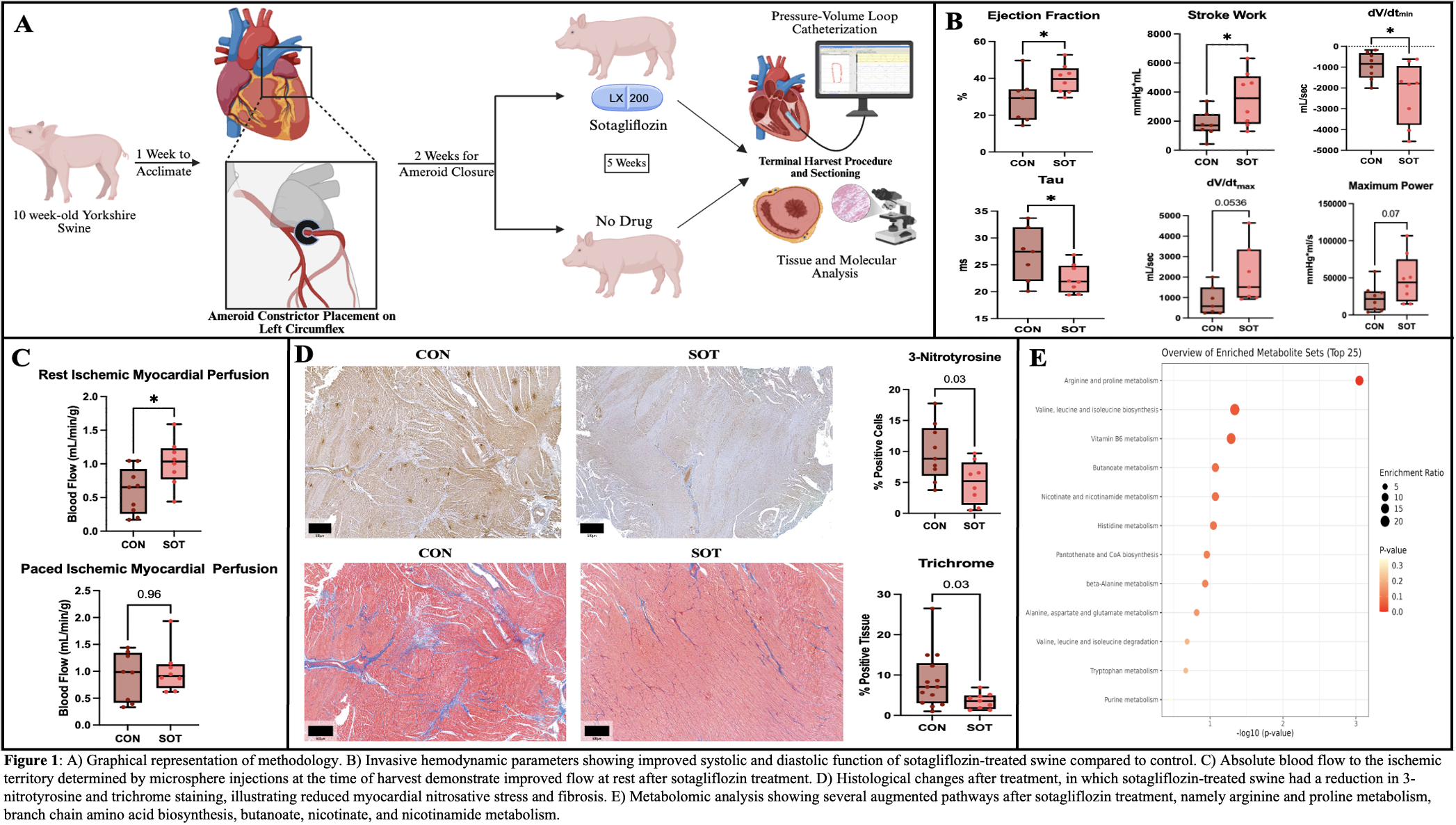
Methods: Yorkshire swine (n=16) underwent placement of an ameroid constrictor around the left circumflex coronary artery. This is followed by a 2-week recovery period in which the ameroid gradually closes to simulate IHD. Swine were then randomized to receive either 400mg daily oral sotagliflozin (SOT, n=8) or no drug (CON, n=8) for 5 weeks. Afterwards, swine underwent terminal harvest to acquire cardiac functional data with pressure-volume loops, myocardial perfusion by microsphere injection, and ventricular sectioning. To investigate the cellular and tissue level impact of therapy, histology, immunoblotting, and high-throughput techniques were performed.
Results: SOT swine were found to have improved ejection fraction and stroke work compared to CON (p=0.049, p=0.04; respectively) and enhanced diastolic function as seen by a reduction in tau (p=0.03). Absolute blood flow to the ischemic myocardium was increased in the SOT group (p=0.02). SOT swine had a reduction in 3-nitrotyrosine and trichrome staining, representing decreased reactive nitrogen species and myocardial fibrosis (p=0.03 for both). Molecularly within the ischemic myocardium, SOT swine had increased expression of endothelial nitric oxide synthase and superoxide dismutase 1 (p=0.02, p=0.04; respectively), augmented arginine metabolism on metabolomic analysis, increased GLUT4 expression (p=0.045), and significant downstream myocardial metabolic shifts.
Conclusion: Sotagliflozin treatment improved left ventricular function, myocardial perfusion, and diastolic relaxation, likely through reduced oxidative stress and myocardial fibrosis, improved nitric oxide coupling, enhanced insulin signaling, and favorable metabolic shifts. This study suggests a potential role for sotagliflozin as a cardioprotective therapy in patients with IHD beyond current treatment strategies.
Muir, Kelsey
(
Brown University Warren Alpert Medi
, Providence , Rhode Island , United States )
Stone, Christopher
(
Brown University Warren Alpert Medi
, Providence , Rhode Island , United States )
Kanuparthy, Meghamsh
(
Brown University Warren Alpert Medi
, Providence , Rhode Island , United States )
Hamze, Jad
(
Brown University
, Memphis , Tennessee , United States )
Harris, Dwight
(
Brown University Warren Alpert Medi
, Providence , Rhode Island , United States )
Abid, Ruhul
(
BROWN UNIV WARREN ALPERT MED
, Providence , Rhode Island , United States )
Sellke, Frank
(
Brown Medical School
, Providence , Rhode Island , United States )
Author Disclosures:
Kelsey Muir:DO NOT have relevant financial relationships
| Christopher Stone:DO NOT have relevant financial relationships
| Meghamsh Kanuparthy:DO NOT have relevant financial relationships
| Jad Hamze:No Answer
| Dwight Harris:No Answer
| Ruhul Abid:DO NOT have relevant financial relationships
| Frank Sellke:DO have relevant financial relationships
;
Ownership Interest:xm therapeutics:Active (exists now)