Time-Sensitive Cardiovascular Risk After COVID-19: A Population-Based Study Across Variant Eras
Abstract Body (Do not enter title and authors here): Introduction Cardiovascular risks following SARS-CoV-2 infection are incompletely defined. We evaluated evolving cardiovascular outcomes across COVID-19 variant eras using a large community-based cohort to inform risk stratification and clinical care.
Methods We conducted a retrospective cohort study of 162,471 adults with COVID-19 between March 2020 and December 2023 using the Rochester Epidemiology Project. Patients were stratified by variant era (Pre-Delta, Delta, and Omicron). Cardiovascular outcomes included major adverse cardiovascular events (MACE: myocardial infarction, stroke, death), ischemic and inflammatory heart disease, thrombotic events, and dysrhythmias. Diagnoses were identified using ICD-10 codes and validated in a subset. Cumulative incidence was estimated using Kaplan-Meier and competing risk models. Cox proportional hazards regression was used to assess differences by era and age.
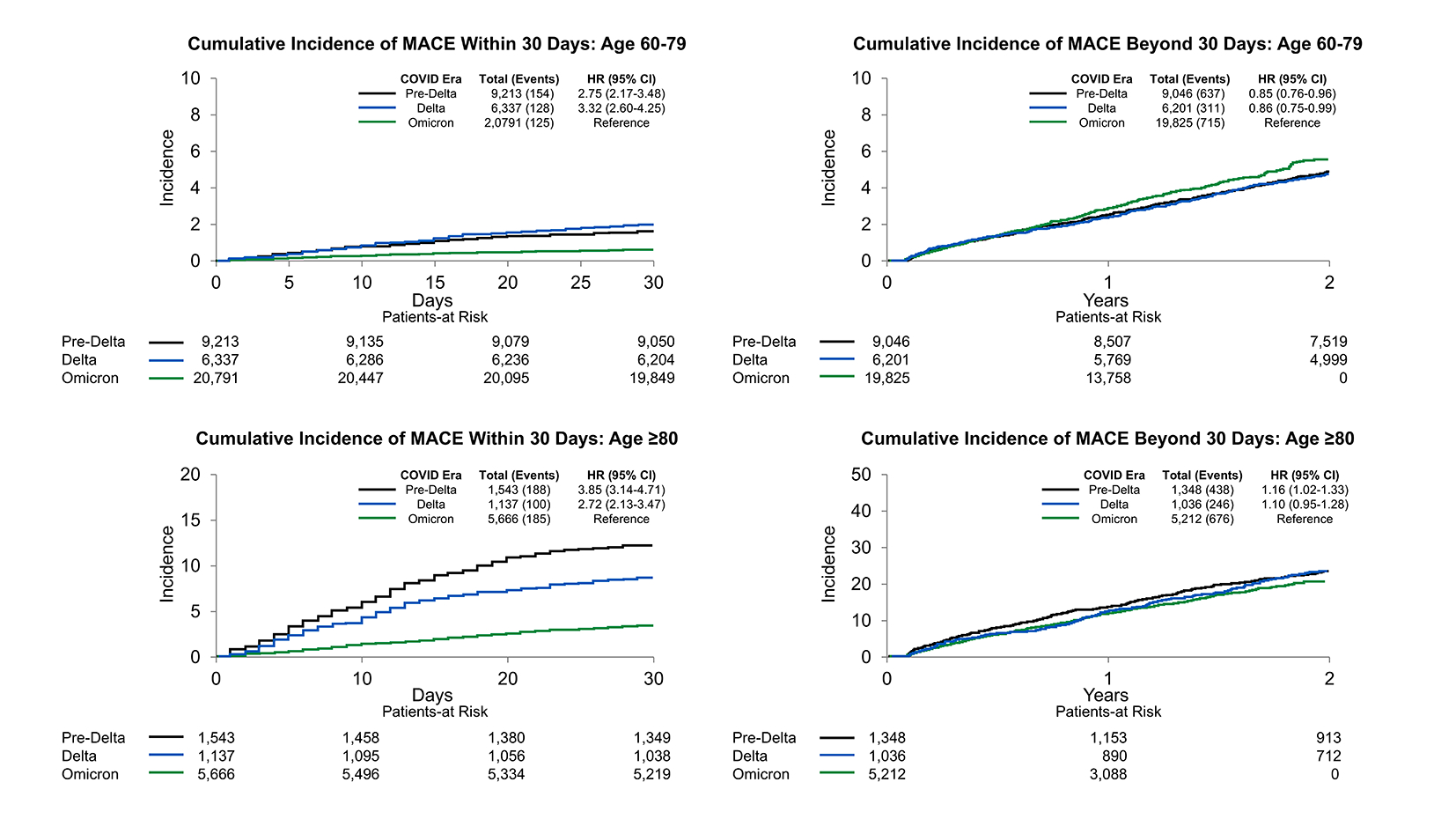
Results MACE occurred in 4,922 patients, primarily in those ≥80 (2-year incidence: 17%). Event rates peaked within 30 days post-infection, with marked variation by variant. In patients ≥80, 30-day MACE risk was highest in the Pre-Delta (HR 3.85; 95% CI, 3.14–4.71) and Delta (HR 2.72; 95% CI, 2.13–3.47) eras versus Omicron. After 30 days, event rates fell and era differences narrowed. Thrombotic events (n=2,090; 1.4%) decreased across eras. Ischemic and inflammatory heart disease rates were stable. Myocarditis/pericarditis were rare (0.1%) without age trends.
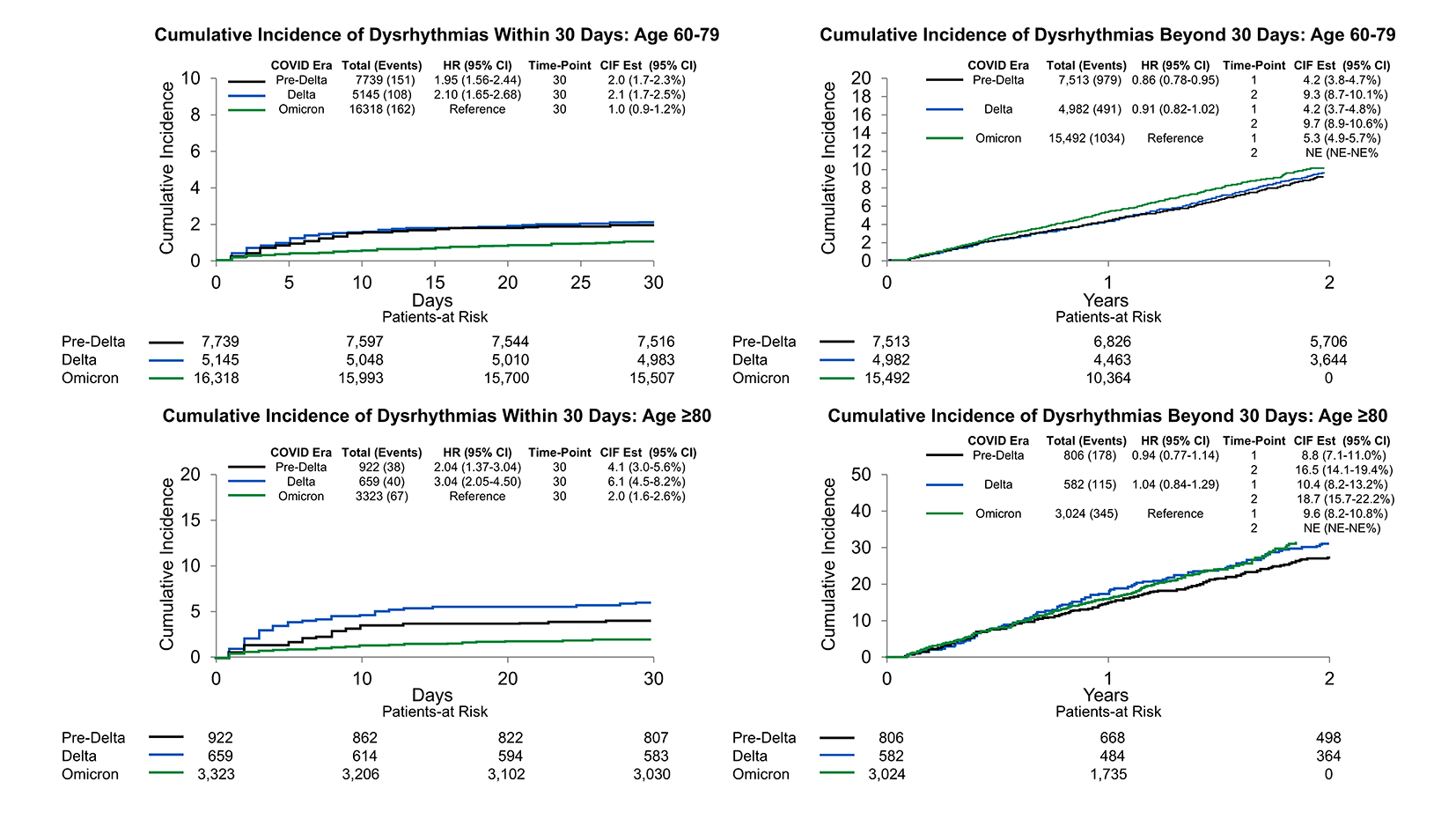
Dysrhythmias affected 6,765 patients (2-year incidence: 4.9%) and rose with age (2.0% in <40 vs. 19.9% in ≥80). Within 30 days, risk was higher in the Pre-Delta and Delta eras for age ≥40, especially ≥80 (Delta HR 3.08; 95% CI, 2.08–4.56) and 60–79 (HR 2.23; 95% CI, 1.75–2.85). Among those 40–59, Delta posed the highest risk (HR 2.74; 95% CI, 1.94–3.86 vs. Pre-Delta HR 1.77; 95% CI, 1.26–2.49). No differences were observed in <40. Beyond 30 days, risk converged across variants.
Conclusion Cardiovascular risk after SARS-CoV-2 infection was concentrated in the first 30 days, with attenuation thereafter. While MACE and thrombotic event rates declined over time, early dysrhythmia risk varied by variant and age, especially in older adults. These findings define a time-sensitive, variant-specific risk window and support short-term, risk-stratified post-COVID monitoring. This work informs targeted follow-up protocols by infection era and age, with implications for quality improvement, resource use, and equitable care.
Howick, James
(
Mayo Clinic
, Jacksonville , Florida , United States )
Gersh, Bernard
(
MAYO CLINIC
, Rochester , Minnesota , United States )
Scott, Christopher
(
Mayo clinic
, Rochester , Minnesota , United States )
Chamberlain, Alanna
(
MAYO CLINIC
, Rochester , Minnesota , United States )
Shapiro, Brian
(
MAYO CLINIC
, Jacksonville , Florida , United States )
Mcleod, Christopher
(
MAYO CLINIC FLORIDA
, Jacksonville , Florida , United States )
Van Niekerk, Christoffel
(
MAYO CLINIC
, Jacksonville , Florida , United States )
Taylor, Bryan
(
MAYO CLINIC FLORIDA
, Jacksonville , Florida , United States )
Fairweather, Delisa
(
Mayo Clinic
, Jacksonville , Florida , United States )
Raphael, Claire
(
MAYO CLINIC
, Rochester , Minnesota , United States )
Kiernan, Jack
(
MAYO CLINIC
, Jacksonville , Florida , United States )
Kafil, Tahir
(
MAYO CLINIC
, Rochester , Minnesota , United States )
Cooper, Leslie
(
MAYO CLINIC
, Jacksonville , Florida , United States )
Bois, John
(
MAYO CLINIC
, Rochester , Minnesota , United States )
Author Disclosures:
James Howick:DO NOT have relevant financial relationships
| Claire Raphael:No Answer
| Jack Kiernan:DO NOT have relevant financial relationships
| Tahir Kafil:DO NOT have relevant financial relationships
| Leslie Cooper:DO have relevant financial relationships
;
Consultant:Cardiol Therapeutics:Active (exists now)
; Ownership Interest:Stromal therapeutics:Active (exists now)
; Consultant:Moderna:Active (exists now)
; Consultant:BMS:Past (completed)
| John Bois:No Answer
| Bernard Gersh:DO NOT have relevant financial relationships
| Christopher Scott:DO NOT have relevant financial relationships
| Alanna Chamberlain:DO have relevant financial relationships
;
Research Funding (PI or named investigator):Exact Sciences :Past (completed)
| Brian Shapiro:DO NOT have relevant financial relationships
| Christopher McLeod:No AnswerBryan Taylor:DO NOT have relevant financial relationships
| DeLisa Fairweather:DO NOT have relevant financial relationships