Logo

American Heart Association

  18
  0


Final ID: MP691

Successful Intracardiac Radiofrequency Ablation of Recurrent Subaortic Membrane Causing LVOT Obstruction

Abstract Body (Do not enter title and authors here): Background
Subaortic membrane (SAM) is a fibromuscular ridge beneath the aortic valve that causes fixed left ventricular outflow tract (LVOT) obstruction. Surgical resection is the standard treatment for symptomatic patients or those with high gradients; however, recurrence occurs in up to 14% of adults within 5 years. While radiofrequency ablation (RFA) is well-established in arrhythmia management, its role in treating SAM has not been previously described.

Case Information
53-year-old man with HTN, BMI 51.7, and well-controlled OSA presented with worsening exertional dyspnea and fatigue in April 2024. He had prior surgical SAM resection in 2018, complicated by third-degree AV block requiring pacemaker implantation. Follow-up echocardiography revealed SAM recurrence with peak LVOT gradient of 52 mmHg. Given elevated surgical risk, a novel catheter-based RFA approach was pursued.

In July 2024, the patient underwent catheter-based RFA under general anesthesia. A ThermoCool SmartTouch SF catheter was advanced retroaortically across the aortic valve toward the subaortic ridge, guided by CARTO 3 with CartoSound. A semi-circular lesion set was delivered to the septum inferior to the membrane. Two steam pops occurred during ablation in this area.

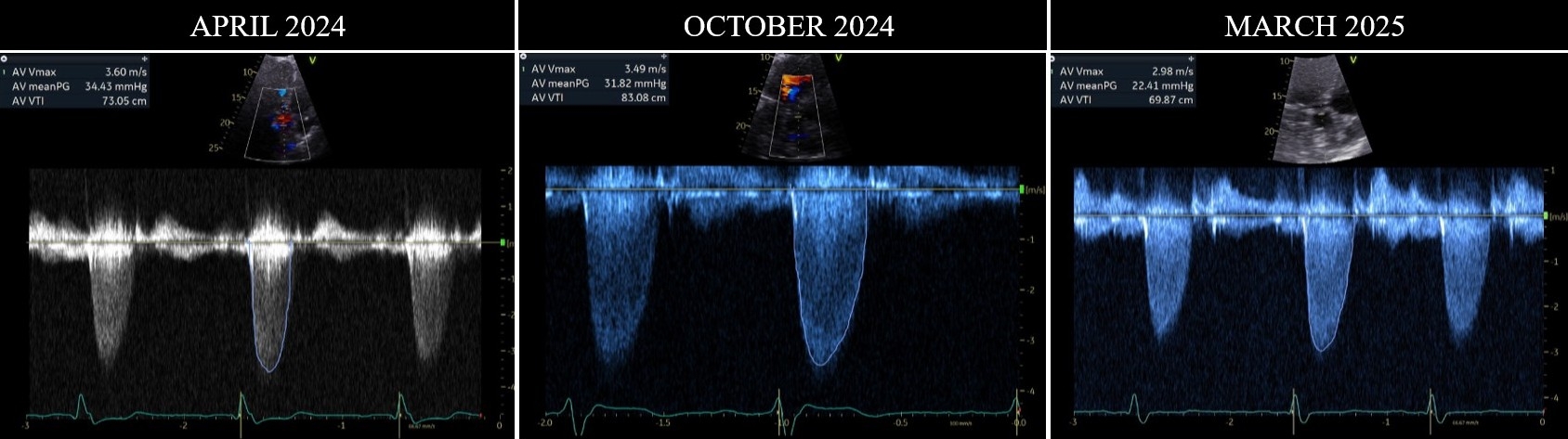
Serial transthoracic echocardiograms at 3 and 8 months demonstrated sustained LVOT gradient reduction, from 52 mmHg pre-ablation to 49 mmHg and 38 mmHg, respectively. Left ventricular ejection fraction (EF) remained stable at 61%, with no new wall motion abnormalities or pericardial effusion. The patient reported marked improvement in symptoms and normalization of daily activity tolerance. No procedural complications or hospital readmissions occurred.

Decision-Making
Given the patient’s high surgical risk and recurrent symptoms, the multidisciplinary team determined that repeat sternotomy carried elevated morbidity. RFA offered a targeted, minimally invasive solution that leveraged electrophysiology tools and preserved structural integrity while maximizing safety.

Conclusions
This first-in-human case illustrates the feasibility of intracardiac RFA for recurrent SAM. The patient experienced sustained LVOT gradient reduction, preserved EF, and marked symptomatic improvement. This novel approach may offer a viable option for select patients with recurrent subaortic obstruction and prior sternotomy, warranting further investigation to define lesion durability, depth of tissue effect, and conduction system safety.
  • Franczak, Stephanie  ( Mayo Clinic Alix School of Medicine , Jacksonville , Florida , United States )
  • Howick, James  ( Mayo Clinic , Jacksonville , Florida , United States )
  • Yoo, Jeanwoo  ( Mayo Clinic , Jacksonville , Florida , United States )
  • Pasupula, Deepak  ( Mayo Clinic , Jacksonville , Florida , United States )
  • Van Niekerk, Christoffel  ( Mayo Clinic , Jacksonville , Florida , United States )
  • Mcleod, Christopher  ( Mayo Clinic , Jacksonville , Florida , United States )
  • Author Disclosures:
    Stephanie Franczak: DO NOT have relevant financial relationships | James Howick: DO NOT have relevant financial relationships | Jeanwoo Yoo: No Answer | Deepak Pasupula: No Answer | Christoffel van Niekerk: DO NOT have relevant financial relationships | Christopher McLeod: No Answer
Meeting Info:

Scientific Sessions 2025

2025

New Orleans, Louisiana

Session Info:

Out of Sync: Puzzling Cases in Electrophysiology

Saturday, 11/08/2025 , 03:15PM - 04:30PM

Moderated Digital Poster Session

More abstracts on this topic:
AV Junctional Ablation in the Era of Conduction System Pacing: Just Rate Control or also Rhythm Control?

Mencer Nicholas, Patel Ritesh, Brunetti Ryan, Mumtaz Mishal, Khan Shoaib, Einhorn Nathan, Herweg Bengt

Ablation for Atrial Fibrillation: A Comprehensive Meta-Analysis of Randomized Controlled Trials with Reconstructed Time-to-Event Data

Mi Jiaqi, Katapadi Aashish, Darden Douglas, Uppalapati Sree Varuntej, Kabra Aanya, Katapadi Aashika

More abstracts from these authors:
Adult congenital heart disease (ACHD) as career? Examining encouraging and discouraging factors around the globe in the Global ACHD Survey.

Bravo-jaimes Katia, Elizari Maria Amalia, Valdez Ramos Miriam, Cupido Blanche, Zentner Dominica, Almasri Murad, Phillips Sabrina, Mcleod Christopher, Burchill Luke, Bullock-palmer Renee, Windram Jonathan, Srour Mhd Osama, Jenkins Petra, Luna-lopez Raquel, Tutarel Oktay, Kandavello Geetha, Guerrero Carlos, García Cruz Edgar, Ackerman Judith

Time-Sensitive Cardiovascular Risk After COVID-19: A Population-Based Study Across Variant Eras

Howick James, Raphael Claire, Kiernan Jack, Kafil Tahir, Cooper Leslie, Bois John, Gersh Bernard, Scott Christopher, Chamberlain Alanna, Shapiro Brian, Mcleod Christopher, Van Niekerk Christoffel, Taylor Bryan, Fairweather Delisa

You have to be authorized to contact abstract author. Please, Login
Not Available