A “numerical autopsy” of out-of-hospital cardiac arrest: reclassifying unknown etiologies from five years of nationwide health data
Abstract Body: Background: Out-of-hospital cardiac arrest (OHCA) remains a major public health issue. However, most cases are classified as having “unknown” etiologies, because the majority of patients die on scene after unsuccessful or not initiated resuscitation. This limitation is compounded by the low autopsy rate in France, can make it difficult both family screening and epidemiological understanding. We developed a semi-supervised machine learning framework to retrospectively infer the most likely cause of OHCA from patients’ longitudinal healthcare histories.
Methods: We included 22170 adults OHCA cases recorded in the Sudden Death Expertise Center registry between 2011 and 2020, of whom 18817 (84.9 %) had an unknown etiology at the time of inclusion. Using the French National Health Insurance Database (SNDS), we extracted all hospital discharge diagnoses, outpatient drug dispensations, and reimbursed diagnostic or therapeutic procedures over the five years preceding the OHCA. Leveraging patients with known causes, we trained two models within an expectation-maximization (EM) semi-supervised framework: (i) an observability model predicting whether a case was likely to have a known etiology, and (ii) a cause model assigning one of several medical categories (cardiac ischemic, cardiac rhythmic, cardiac other, pulmonary, neurologic, embolic, other). Models were validated using a temporal split.
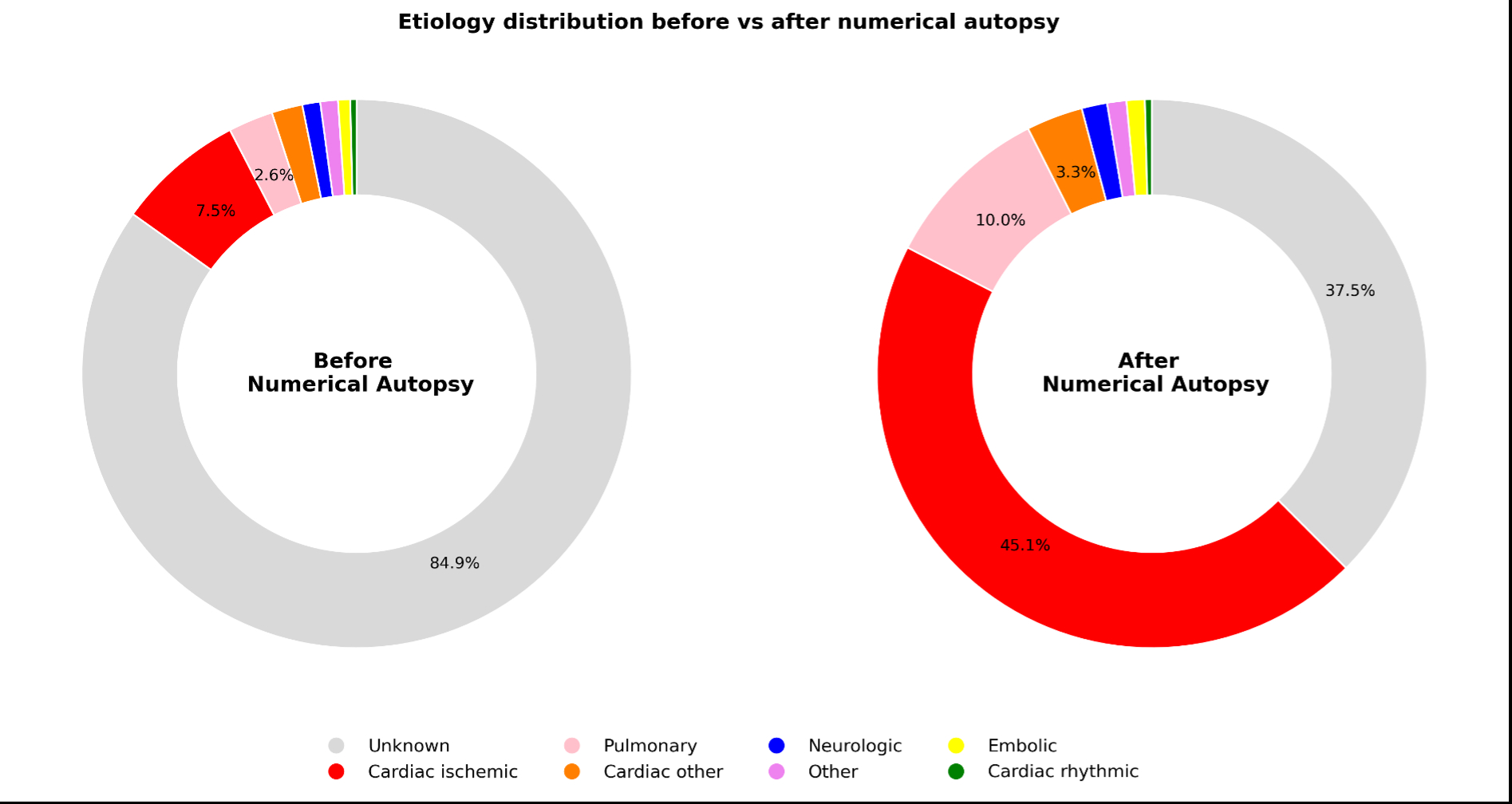
Results: With a posterior probability threshold of 0.5, overall accuracy reached 64.0%. Applying the algorithm to previously unknown cases enabled the reclassification of 10497 patients (55.8% of those initially unknown). After this “numerical autopsy,” the distribution of etiologies shifted from: cardiac ischemic (7.5% to 45.1%), pulmonary (2.6% to 10.0%), cardiac other (1.8% to 3.3%), neurologic (1.1% to 1.5%), other (1.0% to 1.1%), embolic (0.7% to 1.1%), and cardiac rhythmic (0.4% to 0.4%), while unknown cases decreased from 84.9% to 37.5%. Model performance was moderate yet clinically informative (AUC = 0.70, log-loss = 1.20, F1-score = 0.23), reflecting meaningful discrimination despite limited number of cases with known etiology.
Conclusions: Nearly half of OHCA cases initially labeled as “unknown” can be probabilistically reclassified using routinely collected longitudinal health data. These “numerical autopsies” could inform family counseling and screening strategies, and strengthen population-level surveillance.
Cezard, Pierre
(
Paris Cardiac Arrest Center
, Paris , France )
Laurenceau, Thomas
(
Paris Cardiac Arrest Center
, Paris , France )
Meli, Ugo
(
INSERM UMR 970
, Paris , France )
Lebled, Julien
(
INSERM UMR 970
, Paris , France )
Menant, Emma
(
INSERM UMR 970
, Paris , France )
Chocron, Richard
(
Paris Cardiac Arrest Center
, Paris , France )
Jouven, Xavier
(
Paris Cardiac Arrest Center
, Paris , France )
Ahmad Husnain, Khan Muhammad, Sharif Aleena, Hossain Mohammad, Eltawansy Sherif, Faizan Muhammad, Ali Muhammad Faizan, Ahmed Ashraf, Abdul Malik Mohammad Hamza Bin, Pahwani Ritesh, Patel Rahul, Mehdi Hassan