High Visceral-to-Subcutaneous Fat Ratio is Correlated with Increased Cardiovascular Events in Patients with a Low Lean Body Mass Index Suspected of Coronary Artery Disease
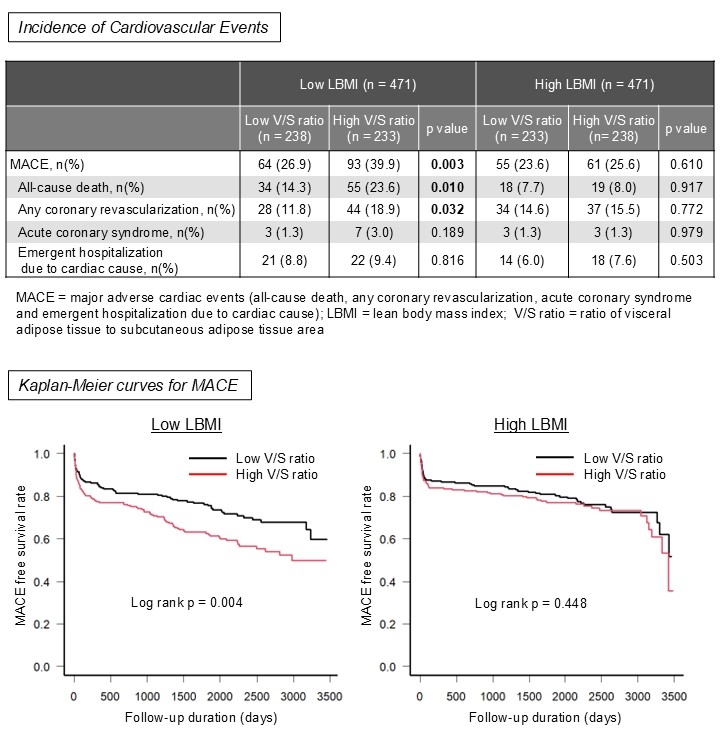
Abstract Body (Do not enter title and authors here): Introduction: Abdominal fat distribution, quantified through the ratio of visceral adipose tissue (VAT) to subcutaneous adipose tissue (SAT) area (V/S ratio), may be associated with an increased risk of cardiovascular disease (CVD). Lean body mass index (LBMI) has been established as a suitable marker for frailty and sarcopenia and is associated with worse CVD outcomes. However, few studies have examined the effects of the V/S ratio and physique stratified by LBMI on long-term clinical outcomes of CVD. Methods: We assessed 942 consecutive patients (mean age, 66.7 years; 42.5% females) with suspected coronary artery disease who underwent computed tomography (CT) angiography. The patients also underwent plain abdominal CT to measure the VAT and SAT areas. The V/S ratio was calculated to assess abdominal fat distribution. The patients were classified into four groups based on the median V/S ratio (0.625) and the median LBMI value for both sexes (male: 18.8 kg/m2, female: 16.1 kg/m2). The association between the V/S ratio and long-term outcomes was examined for each LBMI group. The primary outcome was major adverse cardiac events (MACEs) (including all-cause death, any coronary revascularization, acute coronary syndrome, and emergent hospitalization due to cardiac cause). Results: Over a median follow-up of 2,117 days, although the incidence of any cardiovascular event was not associated with the V/S ratio among patients with high LBMI, a higher incidence of MACEs, particularly all-cause death, and any coronary revascularization, was observed among patients with low LBMI in the high V/S ratio group than in the low V/S ratio group. In the Kaplan–Meier analysis, a significantly lower MACE-free survival rate was observed among patients with low LBMI in the high V/S ratio group than in the low V/S ratio group, despite no differences among patients with high LBMI in both V/S ratio groups (Figure). Furthermore, among patients with low LBMI, a high V/S ratio was associated with a 47% increase in the risk of MACEs (hazard ratio, 1.471; 95% confidence interval: 1.06–2.05; p = 0.02) in Cox regression analysis adjusted for traditional coronary risk factors. Conclusion: A high V/S ratio was associated with an increased risk of MACEs only in patients with low LBMI. A high V/S ratio may be an essential risk factor for CVD, particularly in patients with low LBMI. In contrast, abdominal fat distribution was not associated with CVD prognosis in patients with high LBMI.
Otagiri, Kyuhachi
(
Ina Central Hospital
, Ina , Japan )
Okawa, Keishiro
(
Ina Central Hospital
, Ina , Japan )
Oyama, Yushi
(
Ina Central Hospital
, Ina , Japan )
Sakai, Takahiro
(
Ina Central Hospital
, Ina , Japan )
Kitabayashi, Hiroshi
(
Ina Central Hospital
, Ina , Japan )
Author Disclosures:
Kyuhachi Otagiri:DO NOT have relevant financial relationships
| Keishiro Okawa:DO NOT have relevant financial relationships
| Yushi Oyama:DO NOT have relevant financial relationships
| Takahiro Sakai:DO NOT have relevant financial relationships
| Hiroshi Kitabayashi:No Answer