Accumulation of Skeletal Muscle Adiposity over 18-years is Associated with Lower Cognitive Functioning: The Tobago Health Study
Abstract Body: Background: Skeletal muscle adiposity (i.e. myosteatosis) increases with age and is a risk factor for cardiometabolic diseases. Recent studies suggest that myosteatosis may play a role in cognitive functioning. Prospective studies in African ancestry populations are sparse, yet this population has higher risks of myosteatosis and Alzheimer’s disease and related dementias than Whites.
Aim: To investigate the association between changes in myosteatosis over an 18-year follow-up period and cognitive functioning among middle-aged and older African Caribbean men.
Method: Two hundred ninety-two (292) men participating in the Tobago Health Study were analyzed. Calf muscle density (MD) was measured at baseline, follow-up visit (FV) 1 (6.2±0.4 years after baseline), and FV2 (12.0±0.8 years after FV1) using peripheral quantitative computed tomography, where lower density reflects greater myosteatosis. Neurocognitive functioning was assessed using validated tests at FV2 across 6 domains (global cognition (MoCA), executive function (Trails B), psychomotor speed (Digit Symbol, Trails A), language (Animals & Vegetables), memory (Word List Recall), and visual-spatial skills (Benson Figure Copy)). Individual slopes of MD change over time from linear regression were used as predictors in linear and Poisson regression models to test the association between cognition and longitudinal changes in MD.
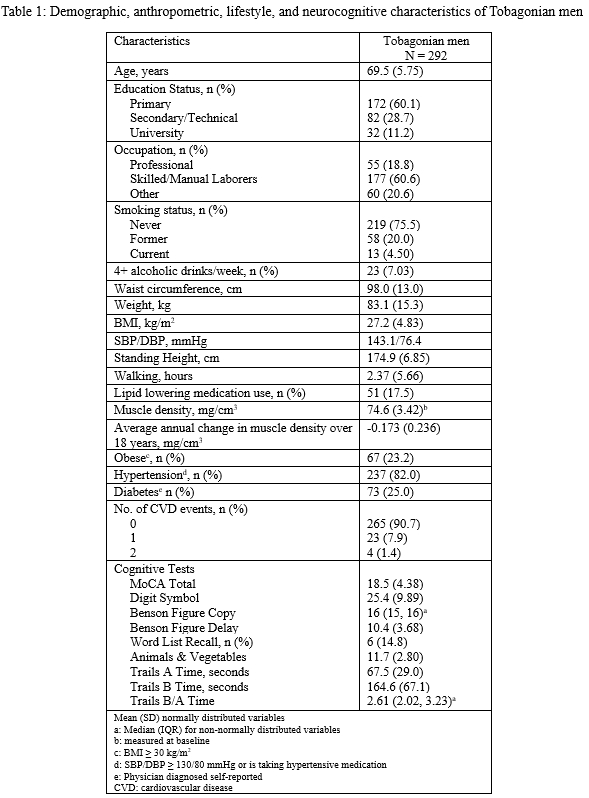
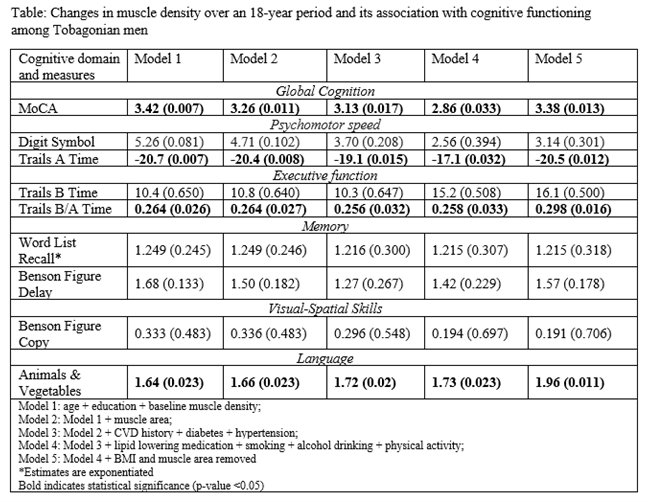
Results: At FV2, men were 69.5 ± 5.8 years old, with high prevalences of obesity (23.2%), hypertension (82.0%), and diabetes (25.0%). MD decreased over the 18-year follow-up period (-0.17 ± 0.24 mg/cm3 per year). After adjusting for demographics, baseline MD, muscle area, comorbidities, lifestyle factors, and medication use, a 0.1 mg/cm3 per year faster decline in MD was associated with a 0.286-point lower MoCA score (p=0.03). Similarly, a 0.1 mg/cm3 per year faster decline in MD was associated with a 1.71 second slower psychomotor speed (p=0.032). Yearly decreases in MD were also associated with worse semantic verbal fluency (β: -1.73, p=0.02).
Conclusion: Faster declines in muscle density are associated with poor domain-specific cognitive performance and may signal early cognitive impairment. Future research should include women and focus on mechanisms to understand the role of myosteatosis in cognitive impairment.
Grant, Alex
(
University of Pittsburgh
, Pittsburgh , Pennsylvania , United States )
Roe, Lauren
(
University of Pittsburgh
, Pittsburgh , Pennsylvania , United States )
Cvejkus, Ryan
(
University of Pittsburgh
, Pittsburgh , Pennsylvania , United States )
Snitz, Beth
(
University of Pittsburgh
, Pittsburgh , Pennsylvania , United States )
Zmuda, Joseph
(
University of Pittsburgh
, Pittsburgh , Pennsylvania , United States )
Wheeler, Victor
(
TOBAGO HEALTH STUDIES OFFICE
, Scarborough , Trinidad and Tobago )
Gordon, Christopher
(
University of Pittsburgh
, Pittsburgh , Pennsylvania , United States )
Rosano, Caterina
(
University of Pittsburgh
, Pittsburgh , Pennsylvania , United States )
Miljkovic, Iva
(
University of Pittsburgh
, Pittsburgh , Pennsylvania , United States )