High Visceral-to-Subcutaneous Fat Ratio is Correlated with Increased Coronary Artery Disease Severity Based on Computed Tomography-derived SYNTAX Score Regardless of Physique Stratified by Lean Body Mass Index
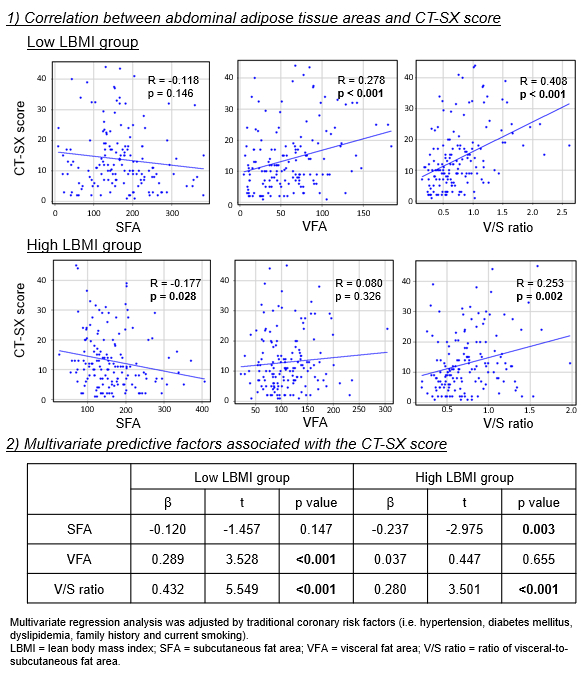
Abstract Body (Do not enter title and authors here): Background: The lean body mass index (LBMI) is determined by dividing an individual’s lean body mass by the square of their height. It is closely linked to skeletal muscle mass and serves as a key indicator of frailty and sarcopenia. Although abdominal fat distribution (AFD) typically assessed using the ratio of the visceral fat area (VFA) to the subcutaneous fat area (SFA), i.e., the V/S ratio, has been associated with an increased coronary artery disease (CAD) risk, limited studies have explored the combined impact of AFD and overall physique on CAD. A computed tomography (CT)-derived SYNTAX score (CT-SX score) has been proposed as a feasible method for assessing CAD severity based on coronary CT angiography (CCTA). Using the CT-SX score, we aimed to evaluate the impact of AFD based on the V/S ratio and physique classified by LBMI on CAD complexity. Methods: CCTA was performed on 931 consecutive patients with suspected CAD. Additionally, to quantify VFA and SFA, a plain abdomen CT scan was conducted. To assess the AFD, the V/S ratios were also calculated. CAD severity was ascertained using CCTA. A stenosis of ≥50% diameter was considered significant. The CT-SX score was calculated for patients with ≥1 significant stenosis. Finally, the patients were divided into low and high LBMI groups based on their median value (males: 18.8 kg/m2, females: 16.0 kg/m2). Results: Of the 931 patients enrolled, 308 (33.1%) exhibited ≥1 significant stenosis. A positive correlation was noted between the V/S ratio and the CT-SX score irrespective of the LBMI. Although VFA was positively correlated with the CT-SX score in the low LBMI group, SFA was negatively correlated with the CT-SX score in the high LBMI group. Multivariate analysis adjusted for traditional coronary risks yielded comparable results (Figure). Conclusions: Although AFD, as indicated by the V/S ratio, appears to be an effective indicator of CAD severity irrespective of the physique and frailty of patients based on LBMI, the factors contributing to an elevated V/S ratio may vary depending on the physique. Given that body composition varies individually with factors such as aging, lifestyle, sex, racial background, and physical constitution, physique-based personalized interventions—rather than standardized protocols—may more effectively mitigate CAD progression.
Okawa, Keishiro
(
Ina Central Hospital
, Ina , Japan )
Otagiri, Kyuhachi
(
Ina Central Hospital
, Ina , Japan )
Oyama, Yushi
(
Ina Central Hospital
, Ina , Japan )
Sakai, Takahiro
(
Ina Central Hospital
, Ina , Japan )
Kitabayashi, Hiroshi
(
Ina Central Hospital
, Ina , Japan )
Author Disclosures:
Keishiro Okawa:DO NOT have relevant financial relationships
| Kyuhachi Otagiri:DO NOT have relevant financial relationships
| Yushi Oyama:DO NOT have relevant financial relationships
| Takahiro Sakai:DO NOT have relevant financial relationships
| Hiroshi Kitabayashi:No Answer