Glucagon-like Peptide 1 Receptor Agonists and Risk of Pulmonary Hypertension
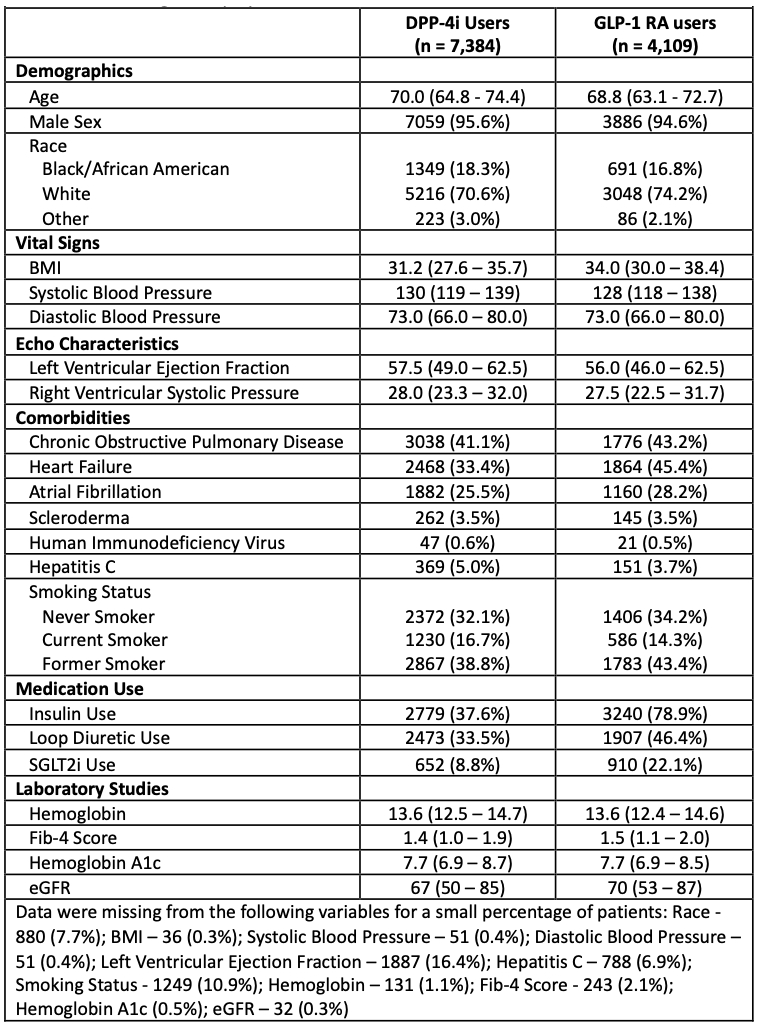
Abstract Body (Do not enter title and authors here): Introduction: Cardiometabolic dysfunction is a major contributor to the development of pulmonary hypertension (PH). In this context, Glucagon-like peptide 1 receptor agonists (GLP-1 RAs) have been identified as potential agents to prevent and treat PH based on their broad salutary metabolic effects. Aim: To determine whether GLP-1 RA exposure is associated with a reduced risk for developing PH. Methods: We conducted a retrospective cohort study using the active comparator, new user design to emulate a clinical trial. Data was derived from the Veterans Health Administration. Patients with diabetes and an echocardiogram (TTE) without PH (defined by a right ventricular systolic pressure of >35 mmHg) who initiated a GLP-1 RA or Dipeptidyl Peptidase 4 inhibitor (DPP4i) between Jan 1, 2007 and Dec 30, 2021 were included. Patients were required to have at least one follow up TTE after baseline. GLP-1 RA new users were compared to DPP4i new users, using inverse probability weighting (IPW) to adjust for confounding. Patients were followed from their first prescription date (baseline) until they developed PH (primary outcome), stopped the medication, died, or reached the end of the study (Jan 31, 2022). We conducted sensitivity analyses with modifications to inclusion criteria, time modeling, crossover handling, and censoring to ensure the robustness of our findings. Results: We identified 4,109 GLP-1 RA new users and 7,384 DPP-4i new users free of PH at baseline. GLP-1 RA and DPP4i users were similar in age (median [Q1-Q3], 69 [63-73] vs 70 [65-74]) and sex (94.6% vs 95.6% male). Full characteristics are detailed in Image 1. Patient IPWs were calculated using demographics, vitals, comorbidities, labs, and meds, with balance achieved between groups (standardized mean difference for all <0.10). In cox regression modeling of the IPW cohort, GLP-1 RA exposure compared to DPP4i exposure was associated with a 28% reduced risk of developing PH (HR 0.72; 95%CI 0.61-0.84). Unadjusted incidence rates of PH for GLP-1 RA compared to DPP4i were 54.8 vs 69.7 cases per 1000 person-years. Reduced risk of PH with GLP-1 RA use was consistent across sensitivity and subgroup analyses, including when stratified by obesity, heart failure status, and diabetes severity (Images 2&3). Conclusions: GLP-1 RA use associated with a reduced risk of developing PH. This finding supports the need for clinical trials to evaluate GLP-1 RA therapy for the prevention of PH among high risk individuals.
Garry, Jonah
(
Vanderbilt Univ Medical Center
, Nashville , Tennessee , United States )
Kundu, Suman
(
Vanderbilt Univ Medical Center
, Nashville , Tennessee , United States )
Alcorn, Charles
(
University of Pittsburgh
, Pittsburgh , Pennsylvania , United States )
Eden, Svetlana
(
Vanderbilt Univ Medical Center
, Nashville , Tennessee , United States )
Smith Wells, Emily
(
Vanderbilt Univ Medical Center
, Nashville , Tennessee , United States )
Greevy, Robert
(
Vanderbilt Univ Medical Center
, Nashville , Tennessee , United States )
Tindle, Hilary
(
Vanderbilt Univ Medical Center
, Nashville , Tennessee , United States )
Freiberg, Matthew
(
Vanderbilt Univ Medical Center
, Nashville , Tennessee , United States )
Brittain, Evan
(
Vanderbilt Univ Medical Center
, Nashville , Tennessee , United States )
Author Disclosures:
Jonah Garry:DO NOT have relevant financial relationships
| Suman Kundu:DO NOT have relevant financial relationships
| Charles Alcorn:No Answer
| Svetlana Eden:DO NOT have relevant financial relationships
| Emily Smith Wells:DO NOT have relevant financial relationships
| Robert Greevy:No Answer
| Hilary Tindle:No Answer
| Matthew Freiberg:No Answer
| Evan Brittain:DO NOT have relevant financial relationships