
Unsupervised Machine Learning Identifies Distinct Clinical Phenotypes in Acute Heart Failure Hospitalizations: A Nationwide Study Using the National Inpatient Sample
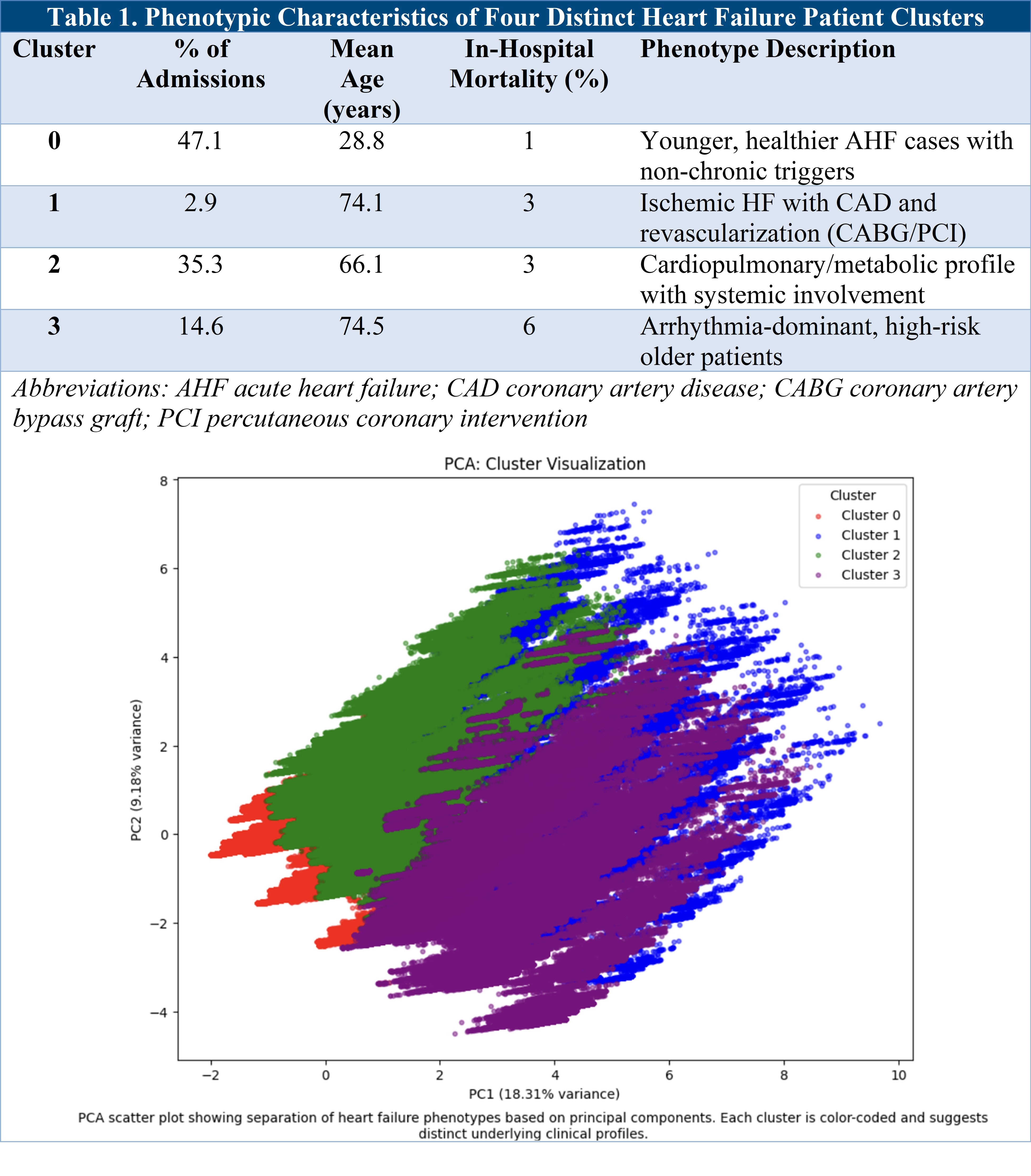
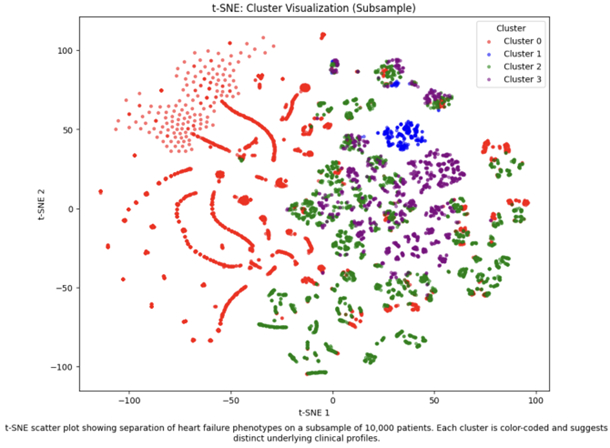
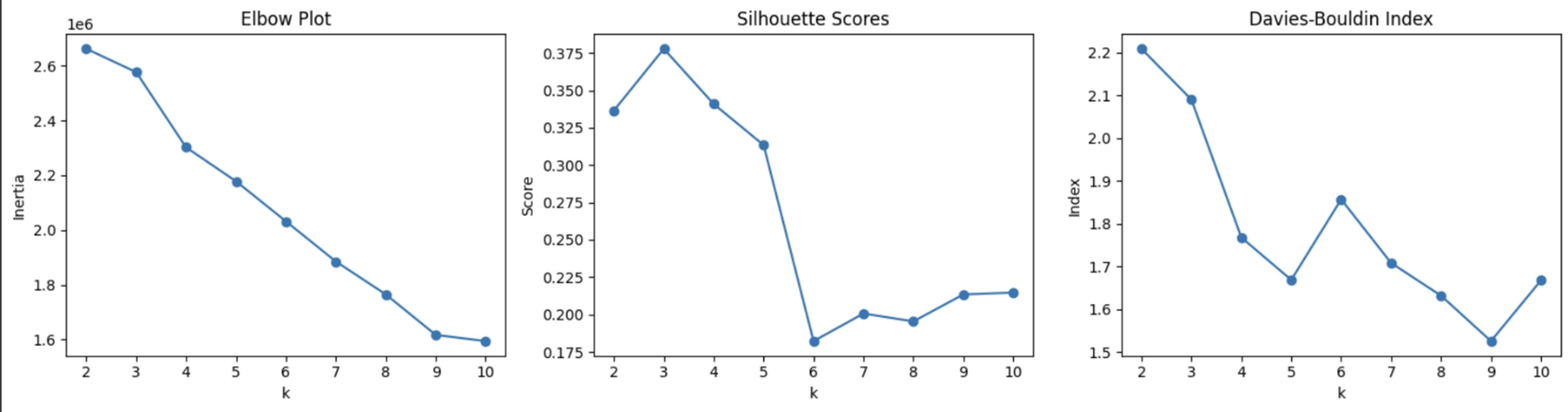
Abstract Body (Do not enter title and authors here): Background Heart failure has traditionally been classified as systolic vs diastolic, however acute heart failure (AHF) hospitalizations, often has various outcomes seen in bedside clinical medicine, driven by comorbidities, hemodynamic states, and initial presentation. ResearchQuestion Can unsupervised machine learning (ML) identify distinct clinical phenotypes among adults hospitalized with acute heart failure and guide management strategies? Methods We analyzed non-elective adult hospitalizations with AHF from the 2022 National Inpatient Sample (NIS). Five machine learning models were employed for prediction: Logistic Regression, Naive Bayes, Random Forest, XGBoost, and an artificial neural network (ANN) model. Unsupervised clustering was performed using K-means after principal component analysis (PCA) (k=4, Fig 1). Cluster visualization was enhanced via t-distributed stochastic neighbor embedding (t-SNE) and Uniform Manifold Approximation and Projection (UMAP) on a 10,000-patient subsample (Fig 2). Clusters were profiled by demographic and clinical characteristics.All analysis was conducted using Python 3.11. Results Four distinct patient clusters were identified amongst heart failure admissions. Cluster 0 (47.1%) comprised younger healthier patients (mean age 28.8 years) and lowest in-hospital mortality (1%) representing AHF cases with non-chronic triggers. Cluster 1(2.9%) consisted of older individuals, with coronary artery disease and interventions, such as CABG, PCI (mean age 74.1 years) and moderate mortality (3%) confirming an ischemic heart disease phenotype. Cluster 2 (35.3%) exhibited a cardiopulmonary/ metabolic profile with moderate mortality (3%, mean age 66.1 years) indicating a common heart failure phenotype with systemic involvement. Cluster 3 (14.6%) was dominated by arrhythmia and older population (mean age 74.5 years) and had the highest in-hospital mortality(6%) suggesting a high-risk arrhythmia-dominant phenotype (p <0.001 for all).(Image 3) Conclusions Unsupervised machine learning identified four unique and clinically relevant phenotypes among adults hospitalized with AHF, differentiated by comorbidity burden and in-hospital mortality. Our study highlights the potential of ML driven phenotyping to inform risk stratification, and clinical decisions in acute heart failure management.
Chilingarashvili, Giorgi
( Nazareth Hospital
, Philadelphia
, Pennsylvania
, United States
)
Diaz Fraga, Julian
( Reading Hospital, Tower Health
, Pennsylvania
, Pennsylvania
, United States
)
Razdan, Nandini
( Reading Hospital, Tower Health
, Pennsylvania
, Pennsylvania
, United States
)
Singh, Aniruddha
( Reading Hospital, Tower Health
, Pennsylvania
, Pennsylvania
, United States
)
Green, Jared
( Reading Hospital, Tower Health
, Pennsylvania
, Pennsylvania
, United States
)
Fagan, James
( PCOM
, Philadelphia
, Pennsylvania
, United States
)
Basnet, Arjun
( Reading Hospital, Tower Health
, Pennsylvania
, Pennsylvania
, United States
)
Li, Aobo
( Inspira Health Vineland
, Glassboro
, New Jersey
, United States
)
Tripathi, Devendra
( Nazareth Hospital
, Philadelphia
, Pennsylvania
, United States
)
Mondal, Avilash
( West Virginia University
, Morgantown
, West Virginia
, United States
)
Author Disclosures:
Giorgi Chilingarashvili:DO NOT have relevant financial relationships
| Julian Diaz Fraga:No Answer
| Nandini Razdan:No Answer
| Aniruddha Singh:No Answer
| Jared Green:No Answer
| James Fagan:DO NOT have relevant financial relationships
| Arjun Basnet:DO NOT have relevant financial relationships
| Aobo Li:DO NOT have relevant financial relationships
| Devendra Tripathi:DO NOT have relevant financial relationships
| Avilash Mondal:DO NOT have relevant financial relationships