Early vs Delayed Ablation for New-Onset Atrial Fibrillation
Abstract Body (Do not enter title and authors here): Background: Recent updated guidelines recognize catheter ablation as a first-line therapy for symptomatic atrial fibrillation (AF). The optimal timing of catheter ablation following AF diagnosis remains uncertain. This study assessed the impact of diagnosis-to-ablation time (DAT) <1 year versus DAT ≥1 year on AF recurrence and adverse clinical outcomes.
Hypothesis: We hypothesize that earlier DAT reduces AF recurrence and adverse outcomes by decreasing atrial remodeling associated with AF.
Methods: We queried the TriNetX research network for patients ≥18 years of age with AF who underwent ablation between January 1, 2010, and June 30, 2019. Patients were stratified based on DAT <1 year vs. DAT ≥1 year and matched using 1:1 propensity scoring for relevant factors. The primary outcome was AF recurrence, defined as a composite of cardioversion, antiarrhythmic drug (AAD) use, or re-ablation at 3 and 5 years, after a 3-month blanking period. Secondary outcomes included a composite of heart failure exacerbation, ischemic stroke, all-cause hospitalization, and mortality along with individual components.
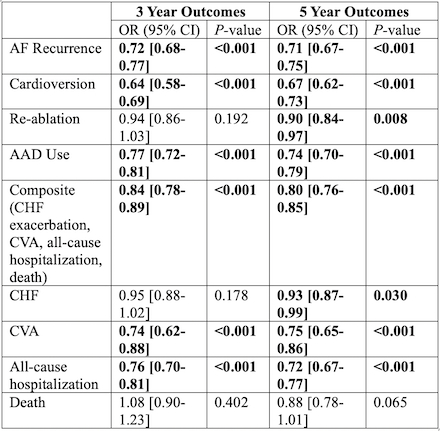
Results: A total of 17,683 patients with DAT <1 year and 13,939 patients with DAT ≥1 year were identified. Propensity matching (1:1) resulted in 9,566 patients in each cohort. The two cohorts were balanced for all baseline covariates except index age, with DAT≥1 being marginally older (63.2 ± 10.0 vs. 63.5 ±10.1, p=0.026). DAT <1 year was associated with significantly lower AF recurrence both at 3 years (adjusted OR: 0.725; 95% CI: 0.683-0.770; p<0.001) and 5 years (adjusted OR: 0.707; 95% CI: 0.667-0.750; p<0.001). The secondary composite outcome was also significantly lower in the DAT <1 year group both at 3 years (adjusted OR 0.84 [95% CI: 0.78–0.89]; p < 0.001) and 5 years (adjusted OR 0.80 [95% CI: 0.76–0.85]; p < 0.001). At 3 years, secondary individual outcomes significantly reduced in the DAT <1 year group included cardioversion, AAD use, ischemic stroke, and all-cause hospitalization. At 5 years, secondary individual outcomes significantly reduced in the DAT <1 year group included cardioversion, re-ablation, AAD use, heart failure exacerbation, ischemic stroke, and all-cause hospitalization. (Figure)
Conclusion: Catheter ablation within one year of AF diagnosis is associated with reduced AF recurrence and major adverse clinical outcomes. These findings support early referral for ablation to improve long-term outcomes.
Heath, Jacob
(
University of Iowa
, Iowa City , Iowa , United States )
Han, Sangwoo
(
University of California, Irvine
, Irvine , California , United States )
Alzahrani, Ashraf
(
University of Iowa
, Iowa City , Iowa , United States )
Hamon, David
(
University of Iowa
, Iowa City , Iowa , United States )
Powers, Edward
(
University of Iowa
, Iowa City , Iowa , United States )
Conti, Sergio
(
University of Iowa
, Iowa City , Iowa , United States )
Farjo, Peter
(
University of Iowa
, Iowa City , Iowa , United States )
Dominic, Paari
(
University of Iowa
, Iowa City , Iowa , United States )
Author Disclosures:
Jacob Heath:DO NOT have relevant financial relationships
| Sangwoo Han:No Answer
| Ashraf Alzahrani:DO NOT have relevant financial relationships
| david hamon:No Answer
| Edward Powers:No Answer
| Sergio Conti:DO NOT have relevant financial relationships
| Peter Farjo:DO NOT have relevant financial relationships
| Paari Dominic:DO have relevant financial relationships
;
Consultant:Boston Scientific:Active (exists now)
; Consultant:Biosense Webster:Active (exists now)