
Logo

American Heart Association

  22
  0


Final ID: MP991

Effect of Inflammatory Bowel Disease on Ablation Success and Predisposition for Atrial Fibrillation Recurrence

Abstract Body (Do not enter title and authors here): Background:
Inflammatory bowel disease (IBD) has been shown to be associated with development of early ischemic heart disease and arrythmias, especially atrial fibrillation (AF). This is suspected to be secondary to the chronic inflammatory state of IBD and atrial remodeling. With recent guidelines now recognizing catheter ablation as first-line therapy for symptomatic AF, the effect on IBD on AF ablation success is uncertain.

Hypothesis:
We hypothesize that patients undergoing ablation with a history of both IBD and AF are more likely to have a recurrence of AF secondary to the long-standing chronic inflammatory state of IBD.

Methods:
We queried the TriNetX research network for patients ≥18 years of age with a diagnosis of IBD and AF who underwent ablation between January 1, 2010, and December 31, 2021. Patients were stratified into cohorts based on IBD vs. non-IBD and matched using 1:1 propensity scores for underling comorbidities. The primary outcome was AF recurrence, defined as a composite of cardioversion, antiarrhythmic use, or re-ablation at 3 years, after a 3-month blanking period. Time-to-event analysis for first-time ablation events between patients with IBD who develop AF and those with AF without a history of IBD was also undertaken to evaluate for differences in ablation rates.

Results:
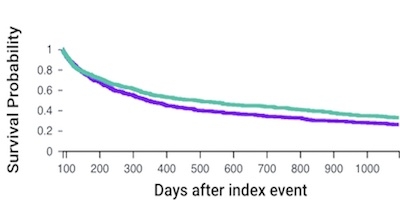
After propensity matching, there were 529 patients in each cohort. All underlying comorbidities were adjusted for with no significant differences noted between the final cohorts for matched analysis. The primary outcome analysis showed that AF with concurrent IBD was associated with increased AF recurrence at 3 years on Kaplan-Meier survival analysis as seen in the Figure (adjusted HR: 1.21; 95% CI: 1.04-1.41; p=0.0130). Patients with IBD were also less likely to undergo ablation therapy compared to the general population after the diagnosis of AF on Kaplan-Meier survival analysis (adjusted HR: 0.88; 95% CI: 0.82-0.94; p=0.0004).

Conclusions:
Patient undergoing AF catheter ablation with a concurrent history of IBD are associated with increased AF recurrence. Patients with underlying IBD who develop AF are also more likely not to undergo ablation therapy for unknown reasons. These findings support further evaluation of the underlying cardiac remodeling and arrhythmia burden with IBD patients and other inflammatory diseases, as well as further research into why patients with IBD appear to systemically not receive ablation therapy as often as the general population.
  • Heath, Jacob  ( University of Iowa , Iowa City , Iowa , United States )
  • Dominic, Paari  ( University of Iowa , Iowa City , Iowa , United States )
  • Author Disclosures:
    Jacob Heath: DO NOT have relevant financial relationships | Paari Dominic: DO have relevant financial relationships ; Consultant:Boston Scientific:Active (exists now) ; Consultant:Biosense Webster:Active (exists now)
Meeting Info:

Scientific Sessions 2025

2025

New Orleans, Louisiana

Session Info:

Inflammation as a Driver of Arrhythmic Risk: Pathophysiology and Therapeutic Implications

Saturday, 11/08/2025 , 10:45AM - 12:00PM

Moderated Digital Poster Session

More abstracts on this topic:
More abstracts from these authors:
Cardiac Devices in the Radiation Field: Challenges and Strategies

Dominic Paari, Ajijola Olujimi

Early vs Delayed Ablation for New-Onset Atrial Fibrillation

Heath Jacob, Han Sangwoo, Alzahrani Ashraf, Hamon David, Powers Edward, Conti Sergio, Farjo Peter, Dominic Paari

You have to be authorized to contact abstract author. Please, Login
Not Available