Logo

American Heart Association

  20
  0


Final ID: MP615

Tackling Telemetry: A Resident Run Initiative to Reduce Unnecessary Telemetry Use

Abstract Body (Do not enter title and authors here): Background: Telemetry is a valuable tool for close clinical monitoring. However, when used in non-indicated settings, it contributes to alarm fatigue, increased healthcare costs, and reduced patient satisfaction. Many studies have shown that unnecessary telemetry use does not improve clinical outcomes. Even when initially indicated, telemetry orders often remain active for longer than necessary.

Research Question: Will an educational intervention reduce inappropriate telemetry orders on admission and improve reassessment of telemetry after 48 hours?

Goals: Educate admitting hospitalists and internal medicine residents about American Heart Association (AHA) guidelines for telemetry in order to reduce unnecessary use.

Methods: We designed a quality improvement study using a pre-post analysis to measure the effect of education on telemetry use. Telemetry orders upon admission to a tertiary care center were analyzed by two physicians based on the 2017 AHA Best Practice guidelines. Orders were re-evaluated at 48 hours to assess whether telemetry remained indicated or was discontinued appropriately. Education regarding the AHA guidelines was then given to internal medicine residents and the non-teaching hospitalist service. After education, telemetry orders were again analyzed over a two week period. Results were analyzed for significance with a chi-square test using a p-value of significance set to 0.05.

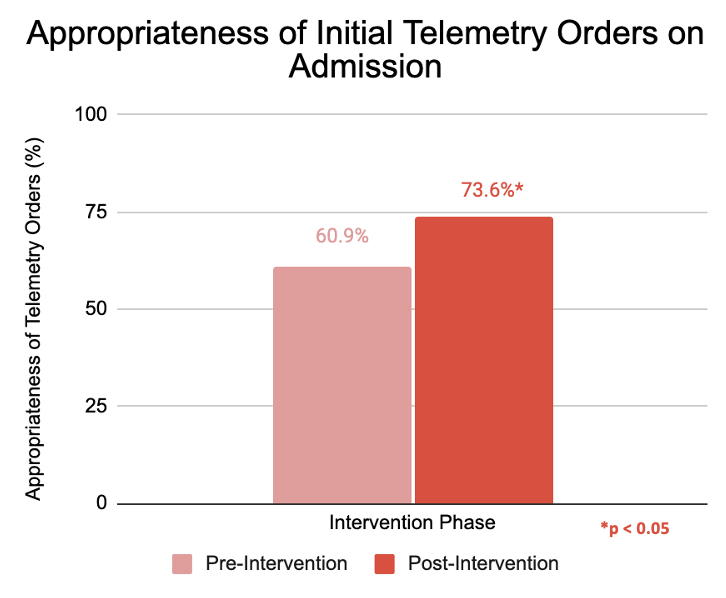
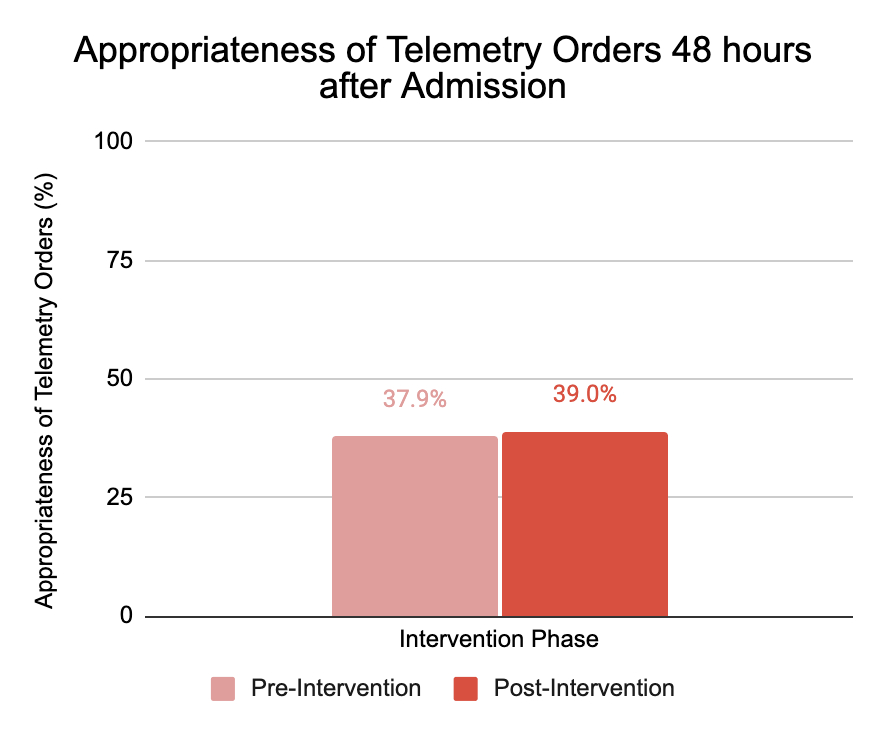
Results: Prior to the educational intervention, 156 admissions were analyzed. Following the intervention, 110 admissions were analyzed. The proportion of appropriate telemetry orders at admission significantly increased from 60.9% to 73.6% (p=0.03; 95% CI: 1.5%–23.9%) (Figure 1). No significant change was observed in appropriateness at 48 hours with 37.9% and 39% of orders deemed appropriate pre and post-education, respectively (p=1.00; 95% CI: -17.0% to 19.2%) (Figure 2).

Conclusion: Our study not only assessed telemetry upon admission but also uniquely re-evaluated use 48 hours later, highlighting an overlooked contributor to overuse. While an educational intervention improved initial ordering practices, it did not significantly impact ongoing telemetry reassessment or timely discontinuation. A future intervention to consider is additional electronic medical record advisories to improve telemetry orders after 48 hours. Future works should investigate the frequency of repeated education required to maintain high level ordering practices.
  • Jamal, Hera  ( Cooper University Hospital , Camden , New Jersey , United States )
  • Laloggia, Michael  ( Cooper University Hospital , Camden , New Jersey , United States )
  • Boggarapu, Shruthi  ( Cooper University Hospital , Camden , New Jersey , United States )
  • Moazamian, Ryan  ( Cooper University Hospital , Camden , New Jersey , United States )
  • Azzo, Joe David  ( Cooper University Hospital , Camden , New Jersey , United States )
  • Nyah, Wilson  ( Cooper University Hospital , Camden , New Jersey , United States )
  • Mcmillan, Tyler  ( Cooper University Hospital , Camden , New Jersey , United States )
  • Author Disclosures:
    Hera Jamal: DO NOT have relevant financial relationships | Michael LaLoggia: DO NOT have relevant financial relationships | Shruthi Boggarapu: No Answer | Ryan Moazamian: No Answer | Joe David Azzo: DO NOT have relevant financial relationships | WILSON NYAH: No Answer | Tyler McMillan: DO NOT have relevant financial relationships
Meeting Info:

Scientific Sessions 2025

2025

New Orleans, Louisiana

Session Info:

From Systems to Solutions: Innovation, Equity, and Implementation at the Frontlines of Cardiovascular Care

Saturday, 11/08/2025 , 10:45AM - 11:55AM

Moderated Digital Poster Session

More abstracts on this topic:
Accelerating Stroke Care at an Academic Hospital: Evaluating the Impact of a Launchpad Initiative on Door-to-Needle Times One Year Later

Shoemaker Camella, Shugrue Leah, Coccia Michael, Bakradze Ekaterina, Shapshak Dag, Gropen Toby, Thompson Karen, Taylor Danielle, Morrison Amanda, Stallings Ashley, Shipley Sarah, Jones Tamicka, Rafferty Rachael, Reid Tonya

A Novel Retrieval-Augmented Generation Approach that Leverages Large Language Models to Parse EHR Data Enhances the Detection of Barriers in Guideline-Directed Medical Therapy Use in Heart Failure

Adejumo Philip, Thangaraj Phyllis, Croon Philip, Dhingra Lovedeep, Aminorroaya Arya, Pedroso Aline, Khera Rohan

You have to be authorized to contact abstract author. Please, Login
Not Available