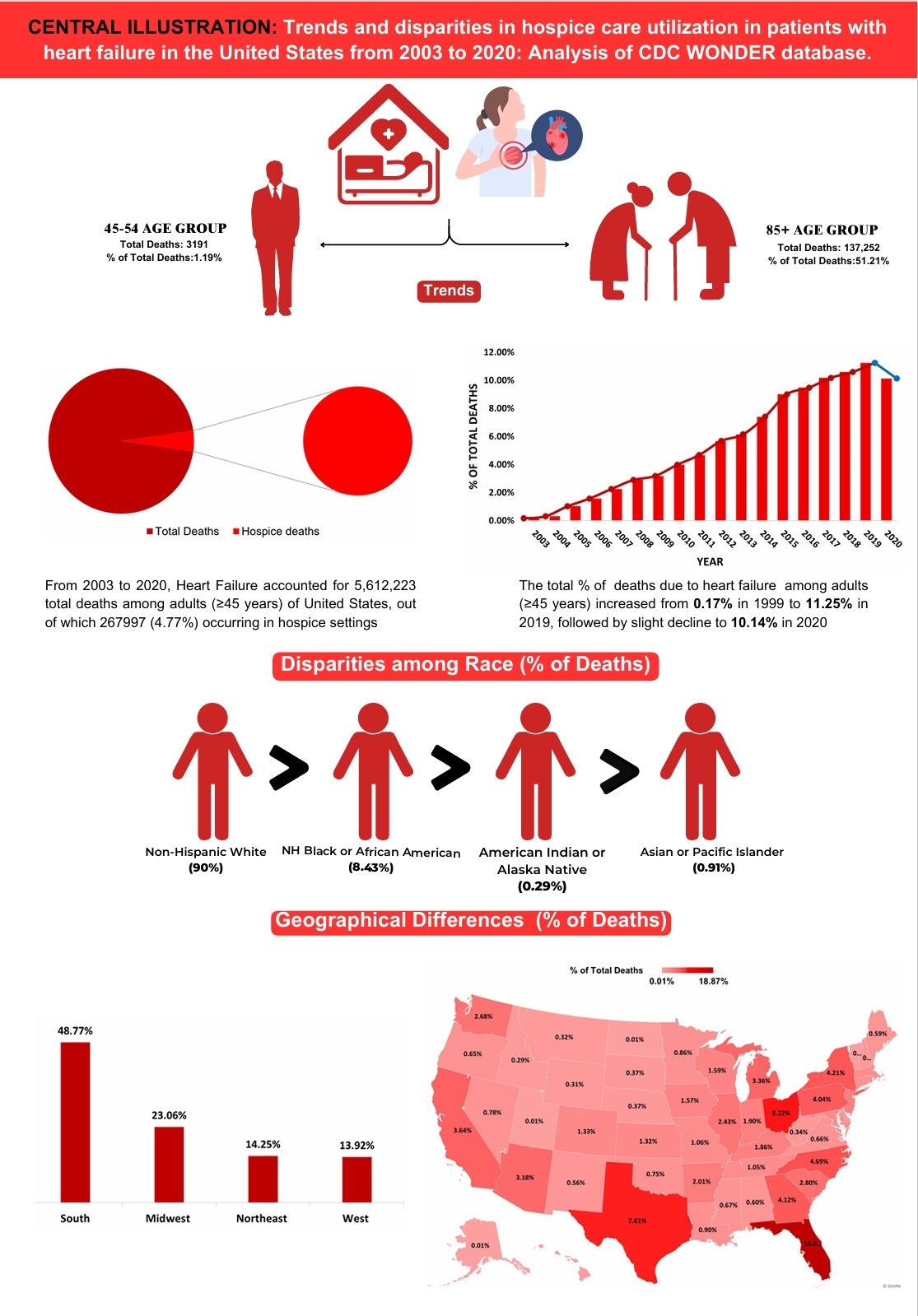
Trends and disparities in hospice care utilization in patients with heart failure in the United States from 2003 to 2020: Analysis of CDC WONDER database
Abstract Body (Do not enter title and authors here):
Background: Heart failure (HF) is a life-threatening condition and a major global cause of mortality, with 56.19 million cases reported worldwide by 2019. In the US, HF contributes to approximately 13.4% of all deaths. Till 2030 around 57% of the US adult population is predicted to suffer from HF. Its increasing prevalence highlights the importance of hospice care, which improves quality of life, reduces healthcare costs, and alleviates psychological distress at the end of life. Despite its benefits, hospice care remains underutilized, particularly among heart failure patients. Aims: Our study aims to increase understanding of hospice care utilization trends to help address disparities and improve care delivery. Methods: The search and analysis were conducted using the CDC WONDER database from January 01, 2003, to December 31, 2020. The data for deaths due to HF were pooled using the ICD-10 Codes: I50, I50.1, and I50.9. The demographic data was obtained to calculate descriptive statistics using age, sex, race, census region, states to analyse utilization of hospice mortality accordingly over the past two decades. Results: A total of 5,612,223 heart failure deaths occurred from 2003 to 2020, with 267,997 (4.77%) in hospice settings. Hospice utilization rose from 0.17% in 2003 to 11.25% in 2019, declining slightly to 10.14% in 2020. More deaths occurred among females (51.97%) than males (48.03%). Non-Hispanic Whites accounted for 90.37% of deaths, followed by Non-Hispanic Black or African Americans (8.43%). Regionally, the South had the highest hospice deaths (48.77%), while age-wise, most occurred in those aged 85+ (51.21%). Florida had the highest state-level deaths (18.87%), followed by Ohio (8.22%) and Texas (7.61%). Alaska, Utah, and the District of Columbia had the lowest rates. Conclusion: This study shows a steady increase in hospice use from 2003–2019, with a decline in 2020, potentially reflecting pandemic related disruptions. Substantial age and regional disparities exist, with significantly lower hospice use in younger age groups and the Western U.S. These findings highlight the need for early hospice discussions and policy interventions to address inequities in end-of-life care for heart failure patients.
Khan, Allahdad
(
Nishtar Medical University
, Multan , Pakistan )
Adeeb, Omar
(
Montefiore St. Luke's Cornwall
, Newburgh , New York , United States )
Ali, Kumail Mustafa
(
Jinnah Sindh Medical University
, Karachi , Pakistan )
Fatima, Ayesha
(
Nishtar Medical University
, Multan , Pakistan )
Asghar, Maryam
(
Nishtar Medical University
, Multan , Pakistan )
Kanwal, Kainat
(
Charleston Area Medical Center, Vandalia Health, Charleston, West Virginia
, Charleston , West Virginia , United States )
Jamil, Umar
(
Nishtar Medical University
, Multan , Pakistan )
Sehar, Alina
(
University of Alabama, Huntsville, Alabama
, Huntsville , Alabama , United States )
Shan E Zainab, Fnu
(
Nishtar Medical University
, Multan , Pakistan )
Shahid, Muhammad Arsalan
(
University of Louisville
, Louisville , Kentucky , United States )
Author Disclosures:
Allahdad Khan:DO NOT have relevant financial relationships
| MUHAMMAD ARSALAN SHAHID:No Answer
| Omar Adeeb:No Answer
| Kumail Mustafa Ali:DO NOT have relevant financial relationships
| Ayesha Fatima:DO NOT have relevant financial relationships
| Maryam Asghar:DO NOT have relevant financial relationships
| Kainat Kanwal:DO NOT have relevant financial relationships
| Umar Jamil:No Answer
| Alina Sehar:DO NOT have relevant financial relationships
| Fnu SHAN E ZAINAB:DO NOT have relevant financial relationships