Trends and Demographic Disparities in Ventricular Septal Defects-related Mortality Among the United States Population, 1999-2023
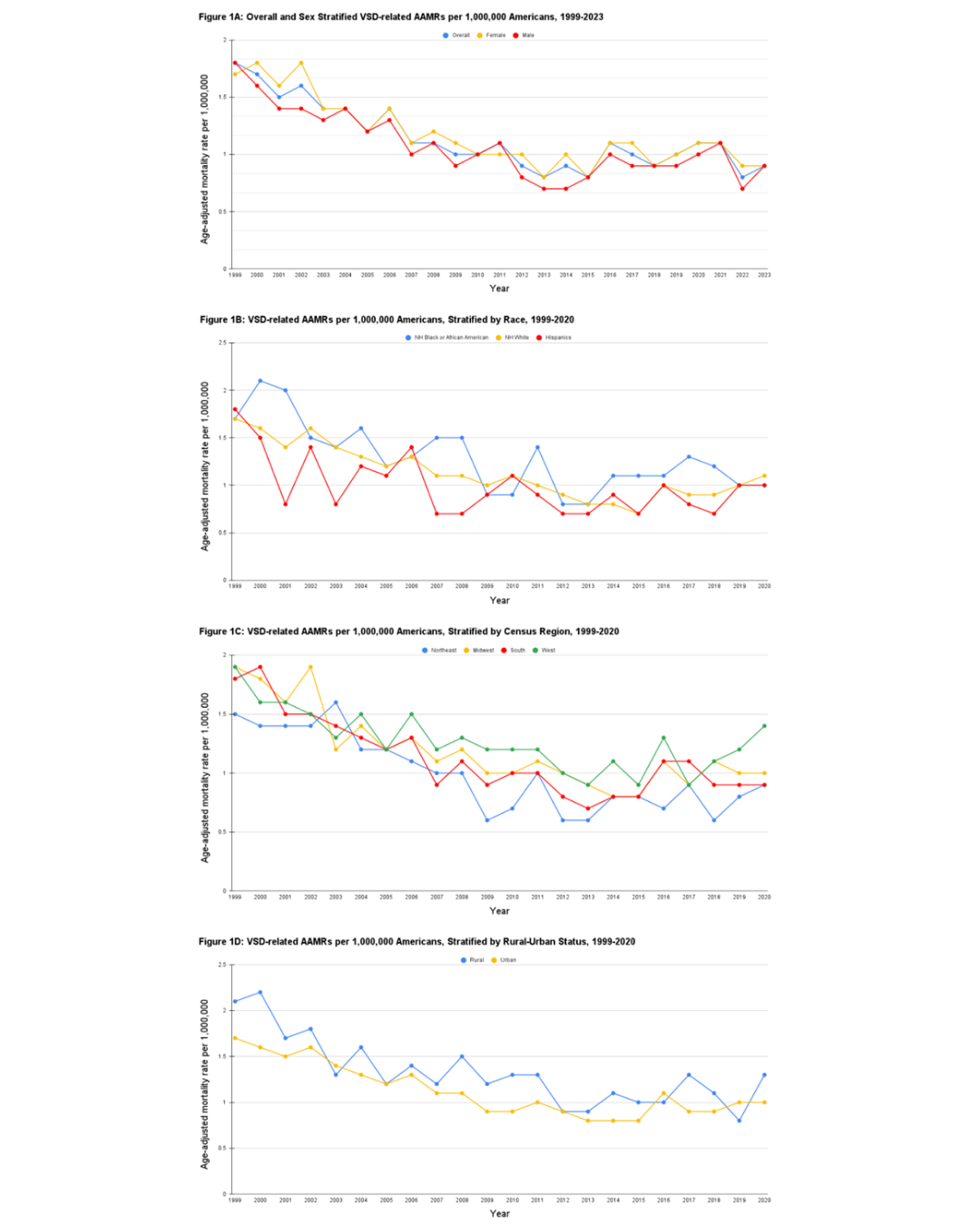
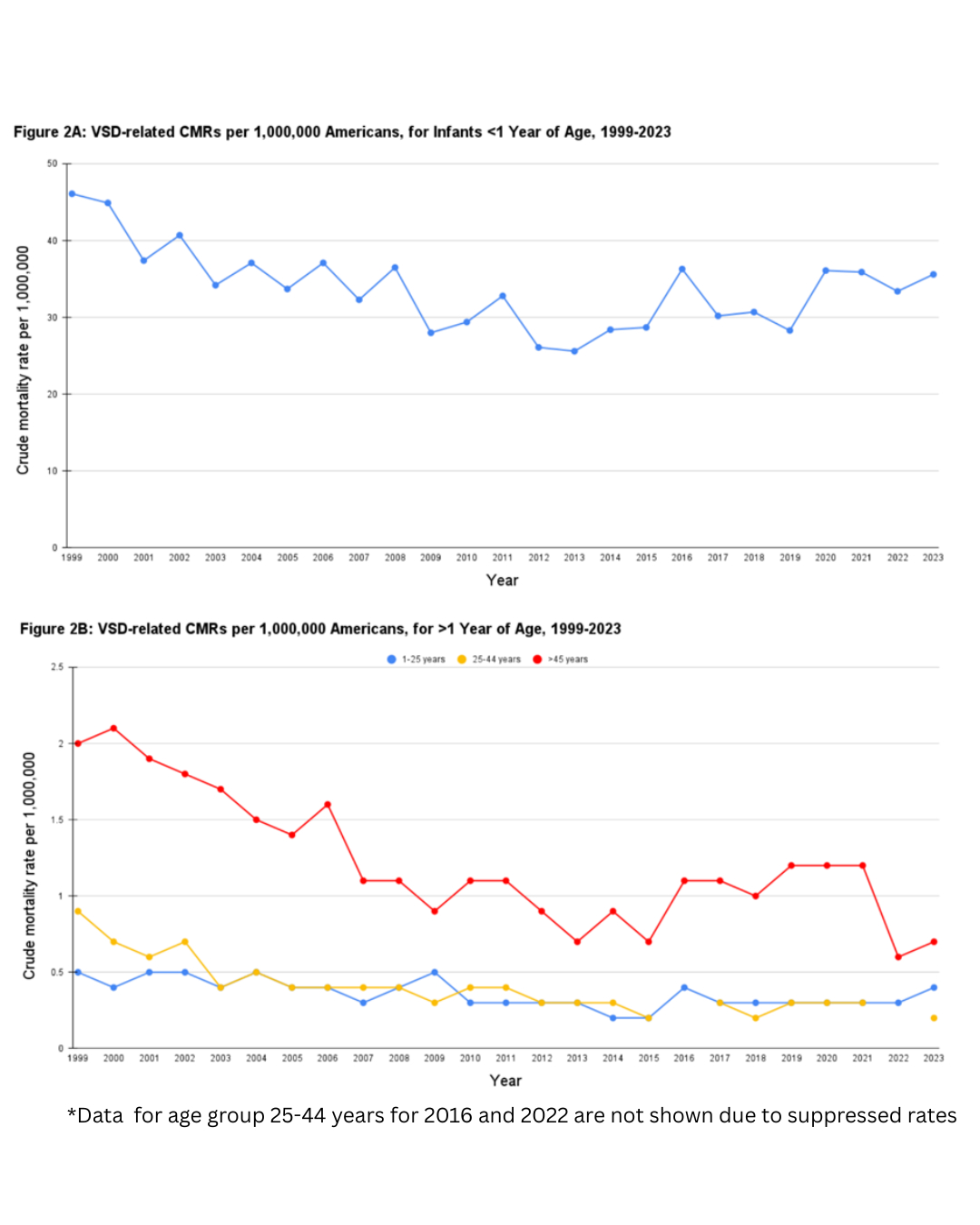
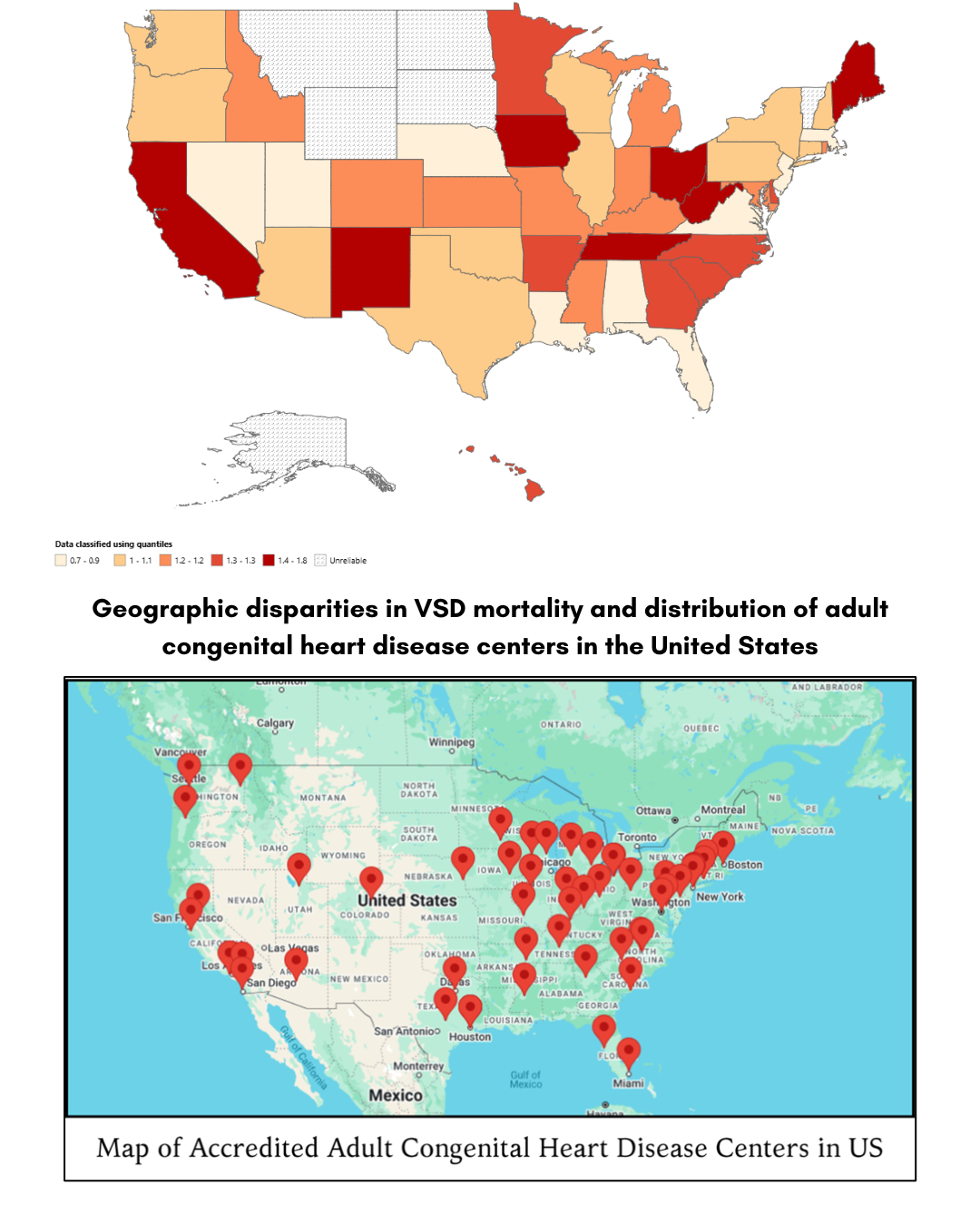
Abstract Body (Do not enter title and authors here): Background: Ventricular Septal Defects (VSDs) are the most common congenital heart defect in children, affecting about 1 in 500 newborns in the United States, and are the second most prevalent cardiac defect in adults. However, limited data is available on demographic disparities in VSD-related mortality within the US. Aims: We assessed the trends in VSD-related mortality among the US population with an emphasis on age-related, racial, and geographic differences. Methods: The CDC WONDER multiple-cause of death database was analyzed from 1999 to 2023 for VSD-related mortality across all age categories, using the ICD-10 code Q21.0 (Ventricular Septal Defect). Crude mortality rates (CMRs) and age-adjusted mortality rates (AAMRs) with 95% confidence intervals (CIs) were calculated per 1,000,000 for age, year, sex, race, region, state, and urbanization status. Annual percentage change (APC) was determined by Joinpoint regression. Results: From 1999 to 2023, 8,601 deaths in the US were attributed to VSDs, with nearly two-thirds occurring in individuals <45 years. The AAMR declined from 1.8 in 1999 to 0.9 in 2012 (APC: -4.8; 95% CI: -8.2, -3.7), then stabilized through 2023 (APC: 0.8, 95% CI: -1.6, 7.2). Infants less than a year old accounted for the most deaths (38.4%) and the highest overall CMRs (33.6) which declined from 46.1 in 1999 to 25.6 in 2013 (APC: -3.2; 95% CI: -6.9, -1.9), then increased to 36.1 in 2023 (APC: 2.8; 95% CI: 0.2, 11.4). CMRs in other age groups either declined or remained stable. Female deaths (53.3%) exceeded male deaths (46.7%), though similar AAMRs were seen (1999: 1.7 vs 1.8; 2023: 0.9 vs 0.9). By race, the highest AAMRs were noted among the non-Hispanic (NH) Blacks (1.2), followed by NH Whites (1.1) and Hispanics/Latinos (0.9). Regionally, the West and Midwest had the highest AAMRs (1.2). Rural areas had higher mortality rates (1.3) than urban areas (1.1). Moreover, states in the top 90th percentile of VSD-related mortality included Iowa, the District of Columbia, West Virginia, Maine, and New Mexico. Conclusion: After declining until 2012, VSD-related mortality rates have stabilized through 2023, although a concerning rise in infant deaths has emerged since 2013. Higher death rates, noted among infants, NH Blacks, Western, Midwestern, and rural residents, highlight the need for targeted surveillance, timely diagnosis, equitable access to specialized care and further research into the factors driving these patterns.
Jamil, Adeena
(
Dow University of Health Sciences
, Karachi , Pakistan )
Ali, Kumail Mustafa
(
Jinnah Sindh Medical University
, Karachi , Pakistan )
Nasar, Muhammad Haleem
(
Northwest School of Medicine
, Peshawar , Pakistan )
Khan, Allahdad
(
Nishtar Medical University
, Multan , Pakistan )
Siddiqi, Asra
(
Dow University of Health Sciences
, Karachi , Pakistan )
Mubariz, Muhammad
(
Doctors Hospital at Renaissance
, Edinburg , Texas , United States )
Pirih, Fnu
(
People’s University of Medical and Health Sciences for Women
, Nawabshah , Pakistan )
Arshad, Hasnan
(
St Francis Medical Center
, Monroe , Louisiana , United States )
Author Disclosures:
Adeena Jamil:DO NOT have relevant financial relationships
| Kumail Mustafa Ali:DO NOT have relevant financial relationships
| Muhammad Haleem Nasar:DO NOT have relevant financial relationships
| S.M Washaqul Arfin:DO NOT have relevant financial relationships
| Allahdad Khan:DO NOT have relevant financial relationships
| Asra Siddiqi:DO NOT have relevant financial relationships
| Muhammad Mubariz:DO NOT have relevant financial relationships
| Fnu Pirih:DO NOT have relevant financial relationships
| Hasnan Arshad:DO NOT have relevant financial relationships
Eltawansy Sherif, Khan Muhammad, Iqbal Asad, Sharif Aleena, Hossain Mohammad, Ali Muhammad Faizan, Ahmad Husnain, Faizan Muhammad, Ahmed Ashraf, Abdul Malik Mohammad Hamza Bin, Pahwani Ritesh, Patel Rahul, Mehdi Hassan
Siddiqi Ahmed Kamal, Book Wendy, De Cecco Carlo, Krasuski Richard, Ur Rehman Obaid, Jamil Adeena, Nadeem Zain, Ali Kumail Mustafa, Naeem Muhammad, Hardin Joel, Rodriguez Fred, Thaler Christina