Logo

American Heart Association

  111
  0


Final ID: 4146824

Performance of Clinician-Assigned SCAI Shock Staging in the AHA Cardiogenic Shock Registry

Abstract Body (Do not enter title and authors here): Background: SCAI staging of cardiogenic shock (CS) severity facilitates communication about the presentation and trajectory of CS. Most prior validations of SCAI staging have used registry-specific algorithmic adaptations of the staging criteria. Few studies have evaluated clinician-assigned SCAI staging based on holistic assessment of all clinical data.

Aim: To assess the ability of initial and serial clinician-assigned SCAI staging to stratify risk of in-hospital mortality in a large, broadly representative CS population from the AHA CS Registry.

Methods: Consecutive CS admissions enrolled in the Registry (64 sites, 2022-2024) were included. Clinician-assigned SCAI stage was captured at CS onset (first 6h) and serially (6-12h after CS onset). Cases with available SCAI stage at both timepoints were classified as having improved, unchanged, or worsened SCAI stage. Associations of in-hospital mortality with initial and early change in SCAI stage were assessed using logistic regression; for the latter, models were adjusted for initial SCAI stage. Key subgroups defined by CS etiology (AMI-CS vs. HF-CS) and preceding cardiac arrest (CA) were examined.

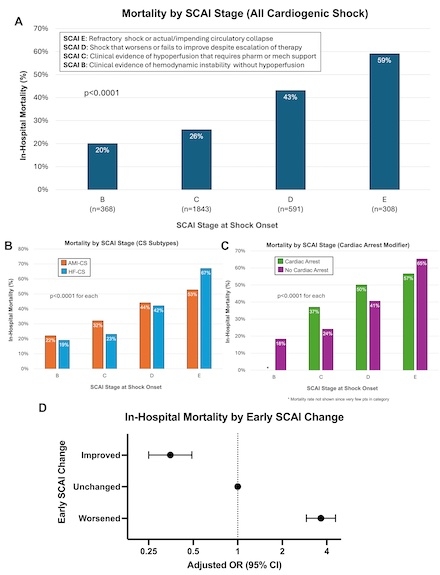
Results: Among 4,311 CS admissions, 3,110 (72%) had initial SCAI stage assessments (median age 66y, 33% women, 30% AMI-CS, 50% HF-CS, 21% preceding CA) and 2,867 (67%) had serial assessments. Most CS was initially staged as SCAI C (B: 12%; C: 59%; D: 19%; E: 10%), with a higher proportion of SCAI D/E in those with AMI-CS (34%) or preceding CA (60%). There was a stepwise gradient of mortality across SCAI stages (p<0.001; Fig-A), consistent when stratifying by CS etiology and preceding CA (p<0.001 for each; Fig-B/C). In the 12h after CS onset, most SCAI staging was unchanged (73%; worsening: 15%; improving: 12%); however, SCAI staging was more dynamic in those with preceding CA. Early worsening or improvement in SCAI stage was associated with higher (aOR 3.7, 95% CI 2.9-4.6) and lower (aOR 0.4, 95% CI 0.3-0.5) odds of mortality, respectively (Fig-D).

Conclusion: In this initial analysis from the AHA CS Registry, clinician-assigned SCAI staging effectively stratified in-hospital mortality risk, and early changes in SCAI stage further refined prognostication in CS.
  • Berg, David  ( Brigham and Women's Hospital TIMI Study Group , Melrose , Massachusetts , United States )
  • Bohula, Erin  ( Brigham and Women's Hospital TIMI Study Group , Melrose , Massachusetts , United States )
  • Patel, Siddharth  ( Brigham and Women's Hospital TIMI Study Group , Melrose , Massachusetts , United States )
  • Palazzolo, Michael  ( Brigham and Women's Hospital TIMI Study Group , Melrose , Massachusetts , United States )
  • Krucoff, Mitchell  ( DUKE MEDICAL CENTER , Chapel Hill , North Carolina , United States )
  • Morrow, David  ( Brigham and Women's Hospital TIMI Study Group , Melrose , Massachusetts , United States )
  • Author Disclosures:
    David Berg: DO NOT have relevant financial relationships | Erin Bohula: No Answer | Siddharth Patel: DO have relevant financial relationships ; Consultant:Janssen:Active (exists now) | Michael Palazzolo: DO NOT have relevant financial relationships | Mitchell Krucoff: DO have relevant financial relationships ; Consultant:Gettinge:Active (exists now) ; Consultant:Boston Scientific:Past (completed) ; Consultant:Medtronic:Past (completed) ; Consultant:Abbott Vascular:Active (exists now) ; Consultant:Abiomed/J&J Medtech:Active (exists now) ; Consultant:Teleflex:Active (exists now) | David Morrow: No Answer
Meeting Info:

Scientific Sessions 2024

2024

Chicago, Illinois

Session Info:

Shocking Developments in Cardiogenic Shock

Monday, 11/18/2024 , 01:30PM - 02:45PM

Abstract Oral Session

More abstracts on this topic:
Association Between Hospital Teaching Status and Outcomes in Patients with Cardiogenic Shock Complicating Acute Myocardial Infarction

Arshad Muhammad Sameer, Iqbal Naeem, Kumari Komal, Manal Ishba, Nasir Aamna, Javaid Syed Sarmad, Arshad Anosha, Abbas Faizan, Abideen Zain Ul, Fatima Saba, Harrison Marian, Hassan Shahzaib, Irshad Ayman

A Contemporary Machine Learning-Based Risk Stratification for Mortality and Hospitalization in Heart Failure with Preserved Ejection Fraction Using Multimodal Real-World Data

Fudim Marat, Weerts Jerremy, Patel Manesh, Balu Suresh, Hintze Bradley, Torres Francisco, Micsinai Balan Mariann, Rigolli Marzia, Kessler Paul, Touzot Maxime, Lund Lars, Van Empel Vanessa, Pradhan Aruna, Butler Javed, Zehnder Tobias, Sauty Benoit, Esposito Christian, Balazard Félix, Mayer Imke, Hallal Mohammad, Loiseau Nicolas

More abstracts from these authors:
Contemporary Practice Patterns of Vasoactive Agents in Cardiogenic Shock: An Analysis of the AHA Cardiogenic Shock Registry

Patel Siddharth, Berg David, Bohula Erin, Palazzolo Michael, Krucoff Mitchell, Morrow David

Mechanical Circulatory Support Device Related Complications in Contemporary North American Cardiac Intensive Care Units

Kochar Ajar, Park Jeong-gun, Berg David, Patel Siddharth, Bohula Erin, Morrow David

You have to be authorized to contact abstract author. Please, Login
Not Available