Variation in Vasoactive Treatments for Cardiogenic Shock: Insights from the Critical Care Cardiology Trials Network
Abstract Body (Do not enter title and authors here): Introduction: The paucity of data to guide selection of specific vasoactive agents in patients with cardiogenic shock (CS) may lead to variability in practice patterns.
Hypothesis: Variation in the utilization of inodilators to treat CS is associated with both institution- and patient-level factors.
Methods: The Critical Care Cardiology Trials Network (CCCTN) is a multicenter network of tertiary CICUs in North America coordinated by the TIMI Study Group. This analysis cohort includes patients with CS from 2018-2023. Shock was defined as systolic blood pressure less than 90 mmHg with end-organ dysfunction ascribed to the hypotension. Shock type was classified by site investigators. Multivariable linear mixed-effect modeling was used to evaluate patient- and institutional-level variation associated with the use of inodilators treatment (milrinone, dobutamine).
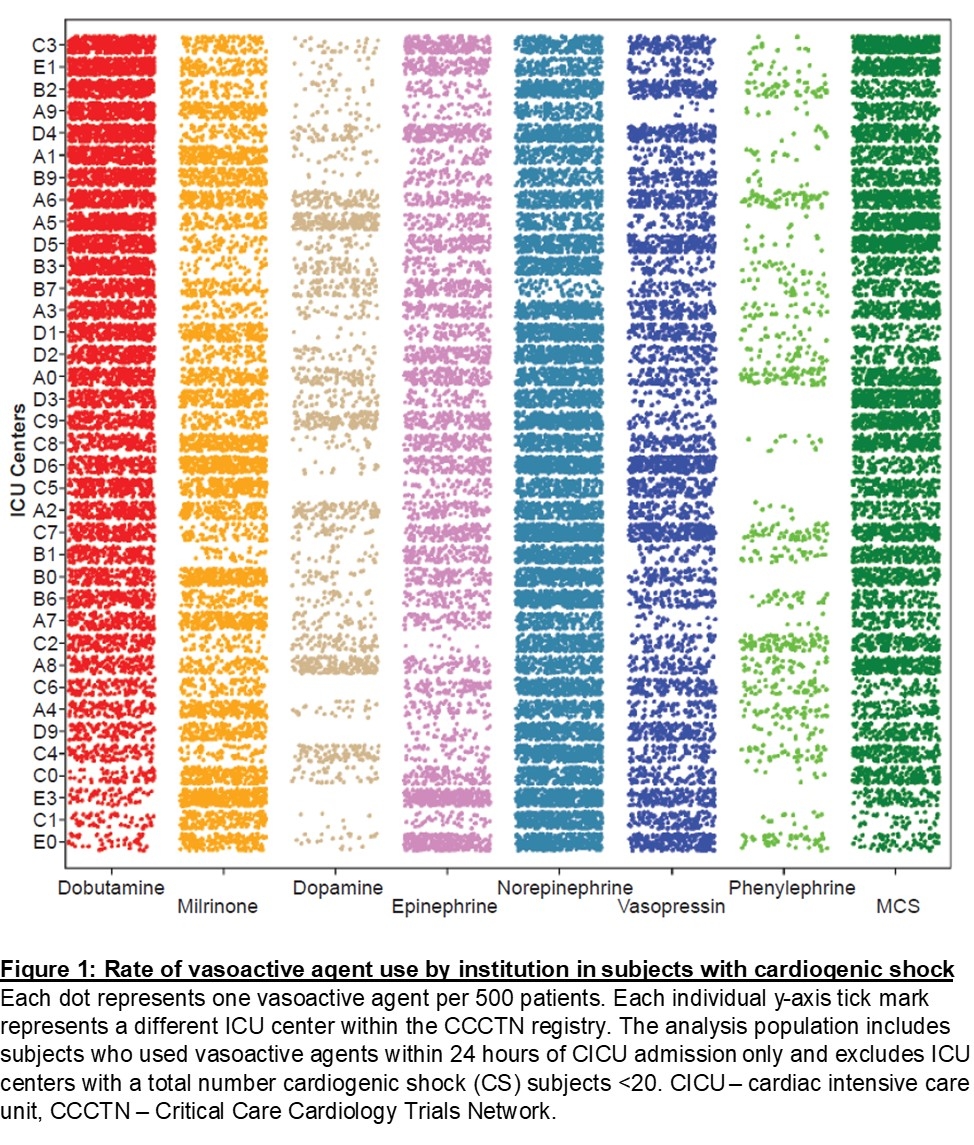
Results: A total of 3,282 patients from 37 CICUs were in the study cohort. The rate of utilization of specific vasoactive medications and MCS varied substantially across institutions (Fig 1). For inodilators, rates of dobutamine use varied by institution from 10% to 82%, while milrinone use varied from 6% to 71%. Patient-level variables that were associated with the use of inodilator treatment included male sex (OR 1.24 [95% CI 1.03-1.49]), history of heart failure (1.98 [1.61-2.43]), SCAI class D vs. B/C (1.35 [1.08-1.69]), and BiV failure vs. LV failure (1.59 [1.27-1.99). Variables less likely to be associated with inodilator use included age (0.97 [0.97-0.98] per year increase), cardiac arrest (0.34 [0.27-0.42]), and acute coronary syndrome presentation (0.72 [0.57-0.91]). MCS use within 36 hours of CICU admission and pulmonary hypertension were not associated with variability in inodilator use. In multivariable linear mixed-effect modeling, 45.9% of variation in inodilator use was attributed to patient-level factors and 21.8% of variation was attributed to the institution.
Conclusion: There is substantial variation in vasoactive treatment and inodilator use related to patient- and institution-level factors. Such variability underscores the need for additional high-quality evidence to guide vasoactive treatment strategies in CS.
Hamilton, David
( University of Michigan
, Ann Arbor
, Michigan
, United States
)
Thompson, Andrea
( University of Michigan
, Ann Arbor
, Michigan
, United States
)
Shriver, Jackson
( University of Michigan
, Ann Arbor
, Michigan
, United States
)
Park, Jeong-gun
( Brigham and Women's Hospital
, Boston
, Massachusetts
, United States
)
Michos, Zoe
( University of Michigan
, Ann Arbor
, Michigan
, United States
)
Ketcham, Scott
( University of Michigan
, Ann Arbor
, Michigan
, United States
)
Adie, Sarah
( University of Michigan
, Ann Arbor
, Michigan
, United States
)
Mathis, Michael
( University of Michigan Medicine
, Ann Arbor
, Michigan
, United States
)
Patel, Siddharth
( Brigham and Womens Hospital
, Boston
, Massachusetts
, United States
)
Morrow, David
( Brigham and Womens Hospital
, Boston
, Massachusetts
, United States
)
Author Disclosures:
David Hamilton:DO NOT have relevant financial relationships
| Andrea Thompson:DO NOT have relevant financial relationships
| Jackson Shriver:No Answer
| Jeong-Gun Park:DO NOT have relevant financial relationships
| Zoe Michos:DO NOT have relevant financial relationships
| Scott Ketcham:DO NOT have relevant financial relationships
| Sarah Adie:DO NOT have relevant financial relationships
| Michael Mathis:DO have relevant financial relationships
;
Research Funding (PI or named investigator):National Institutes of Health:Active (exists now)
; Research Funding (PI or named investigator):Chiesi, USA:Active (exists now)
| Siddharth Patel:DO have relevant financial relationships
;
Consultant:Janssen:Active (exists now)
| David Morrow:DO have relevant financial relationships
;
Research Funding (PI or named investigator):Cleerly:Active (exists now)
; Research Funding (PI or named investigator):Softcell:Active (exists now)
; Consultant:Roche:Active (exists now)
; Research Funding (PI or named investigator):Roche:Active (exists now)
; Consultant:Merck:Active (exists now)
; Consultant:Regeneron:Active (exists now)
; Research Funding (PI or named investigator):Regeneron:Active (exists now)
; Research Funding (PI or named investigator):Pfizer:Active (exists now)
; Research Funding (PI or named investigator):Novartis:Active (exists now)
; Research Funding (PI or named investigator):Daiichi Sankyo:Active (exists now)
; Research Funding (PI or named investigator):AstraZeneca:Active (exists now)
; Research Funding (PI or named investigator):Anthos Therapeutics:Active (exists now)
; Research Funding (PI or named investigator):Abiomed:Active (exists now)
; Consultant:Abbott:Active (exists now)
; Research Funding (PI or named investigator):Abbott:Active (exists now)