
Atrial Fibrillation in American Indians: Comparative Analysis of Characteristics and Anticoagulation Use for Stroke Prevention of Atrial Fibrillation
Abstract Body (Do not enter title and authors here): Background: Atrial fibrillation (AF) is the most common cardiac arrhythmia in the United States, affecting individuals of all races. Anticoagulation (AC) therapy is recommended by the guidelines to reduce the risk of stroke in AF patients. Previous reports indicate that American Indians (AI) have a higher risk of AF and an increased risk of stroke from AF.
Aim: To describe the demographic and clinical characteristics of the AI population with AF and compare their AC status with other racial groups.
Methods: We retrospectively analyzed AF patients age >18 years hospitalized between January 2022 and October 2023 in two hospitals serving a large Navajo Nation AI population in rural Northern Arizona. We compared baseline characteristics, AC status and direct oral anticoagulant (DOAC) use between AI and other races. Between group statistical analysis was completed using a chi-square for categorical variables and a Mann-whiney U test for continuous variables, with statistical significance defined as a p-value ≤ 0.05.
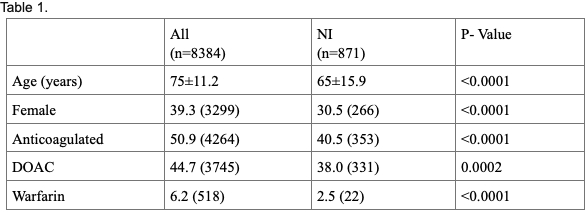
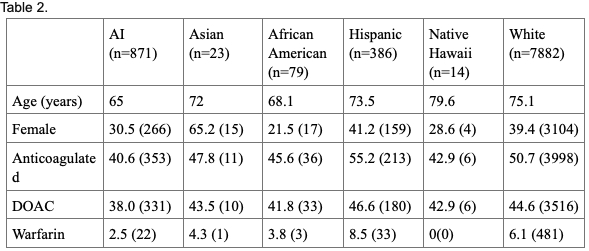
Results: In total, 9255 patients were admitted with AF: 871 (9.4%) were AI, with 696 (79.9%) being Navajo Nation AI and 8284 (89.5%) from other non-AI races. AI patients with AF were younger (average age 65±15.9 vs 75±11.2; p <0.0001), had fewer female patients (30.5% vs 39.3%; p <0.0001), and were less likely to be treated with oral anticoagulation (40.5% vs 50.9%; p <0.0001; OR 0.66; 95% CI: 0.57 to 0.76) compared to non-AI races (table 1). Among those anticoagulated, AI patients were less likely to receive a DOAC (38.0% vs 44.7%; p = 0.0002; OR 0.76; 95% CI: 0.66 to 0.88) compared to non-AI races (table 2).
Conclusions: Our analysis, with a significant number of AI pts, reveal that AI patients develop AF at a younger age and despite an increased risk of stroke, have significantly lower rates of anticoagulation use, particularly with DOACs. Our findings underscore the need for guideline-adherent AC use in this AI population.
Vargas, Juan
( Northern Arizona Healthcare
, Cottonwood
, Arizona
, United States
)
Nagarakanti, Rangadham
( Northern Arizona Health
, Sedona
, New Jersey
, United States
)
Deora, Kunal
( Midwestern University GME
, Cottonwood
, Arizona
, United States
)
Yadav, Ritu
( Midwestern University GME
, Cottonwood
, Arizona
, United States
)
Ashurst, John
( Midwestern University GME
, Cottonwood
, Arizona
, United States
)
Forbeck, Taylor
( Midwestern University GME
, Cottonwood
, Arizona
, United States
)
Lowis, Jaron
( Midwestern University GME
, Cottonwood
, Arizona
, United States
)
Jha, Neha
( Midwestern University GME
, Cottonwood
, Arizona
, United States
)
Peloquin, Sarah
( Midwestern University GME
, Cottonwood
, Arizona
, United States
)
Ashraf, Hammad
( Midwestern University GME
, Cottonwood
, Arizona
, United States
)
Author Disclosures:
Juan Vargas:DO NOT have relevant financial relationships
| Rangadham Nagarakanti:DO NOT have relevant financial relationships
| Kunal Deora:No Answer
| ritu yadav:No Answer
| John Ashurst:No Answer
| Taylor Forbeck:DO NOT have relevant financial relationships
| Jaron Lowis:No Answer
| Neha Jha:DO NOT have relevant financial relationships
| Sarah Peloquin:DO NOT have relevant financial relationships
| Hammad Ashraf:No Answer