Gender Variations in Atrial Fibrillation Incidence Among the American Indian Population in Northern Arizona
Abstract Body (Do not enter title and authors here): Introduction: Atrial fibrillation (AF) is the most common cardiac arrhythmia, with gender disparities in age, comorbidities and anticoagulation (AC) therapy. These differences in American Indians (AI) with AF remain underexplored. We aim to evaluate gender differences in demographics, comorbidities, AC status and direct-oral anticoagulant (DOAC) use among AI patients with AF in rural Northern Arizona.
Methods: We performed a retrospective analysis of AI patients aged >18 years with AF between January 2022 and October 2023 from a health system with two hospitals in northern arizona.We collected demographic variables, comorbidities, AC status, and calculated CHADS-VASc and HAS-BLED scores. Statistical analysis was conducted using chi-square tests for categorical variables and Mann-Whitney U tests for continuous variables, with statistical significance defined as a p-value ≤ 0.05.
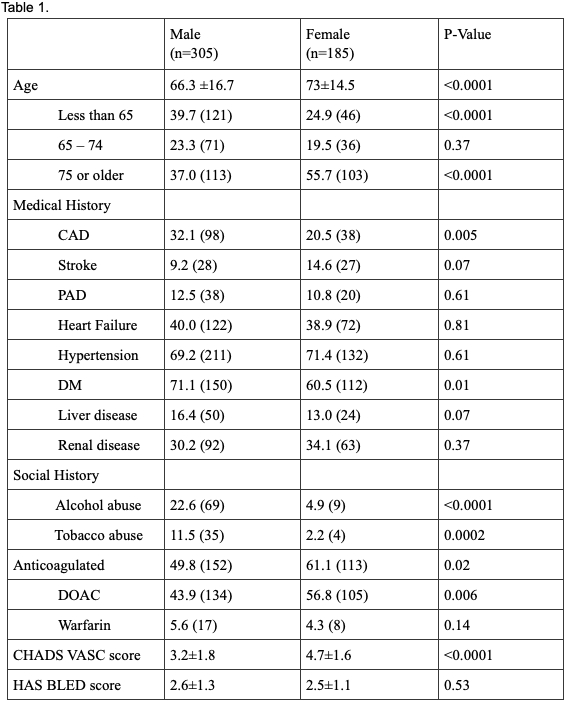
Results: We identified 490 AI patients with AF, 185 (37.8%) were female, and 305 (62.2%) were male. The mean age was 68.8±16.2 years, with females being older on average compared to males (73±14.5 years vs. 66±16.7 years; p < 0.0001) (Table 1). Hypertension was the most common comorbidity, in 70% (343) of patients. Significant gender differences were observed in Coronary artery disease (CAD) (32.1% males vs. 20.5% females, p = 0.005), diabetes mellitus (71.1% males vs. 60.5% females, p = 0.01), alcohol use (22.6% males vs. 4.9% females, p < 0.0001), and tobacco abuse (11.5% males vs. 2.2% females, p = 0.0002). AC use were higher in females (61.1% vs. 49.8% in males, p = 0.02). DOAC use was more prevalent among females (56.8% vs. 43.9% in males, p = 0.006). The mean CHADS-VASc score was higher in females (4.7±1.6 vs. 3.2±1.8 in males, p < 0.0001), whereas HAS-BLED scores did not differ significantly between genders (2.5±1.1 in females vs. 2.6±1.3 in males, p = 0.53)
Conclusions: Our study found significant gender differences in this population of AI patients with AF. Females were older, had higher CHAD-VASC scores, and more likely to be anticoagulated with DOACs compared to males. These findings highlight the need for gender-specific strategies to optimize AC in this population. Further research is warranted to explore the underlying reasons for these differences and develop targeted interventions.
Vargas, Juan
(
Northern Arizona Healthcare
, Cottonwood , Arizona , United States )
Deora, Kunal
(
Midwestern University GME
, Cottonwood , Arizona , United States )
Yadav, Ritu
(
Midwestern University GME
, Cottonwood , Arizona , United States )
Ashraf, Hammad
(
Midwestern University GME
, Cottonwood , Arizona , United States )
Forbeck, Taylor
(
Midwestern University GME
, Cottonwood , Arizona , United States )
Lowis, Jaron
(
Midwestern University GME
, Cottonwood , Arizona , United States )
Jha, Neha
(
Midwestern University GME
, Cottonwood , Arizona , United States )
Ashurst, John
(
Midwestern University GME
, Cottonwood , Arizona , United States )
Nagarakanti, Rangadham
(
Northern Arizona Health
, Sedona , New Jersey , United States )
Author Disclosures:
Juan Vargas:DO NOT have relevant financial relationships
| Kunal Deora:No Answer
| ritu yadav:No Answer
| Hammad Ashraf:No Answer
| Taylor Forbeck:DO NOT have relevant financial relationships
| Jaron Lowis:No Answer
| Neha Jha:DO NOT have relevant financial relationships
| John Ashurst:No Answer
| Rangadham Nagarakanti:DO NOT have relevant financial relationships