Logo

American Heart Association

  113
  0


Final ID: Mo4099

Coronary Artery Air Embolism During Left Heart Catheterization: A Rare Yet Potentially Fatal Complication

Abstract Body (Do not enter title and authors here): Coronary artery air embolism is a rare yet potentially fatal complication of interventional cardiac procedures, presenting from asymptomatic to cardiac arrest. There are no established guidelines for its management, and the focus is on primary prevention. Here, we present a case of iatrogenic coronary artery air embolism during an elective left heart catheterization (LHC).
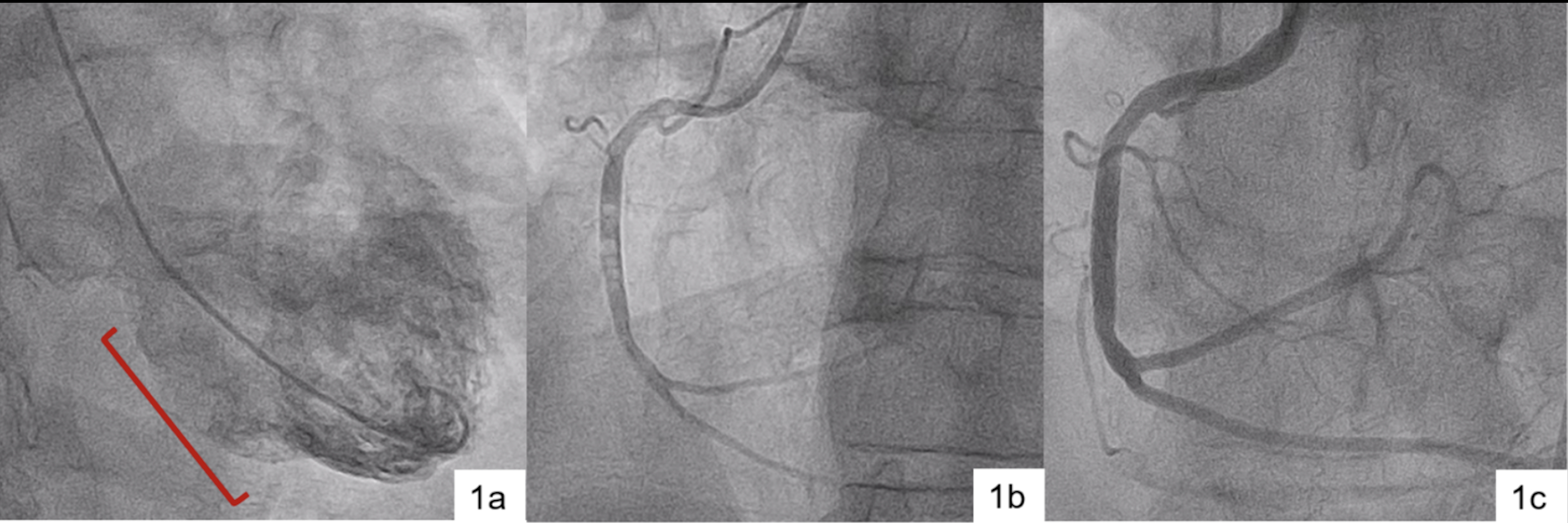
A 61-year-old male with mitral valve prolapse underwent preoperative LHC which showed a stenotic left anterior descending artery and normal right coronary artery (RCA). On the following left ventriculogram, significant inferior wall hypokinesis was observed, and the patient developed acute chest pain, ST elevations, and complete heart block (Figure 1a). Suspecting new RCA pathology, reevaluation revealed multiple air emboli and Thrombolysis In Myocardial Infarction (TIMI) grade 1 flow (Figure 1b). The RCA was flushed multiple times with heparinized saline, resolving the air emboli and restoring TIMI grade 3 flow (Figure 1c). At the procedure's end, the patient was pain-free and in sinus rhythm. A repeat transthoracic echocardiogram showed normal ventricular function without regional wall motion abnormalities. The patient was discharged without further complications.
Coronary air embolism can occur iatrogenically and is inversely correlated with operator experience. Prevention through proper technique is crucial: catheters should be adequately aspirated, all connections tightened, and the catheter should be tested distal to the aortic cusp to prevent emboli occurrence. Although there are no established guidelines, management includes administering 100% oxygen, intracoronary saline boluses, or breaking down emboli with a guidewire.
In our case, the sudden onset hypokinesis of the inferior wall with complete heart block in a confirmed normal RCA raised suspicion for new RCA pathology. Immediate heparinized saline allowed for air emboli dissociation as a more immediate intervention than 100% oxygen and did not involve intravascular manipulation which could result in dissection. Our case highlights the importance of early detection of rapidly changing pathology and stresses meticulous technique for testing equipment as a prevention method.
  • Siddiqui, Arsalan  ( University of Nevada, Las Vegas , Las Vegas , Nevada , United States )
  • Yee, Brianna  ( University of Nevada, Las Vegas , Las Vegas , Nevada , United States )
  • Dicaro, Michael  ( University of Nevada, Las Vegas , Las Vegas , Nevada , United States )
  • Lee, Ki  ( University of Nevada, Las Vegas , Las Vegas , Nevada , United States )
  • Lei, Kachon  ( University of Nevada, Las Vegas , Las Vegas , Nevada , United States )
  • Ahsan, Chowdhury  ( University of Nevada, Las Vegas , Las Vegas , Nevada , United States )
  • Author Disclosures:
    Arsalan Siddiqui: DO NOT have relevant financial relationships | Brianna Yee: DO NOT have relevant financial relationships | Michael DiCaro: DO NOT have relevant financial relationships | Ki Lee: DO NOT have relevant financial relationships | KaChon Lei: DO NOT have relevant financial relationships | Chowdhury Ahsan: No Answer
Meeting Info:

Scientific Sessions 2024

2024

Chicago, Illinois

Session Info:

Complications of Coronary and Structural Intervention

Monday, 11/18/2024 , 01:30PM - 02:30PM

Abstract Poster Session

More abstracts on this topic:
Artificial Intelligence for Predicting Primary Antegrade Wiring Success of Chronic Total Occlusion Crossing

Alexandrou Michaella, Alaswad Khaldoon, Basir Mir, Davies Rhian, Jaffer Farouc, Nicholson William, Azzalini Lorenzo, Gorgulu Sevket, Khatri Jaikirshan, Bangalore Sripal, Rangan Bavana, Rempakos Athanasios, Mastrodemos Olga, Burke M Nicholas, Sandoval Yader, Brilakis Emmanouil, Mutlu Deniz, Strepkos Dimitrios, Carvalho Pedro, Al-ogaili Ahmed, Bahbah Ali, Anastasios Milkas, Tsiafoutis Ioannis

A Machine Learning Approach to Predict Percutaneous Coronary Intervention in Patients with Critical Illness and Signs of Myocardial Injury

Mueller Joshua, Stepanova Daria, Chidambaram Vignesh, Nakarmi Ukash, Al'aref Subhi

More abstracts from these authors:
The “Buddy-Wire” Technique: Navigating Complex Anatomy to Guide Placement of an RP Impella

Lei Kachon, Dicaro Michael, Tasouli-drakou Vasiliki, Yee Brianna, Hawwass Dalia, Ahsan Chowdhury

A Diagnostic Challenge: Wild-Type Transthyretin Cardiac Amyloidosis in a Patient With Systemic Lupus and Ischemic Cardiomyopathy

Abdallah Ala, Khalid Arbab, Dicaro Michael, Lei Kachon, Ahsan Chowdhury

You have to be authorized to contact abstract author. Please, Login
Not Available