Logo

American Heart Association

  121
  0


Final ID: 4138955

Artificial intelligence-guided screening of rheumatic heart disease from single-view two-dimensional echocardiography

Abstract Body (Do not enter title and authors here): Introduction: Rheumatic heart disease (RHD) is the most common acquired heart disorder in children and adolescents worldwide. We developed and validated an automated artificial intelligence (AI)-guided RHD screening algorithm adapted for point-of-care ultrasonography (POCUS) in school-aged children.

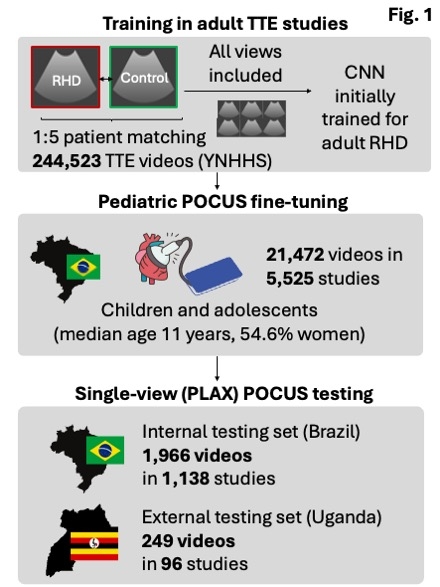
Methods: We employed a cross-domain transfer learning approach, in which a 3D convolutional neural network (CNN) was first trained to detect structural RHD deformation of the mitral or aortic valves in 244,523 videos, representing all views from 5,614 adult transthoracic echocardiograms (1:5 age and sex-matched cases and controls; median age 69 [58-80] years, 76.4% female) in a large US health system. The model was fine-tuned for stage ≥B (“definite”) RHD in 21,472 POCUS videos (2D parasternal and apical acquisitions) from 5,525 studies (75% training, 25% validation) in a pediatric screening program (median age 11 [IQR 10-13] years, 54.6% female) in Brazilian low-income schools. Testing was performed in a held-out set of 1,966 parasternal long-axis (PLAX) videos from 1,138 studies in Brazil (14 [1.2%] with stage ≥B RHD) as well as in an external pediatric screening set in Uganda consisting of 249 videos from 96 studies (34 [35.4%] with stage ≥B RHD) (Fig. 1).

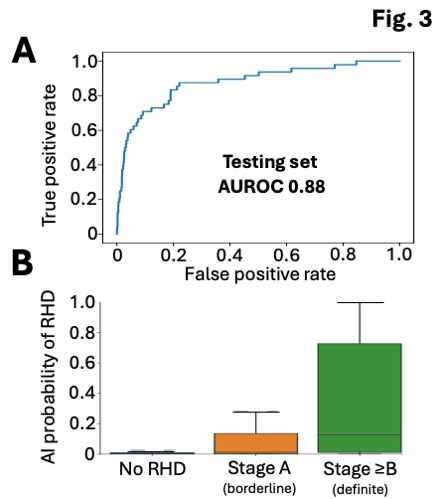
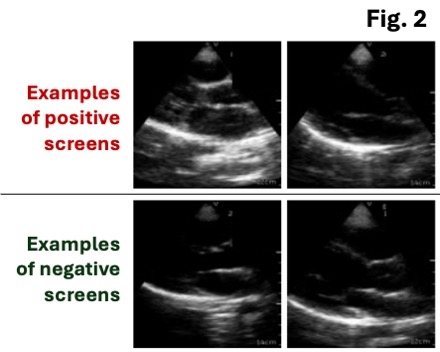
Results: Our model (Fig. 2) achieved a study-level AUROC (area under the receiver operating characteristic curve) of 0.88 across the held-out/external testing sets for identifying stage ≥B RHD from cardiac POCUS (Fig. 3A). On a video-level the model learned a continuous spectrum of phenotypes on PLAX acquisitions spanning stage ≥B (“definite”) and stage A (“borderline”) cases, ranging from a median video-level AI probability of 0.13 [0.01-0.73] for stage ≥B to 0.00 [0.00-0.01] for non-RHD POCUS (Fig. 3B). At the threshold that maximized Youden’s J in the held-out Brazil set, our algorithm’s performance in the set from Uganda showed 97% recall (sensitivity), a positive predictive value (precision) of 46%, and a negative predictive value of 95%.

Conclusions: A transfer learning approach that employs multi-view learning achieves excellent performance for RHD on single-view two-dimensional cardiac POCUS without Doppler. Our study suggests a scalable approach to AI-enabled RHD detection with images that can be acquired by individuals with modest training.
  • Oikonomou, Evangelos  ( Yale School of Medicine , New Haven , Connecticut , United States )
  • Nascimento, Bruno  ( Universidade Federal de Minas Gerais , Belo Horizonte , Brazil )
  • Pedroso, Aline  ( Yale School of Medicine , New Haven , Connecticut , United States )
  • Lombo, Bernardo  ( Yale School of Medicine , New Haven , Connecticut , United States )
  • Mcnamara, Robert  ( Yale University , New Haven , Connecticut , United States )
  • Karnik, Ruchika  ( Yale School of Medicine , New Haven , Connecticut , United States )
  • Sable, Craig  ( Children's National Health System , Washington , District of Columbia , United States )
  • Ribeiro, Antonio  ( Universidade Federal de Minas Gerais , Belo Horizonte , Brazil )
  • Khera, Rohan  ( Yale School of Medicine , New Haven , Connecticut , United States )
  • Author Disclosures:
    Evangelos Oikonomou: DO have relevant financial relationships ; Ownership Interest:Evidence2Health, LLC:Active (exists now) ; Consultant:Caristo Diagnostics Ltd:Past (completed) ; Royalties/Patent Beneficiary:University of Oxford:Past (completed) ; Consultant:Ensight-AI, Inc:Active (exists now) | Bruno Nascimento: DO NOT have relevant financial relationships | Aline Pedroso: DO NOT have relevant financial relationships | Bernardo Lombo: No Answer | Robert McNamara: DO NOT have relevant financial relationships | Ruchika Karnik: No Answer | Craig Sable: DO NOT have relevant financial relationships | Antonio Ribeiro: DO NOT have relevant financial relationships | Rohan Khera: DO have relevant financial relationships ; Research Funding (PI or named investigator):Bristol-Myers Squibb:Active (exists now) ; Ownership Interest:Ensight-AI, Inc:Active (exists now) ; Ownership Interest:Evidence2Health LLC:Active (exists now) ; Research Funding (PI or named investigator):BridgeBio:Active (exists now) ; Research Funding (PI or named investigator):Novo Nordisk:Active (exists now)
Meeting Info:

Scientific Sessions 2024

2024

Chicago, Illinois

Session Info:

Beyond Stethoscopes: AI’s Impact on Cardiovascular Screening

Saturday, 11/16/2024 , 03:15PM - 04:30PM

Abstract Oral Session

More abstracts from these authors:
Fully Automated Detection of Structural Heart Disease from Apple Watch ECGs Using a Noise-Adapted AI Algorithm: The WATCH-SHD Study

Aminorroaya Arya, Pedroso Aline, Khera Rohan, Vasisht Shankar Sumukh, Khan Mariam, Carter Madeleine, Dhingra Lovedeep, Khunte Akshay, Lombo Bernardo, Mcnamara Robert, Oikonomou Evangelos

Leveraging Noise-adapted Deep Learning Algorithm to Detect Structural Heart Disease from 1-lead ECGs Acquired with KardiaMobile 6L Device: The ACCESS-SHD Study

Aminorroaya Arya, Pedroso Aline, Khera Rohan, Vasisht Shankar Sumukh, Carter Madeleine, Khan Mariam, Dhingra Lovedeep, Khunte Akshay, Lombo Bernardo, Mcnamara Robert, Oikonomou Evangelos
You have to be authorized to contact abstract author. Please, Login
Not Available