Non-invasive, Automated Approach to Estimate Septal Curvature as a Surrogate of Mean Pulmonary Arterial Pressure for Pediatric Pulmonary Hypertension Patients
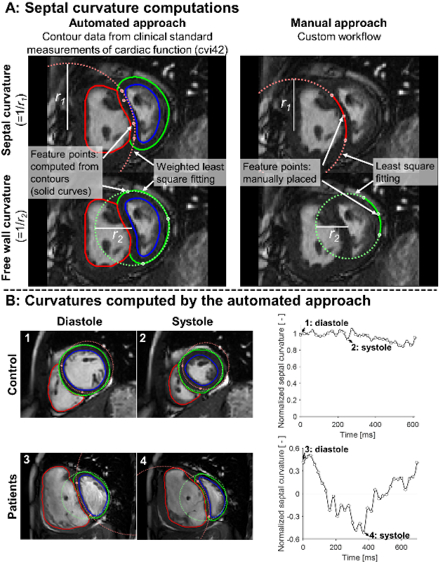
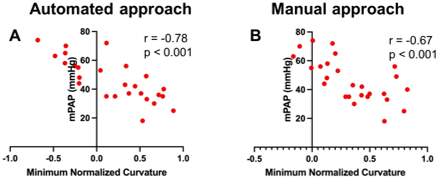
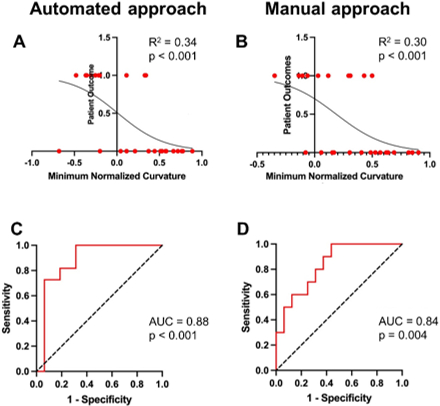
Abstract Body (Do not enter title and authors here): Background Pediatric pulmonary hypertension (PH) is diagnosed and monitored using echocardiography and right heart catheterization. Recently, non-invasive measurements using cardiac MRI have also been investigated for patient monitoring. A promising measurement is MRI-based septal curvature, which has excellent correlation with mean pulmonary arterial pressure (mPAP). However, this approach requires significant manual interaction and is subject to observer-dependent measurement variability. Hypothesis Automated septal curvature computation can predict mPAP and is less observer-dependent than the manual approach. Aims To develop an automated approach to measure septal curvature and compare its performance with a manual approach in pediatric PH patients. Methods Pediatric PH patients (mPAP≥25mmHg) who had both a clinical cardiac MR exam and right heart catheterization were retrospectively enrolled. From the mid-slice of short-axis stack images for the ventricles, time-resolved contours for both ventricles were automatically generated with cvi42, and imported to a custom MATLAB tool to automatically compute normalized septal curvature (Fig.1). The minimum normalized curvature (a 7-point average around the minimum value in a cardiac cycle) was computed to investigate its association with mPAP and a composite outcome (death or referral for heart/lung transplant). The new and manual approaches were conducted by two observers to test interobserver agreement. Pearson correlation, univariable logistic regression, receiver-operating characteristic curve, area under the curve (AUC), and intraclass correlation coefficients (ICC) were conducted. P<0.05 was considered statistically significant. Results Twenty-seven patients (14.3±5.4 years; mPAP, 44 [35.5–57] mmHg) were enrolled. Minimum normalized curvature was correlated with mPAP (r=0.78, p<0.001; Fig.2A). Logistic regression found significant association between outcomes and minimum curvature (AUC, 0.88; 95% CI, 0.74–1.00; p<0.001; Fig.3AC). The proposed approach found excellent interobserver agreement (ICC, 0.98; 95% CI, 0.96-0.99) and was similar or superior to the manual one in all performance metrics (manual: correlation with mPAP: r=0.67, p<0.001; AUC: 0.84, 95% CI, 0.69–0.99, p=0.004; ICC: 0.89, 95% CI, 0.81-0.94; Figs.2B,3BD). Conclusion The proposed automated approach to compute septal curvature is less observer dependent than the manual approach and could be a robust tool to follow up pediatric PH patients.
Fujiwara, Takashi
(
Children's Hospital Colorado, University of Colorado Anschutz Medical Campus
, Aurora , Colorado , United States )
Lu, Vivian
(
Children's Hospital Colorado, University of Colorado Anschutz Medical Campus
, Aurora , Colorado , United States )
Ivy, Dunbar
(
Children’s Hospital Colorado, University of Colorado Anschutz Medical Campus
, Aurora , Colorado , United States )
Fonseca, Brian
(
Children’s Hospital Colorado, University of Colorado Anschutz Medical Campus
, Aurora , Colorado , United States )
Malone, Ladonna
(
Children's Hospital Colorado, University of Colorado Anschutz Medical Campus
, Aurora , Colorado , United States )
Frank, Benjamin
(
Children’s Hospital Colorado, University of Colorado Anschutz Medical Campus
, Aurora , Colorado , United States )
Neves Da Silva, Helio
(
Children's Hospital Colorado, University of Colorado Anschutz Medical Campus
, Aurora , Colorado , United States )
Sassoon, Daniel
(
Children's Hospital Colorado, University of Colorado Anschutz Medical Campus
, Aurora , Colorado , United States )
Burkett, Dale
(
Children’s Hospital Colorado, University of Colorado Anschutz Medical Campus
, Aurora , Colorado , United States )
Browne, Lorna
(
Children's Hospital Colorado, University of Colorado Anschutz Medical Campus
, Aurora , Colorado , United States )
Barker, Alex
(
Children’s Hospital Colorado, University of Colorado Anschutz Medical Campus
, Aurora , Colorado , United States )
Author Disclosures:
Takashi Fujiwara:DO NOT have relevant financial relationships
| Lorna Browne:No Answer
| Alex Barker:No Answer
| Vivian Lu:No Answer
| Dunbar Ivy:DO have relevant financial relationships
;
Research Funding (PI or named investigator):Merck:Active (exists now)
; Consultant:Merck:Active (exists now)
; Research Funding (PI or named investigator):Janssen:Active (exists now)
| Brian Fonseca:DO NOT have relevant financial relationships
| LaDonna Malone:DO NOT have relevant financial relationships
| Benjamin Frank:No Answer
| Helio Neves da Silva:No Answer
| Daniel Sassoon:No Answer
| Dale Burkett:No Answer