The functional roles of TGF-beta signaling on cardiac lymphangiogenesis during myocardial ischemia
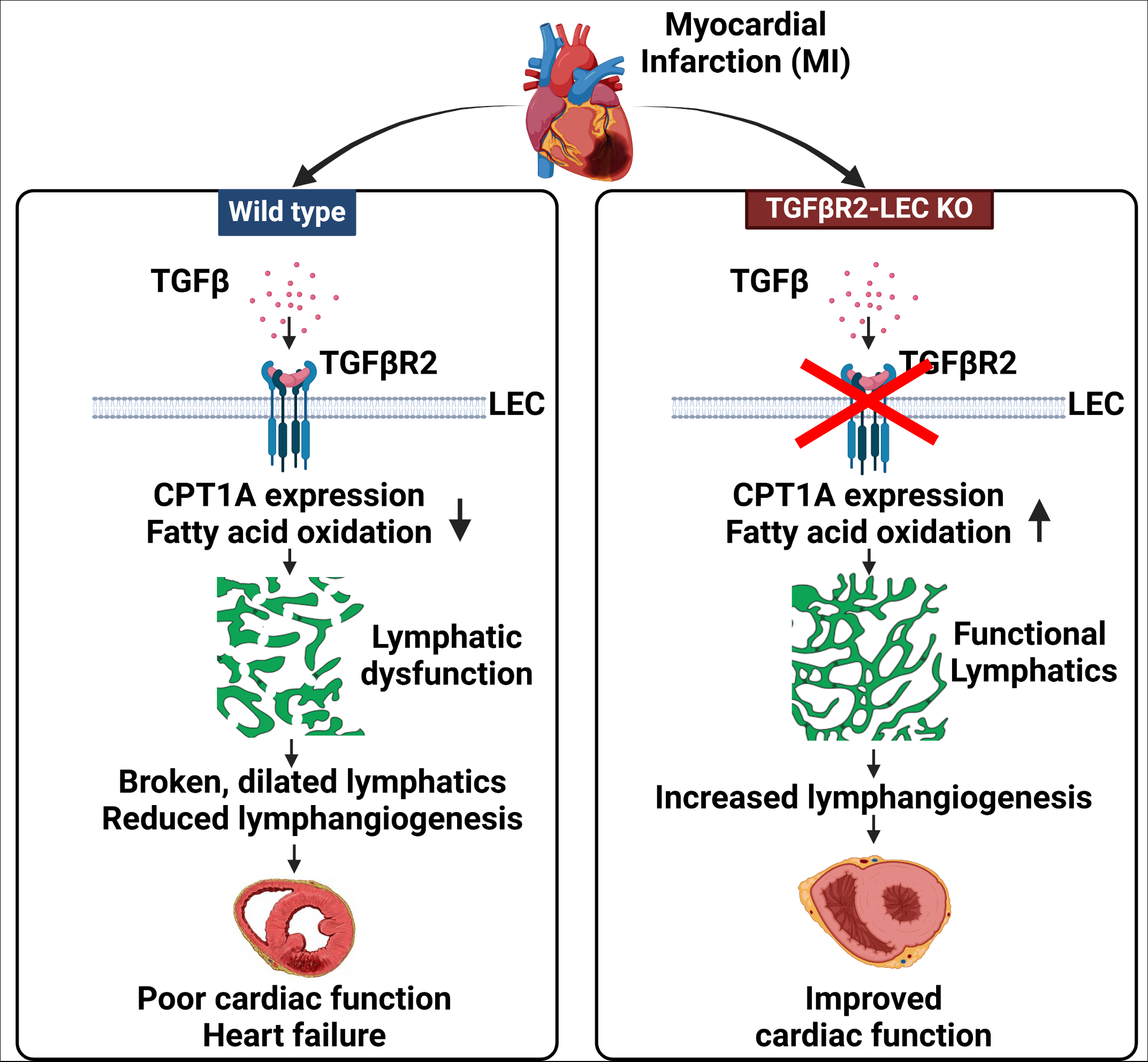
Abstract Body: Heart failure caused by myocardial infarction (MI) remains the leading cause of mortality worldwide. Recent studies show that lymphatic stimulation after MI improves cardiac function and structure. Intriguingly, post-MI cardiac lymphatics in rodent models or MI patients exhibit abnormal lymphatic structure and function. However, molecular and cellular mechanisms promoting lymphatic dysfunction after MI are unknown. Transforming growth factor beta (TGFβ), is a known player in driving cardiac fibrosis after MI. However, whether TGFβ signaling affects post-MI cardiac lymphatics is unknown. My preliminary data showed that lymphatic endothelial cell (LEC)-specific TGFβR2 deficient mice (TGFβR2ΔLEC/ΔLEC mice) exhibit improved post-MI cardiac function and structure, increased cardiac lymphangiogenesis, LEC proliferation, lymphatic junction integrity and macrophage clearance. Strongly suggesting TGFβ negatively regulates post-MI cardiac lymphangiogenesis and cardiac function. In vitro, TGFβ reduced LEC proliferation, migration, increased apoptosis, and disrupted cellular junctions. RNAseq analysis showed enriched metabolic pathways, specifically downregulating CPT1A and Fatty-Acid Oxidation (FAO). CPT1A-mediated FAO has previously been reported to be essential for developmental lymphangiogenesis. Interestingly, enhancing FAO rescued TGFβ mediated LEC activities in vitro, suggesting TGFβ negatively regulates LEC activities by downregulating CPT1A-mediated FAO in LECs. To further validate this mechanism in vivo, one allele of CPT1A was deleted in TGFβR2ΔLEC/ΔLEC mice (TGFβR2ΔLEC/ΔLEC, CPT1AΔLEC/+). Following MI, TGFβR2ΔLEC/ΔLEC, CPT1AΔLEC/+ mice exhibited reduced cardiac lymphangiogenesis, LEC proliferation, lymphatic junction integrity, and increased macrophage accumulation and cardiac dysfunction. These data suggest that mechanistically, TGFβ signaling modulates CPT1A-mediated FAO metabolism in LECs to impede lymphangiogenesis and promote cardiac dysfunction following MI. Inhibition of TGFβ signaling in LECs may provide a novel therapeutic strategy to improve lymphatic vascular integrity and lymphangiogenesis, thereby improving cardiac function following MI.
Delgado, Esteban
(
Temple University
, Philadelphia , Pennsylvania , United States )
Do, Long
(
Temple University
, Philadelphia , Pennsylvania , United States )
Pang, Jingjing
(
Temple University
, Philadelphia , Pennsylvania , United States )
Megill, Emily
(
Temple University
, Philadelphia , Pennsylvania , United States )
Gao, Erhe
(
Lewis Katz Sch of Med at Temple Uni
, Philadelphia , Pennsylvania , United States )
Snyder, Nathaniel
(
Temple University
, Philadelphia , Pennsylvania , United States )
Liu, Xiaolei
(
Temple University
, Philadelphia , Pennsylvania , United States )
Author Disclosures:
Esteban Delgado:DO NOT have relevant financial relationships
| Long Do:No Answer
| Jingjing Pang:DO NOT have relevant financial relationships
| Emily Megill:No Answer
| Erhe Gao:DO NOT have relevant financial relationships
| Nathaniel Snyder:No Answer
| Xiaolei Liu:DO NOT have relevant financial relationships