Defective Lymphatic Drainage and Junctional Disorganization Impair Cardiac Injury Resolution After Myocardial Infarction
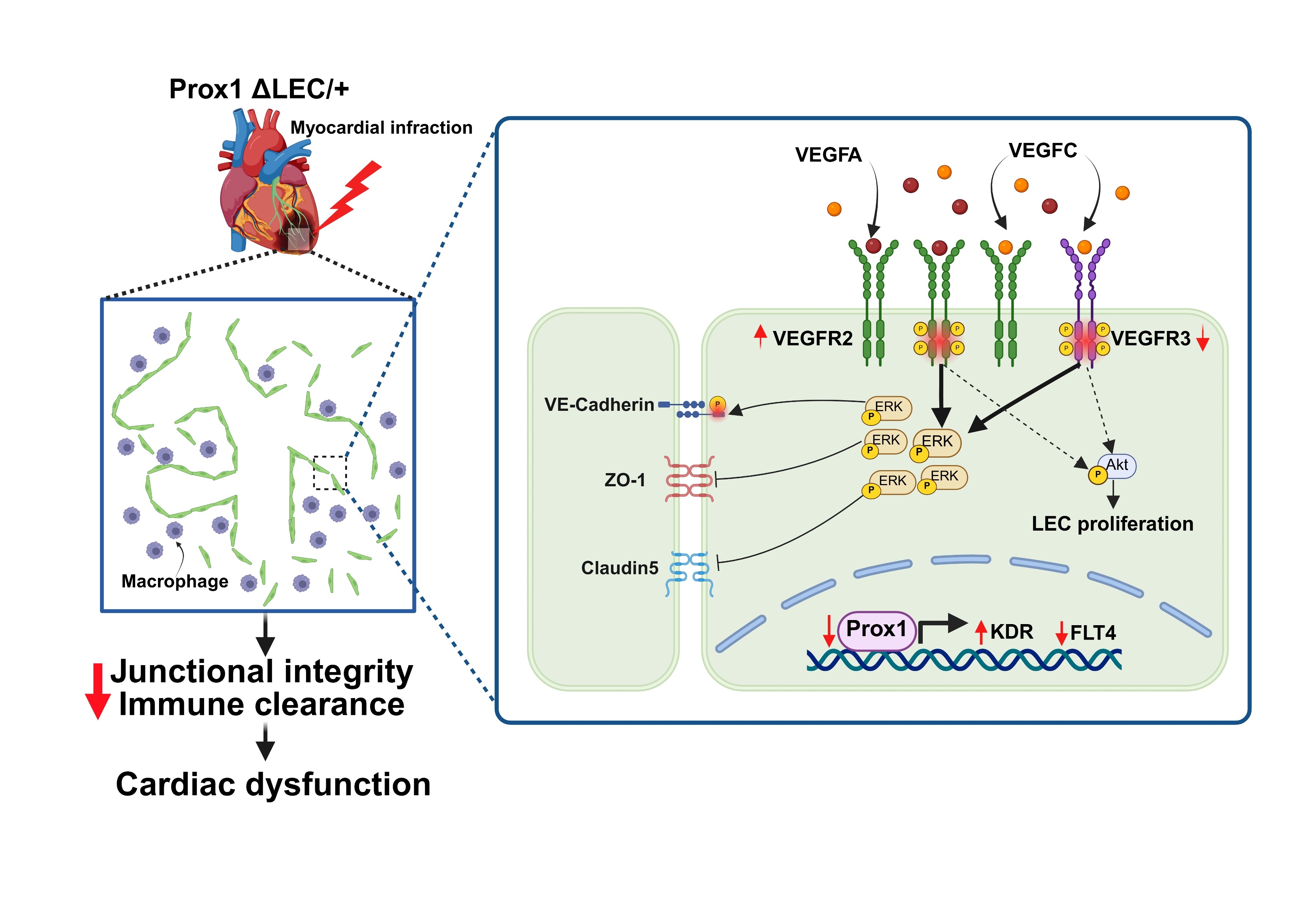
Abstract Body: Introduction: Cardiac lymphatic vessels play a critical role in immune cell clearance, interstitial fluid balance, and tissue repair following myocardial infarction (MI). Despite extensive evidence that promoting lymphangiogenesis improves cardiac outcomes after MI, whether lymphatic dysfunction itself contributes causally to adverse cardiac remodeling has remained unresolved. Furthermore, the molecular mechanisms connecting impaired lymphatic junctional integrity to impaired injury resolution after MI remain poorly defined. Hypothesis: Lymphatic endothelial dysfunction drives impaired cardiac repair after MI. Methods: To determine how impaired lymphatic function influences cardiac repair, we generated a tamoxifen-inducible, lymphatic-specific Prox1 haploinsufficiency mouse. We performed MI in these mice and characterized cardiac lymphatic vessel density, morphology, structure, immune cell infiltration and cardiac function and fibrosis changes after MI. In vitro, human primary lymphatic endothelial cells (LECs) were used to evaluate junctional organization, VEGF receptors’ signaling, and ERK activationthrough siRNA-mediated PROX1 silencing. Results and Conclusions: Using a Lymphatic-specific Prox1 conditional heterozygous mouse line, which exhibits defective lymphatic drainage but retains normal baseline cardiac function, we demonstrated that lymphatic dysfunction significantly exacerbated post-MI inflammation, macrophage accumulation, fibrosis, and systolic dysfunction. Mechanistically, we showed that Prox1 maintains lymphatic endothelial junction integrity by balancing VEGFR2 and VEGFR3 expression, thereby preventing VEGFR2-driven ERK hyperactivation and preserving tight junction proteins such as ZO-1 and Claudin5. Loss of Prox1 disrupted this balance, resulting in severe lymphatic junctional defects, impaired immune clearance, and worsened cardiac remodeling. Importantly, ERK inhibition in vitro and VEGFR2 blockade in vivo successfully rescued lymphatic junction integrity and reduced inflammatory cell accumulation, providing the therapeutic potential of restoring VEGF receptor signaling balance in ischemic heart disease. Our study identified a previously unrecognized mechanism by which lymphatic endothelial dysfunction drives impaired cardiac repair after MI and revealed a Prox1-dependent regulation of VEGFR2/VEGFR3/ERK signaling as a key determinant of lymphatic junction stability and post-MI inflammatory resolution.
Do, Long
(
Temple University
, Philadelphia , Pennsylvania , United States )
Pang, Jingjing
(
Temple University
, Philadelphia , Pennsylvania , United States )
Delgado, Esteban
(
Temple University
, Philadelphia , Pennsylvania , United States )
Yang, Xiao-feng
(
Temple University
, Philadelphia , Pennsylvania , United States )
Liu, Xiaolei
(
Temple University
, Philadelphia , Pennsylvania , United States )
Author Disclosures:
Long Do:No Answer
| Jingjing Pang:DO NOT have relevant financial relationships
| Esteban Delgado:DO NOT have relevant financial relationships
| Xiao-feng Yang:No Answer
| Xiaolei Liu:DO NOT have relevant financial relationships