Ultra-short Echo Time Magnetic Resonance Imaging Staging Predicts Endovascular Immediate Technical Failure, Crossing Time and Case Complexity
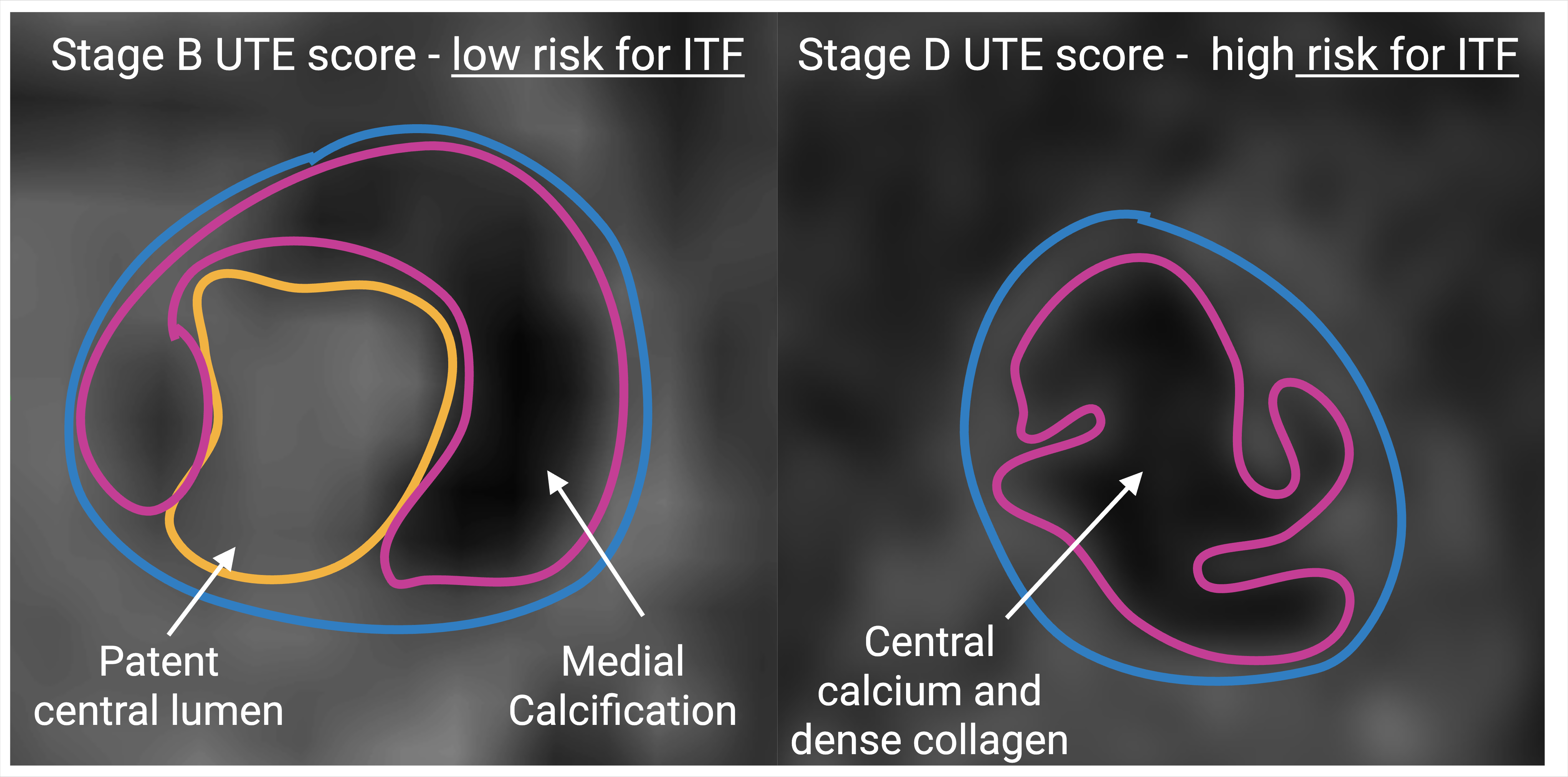
Abstract Body: Introduction Our understanding of plaque morphology and its relationship with immediate technical failure (ITF) in percutaneous vascular intervention (PVI) is poorly understood. Ultrashort echo time (UTE) MRI is a non-contrast MRI technique that can differentiate plaque morphology types. The aim of this study was to evaluate a UTE-defined plaque morphology based staging system and its relationship with ITF and procedural complexity. Methods In this prospective study, patients attending an academic vascular center with CLTI undergoing PVI were included and underwent pre procedural UTE MRI. Lesions were graded based on MRI-defined anatomical characteristics (Stage A=0 points, Stage B=1, Stage C=2, Stage D=3). Lesions were scored based on composition soft (thrombus/cholesterol/lipid plaque)-0 points or hard (calcific/collagenous plaque) – 1 point. In hard lesions morphology was then further defined using MRI as either concentric (0 points), eccentric (1point) or central (2 points). The primary outcome was the association of UTE Stage with ITF and was evaluated using logistic regression. Secondary outcomes included associations between UTE Stage and number of wire/catheter escalations required during the procedure, and UTE Stage and number of treatment devices used. Results 47 patients with 90 arterial lesions were included (68.9% tibial, 23.3% popliteal, 7.8% distal SFA). 44.4% of lesions were defined as >Stage A and 56.6% were Stage A. >Stage A lesions were significantly more likely to result in ITF compared to Stage A lesions (32.5% vs 2%, p<0.001) and of those that were crossable, had significantly higher crossing times (230 seconds vs 56 seconds, p=0.011). Logistic Regression significantly predicted ITF, with Stage D and stage C disease strongly associated with ITF (OR 114.3, 95% CF 10.4-1257.5, p<0.001 and OR 21.0 95% CF 2.33-189.3, p=0.007 respectively). Spearmans Rank correlation between UTE defined stage and number of treatment devices used was not significant (r=0.08, p=0.59), whereas UTE stage showed a significant correlation with number of wire/catheter escalations required for crossing (r=0.42, p<0.001). Logistic regression showed that those with Stage D disease was inversely associated with the probability of not requiring wire/catheter escalation (OR 0.01, p=0.004, 95% CF 0.00-0.24). Conclusion UTE-MRI defined staging is strongly associated with ITF and case complexity. This imaging technique could significantly support treatment planning.
Crichton, Alexander
(
Houston Methodist DeBakey Vascular
, Houston , Texas , United States )
Pomozi, Eniko
(
Houston Methodist Hospital
, Houston , Texas , United States )
Csore, Judit
(
Semmelweis University
, Budapest , Hungary )
Lamichhane, Janak
(
Houston Methodist DeBakey Vascular
, Houston , Texas , United States )
Karmonik, Christof
(
Houston Methodist Hospital
, Houston , Texas , United States )
Lumsden, Alan
(
Houston Methodist DeBakey Vascular
, Houston , Texas , United States )
Roy, Trisha
(
Houston Methodist DeBakey Vascular
, Houston , Texas , United States )
Author Disclosures:
Alexander Crichton:DO NOT have relevant financial relationships
| Eniko Pomozi:DO NOT have relevant financial relationships
| Judit Csore:No Answer
| Janak Lamichhane:No Answer
| Christof Karmonik:DO NOT have relevant financial relationships
| Alan Lumsden:No Answer
| Trisha Roy:DO have relevant financial relationships
;
Research Funding (PI or named investigator):Boston Scientific:Active (exists now)
; Research Funding (PI or named investigator):Baylis Medical Technologies:Active (exists now)
; Advisor:Magellan Biomedical Inc.:Active (exists now)
; Research Funding (PI or named investigator):MicroVention:Active (exists now)
; Research Funding (PI or named investigator):Light Matter Interaction:Active (exists now)
; Research Funding (PI or named investigator):Abbott:Active (exists now)