
Logo

American Heart Association

  3
  0


Final ID: Fri119

Pathology-Validated 9.4-tesla Ultrashort Echo Time Magnetic Resonance Imaging Enables Histology-Like Classification of Peripheral Artery Disease Lesions

Abstract Body: Background: Peripheral artery disease (PAD) involves intertwined intimal, medial, and luminal pathology. Medial arterial calcification (MAC) and nodular deposits are strongly linked to treatment resistance and limb loss, yet conventional imaging lack the contrast and spatial resolution to distinguish these microstructures. Ultrashort echo time (UTE) MRI can visualize tissues with short relaxation time and may provide “histology-like” depiction of vascular composition. We developed an ex vivo 9.4 T UTE-MRI classification system for arterial lesions and rigorously validated it against gold-standard histology.
Hypothesis: Ultra high-resolution 9.4 T UTE-MRI, which sensitizes to short–transverse relaxation tissues, can provide histology-like depiction of plaque and calcium architecture and support reproducible grading of key peripheral lesion domains and can serve as a reliable base for developing an MRI-based classification system for PAD lesions.
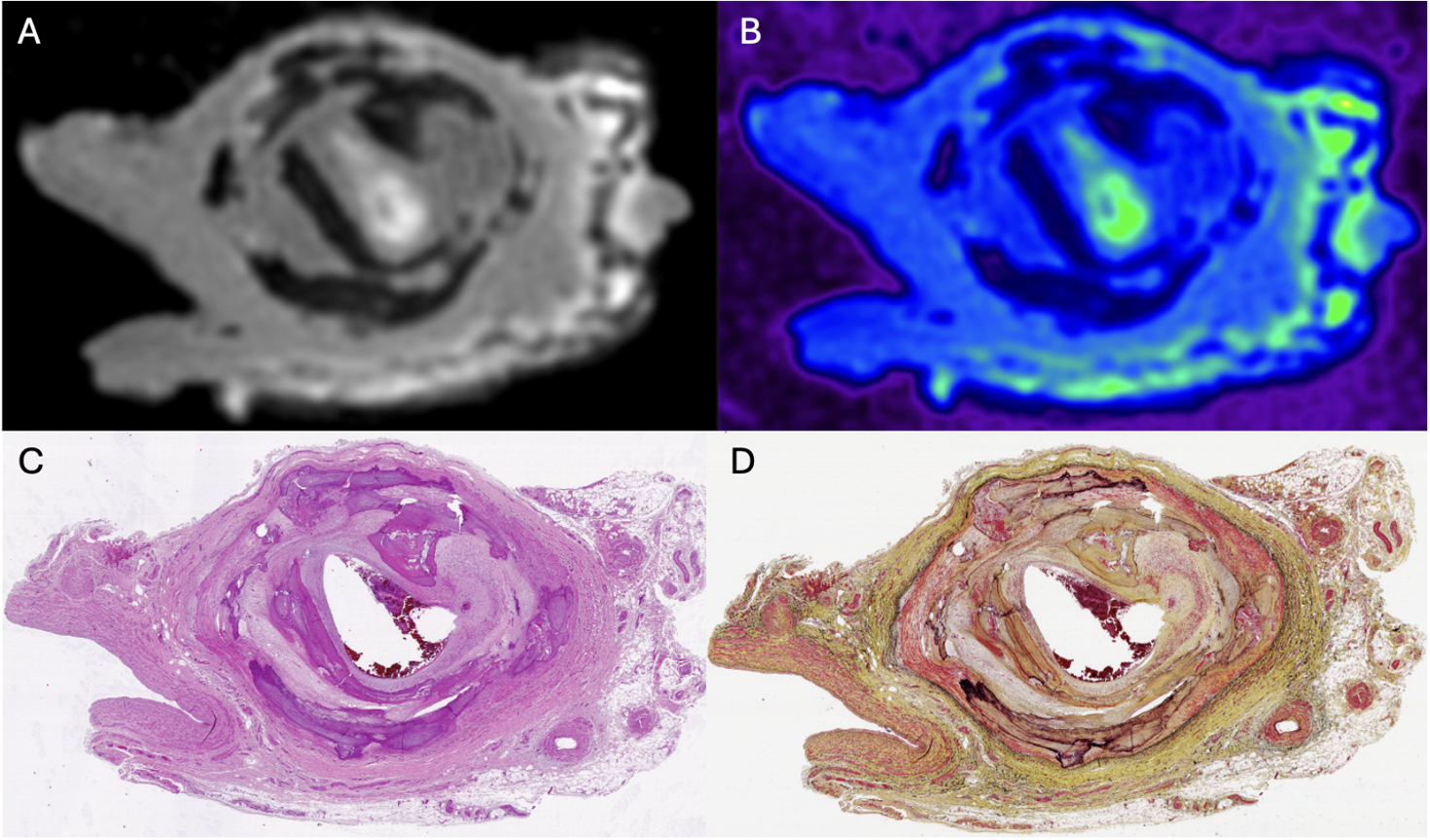
Methods: Popliteal and tibial arterial segments were harvested at amputation from 9 CLTI patients (15 sections), yielding 30 matched arterial cross-sections (Image1). Cross-sections were scored on UTE-MRI using an eight-domain questionnaire by two rater groups: a vascular scientist with MRI expertise and a cardiovascular pathologist-cardiologist team. MRI findings were then validated against matched histology. Observed inter-rater agreement (P0) was calculated for each domain.
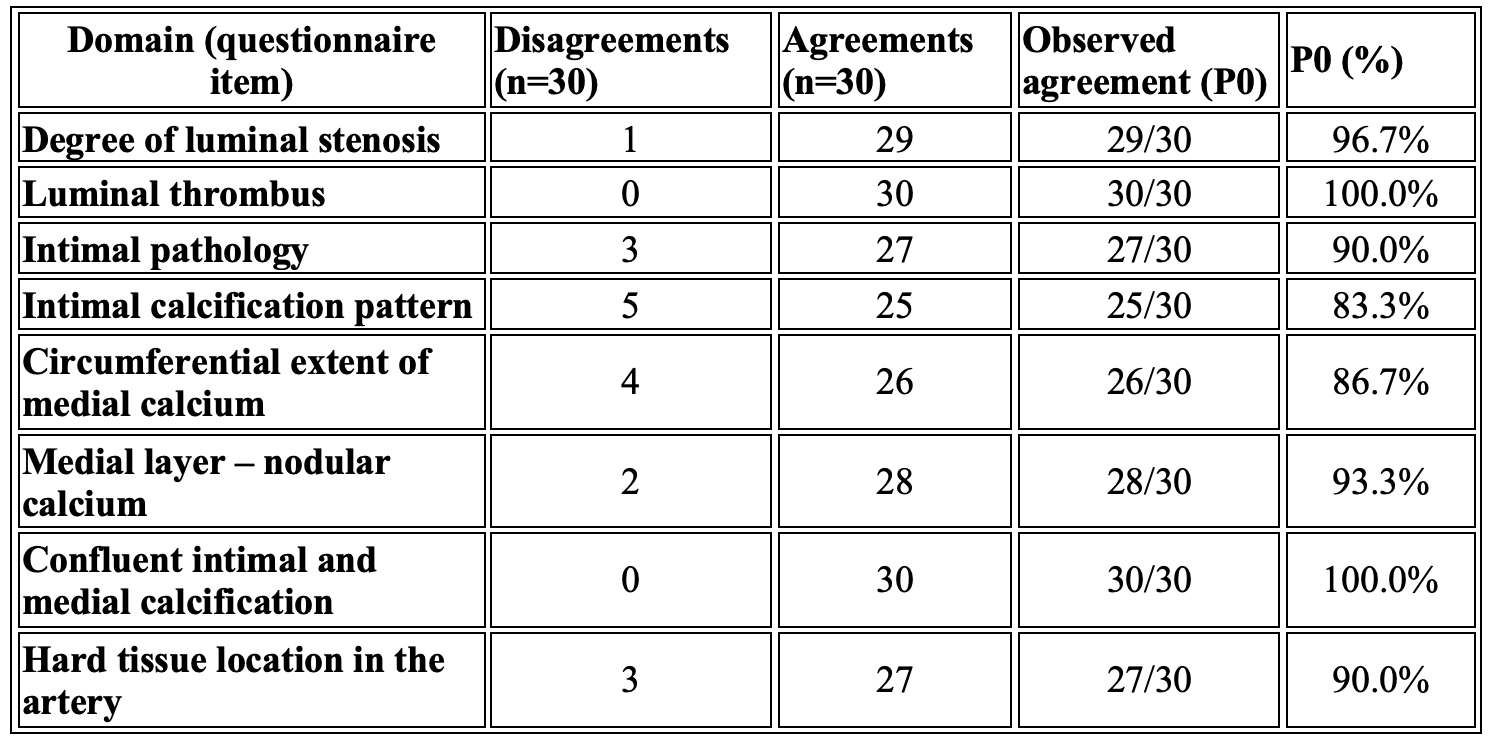
Results: Inter-rater agreement was high across domains: degree of luminal stenosis 29/30 (96.7%); luminal thrombus 30/30 (100%); intimal pathology 27/30 (90.0%); intimal calcification pattern 25/30 (83.3%); circumferential extent of medial calcium 26/30 (86.7%); medial layer nodular calcium 28/30 (93.3%); confluent intimal and medial calcification 30/30 (100%); and hard tissue location within the artery 27/30 (90.0%). Disagreements were uncommon (0–5 of 30 per domain) and were mainly attributable to borderline distinctions between micro/punctate versus fragmentary intimal calcium and estimation of medial circumferential coverage (Table1).
Conclusions: Ex vivo 9.4-tesla UTE-MRI provides histology-validated, microstructural phenotyping of peripheral lesions with excellent reproducibility across clinically relevant plaque and calcification domains. This nondestructive approach can enable standardized PAD lesion classification and informs future translation of UTE-based MRI biomarkers for lesion-specific intervention planning in CLTI.
  • Pomozi, Eniko  ( Houston Methodist Hospital , Houston , Texas , United States )
  • Crichton, Alexander  ( Houston Methodist DeBakey Vascular , Houston , Texas , United States )
  • Narula, Navneet  ( UTHealth Houston , Houston , Texas , United States )
  • Narula, Jagat  ( UTHealth Houston , Houston , Texas , United States )
  • Vela, Deborah  ( TEXAS HEART INSTITUTE , Houston , Texas , United States )
  • Karmonik, Christof  ( Houston Methodist Hospital , Houston , Texas , United States )
  • Roy, Trisha  ( HOUSTON METHODIST CARDIOVASCULAR , Houston , Texas , United States )
  • Author Disclosures:
    Eniko Pomozi: DO NOT have relevant financial relationships | Alexander Crichton: DO NOT have relevant financial relationships | Navneet Narula: DO NOT have relevant financial relationships | Jagat Narula: DO NOT have relevant financial relationships | Deborah Vela: No Answer | Christof Karmonik: DO NOT have relevant financial relationships | Trisha Roy: DO have relevant financial relationships ; Research Funding (PI or named investigator):Boston Scientific:Active (exists now) ; Research Funding (PI or named investigator):Baylis Medical Technologies:Active (exists now) ; Advisor:Magellan Biomedical Inc.:Active (exists now) ; Research Funding (PI or named investigator):MicroVention:Active (exists now) ; Research Funding (PI or named investigator):Light Matter Interaction:Active (exists now) ; Research Funding (PI or named investigator):Abbott:Active (exists now)
Meeting Info:
Session Info:

15. Poster Session 3 & Reception

Friday, 05/15/2026 , 05:00PM - 07:00PM

Poster

More abstracts on this topic:
A novel methodology for simultaneous analysis of electrical activation parameters and myocardial fibrosis in patients with LBBB and indications to cardiac resynchronization therapy

Rimskaya Elena, Chmelevsky Mikhail, Aparina Olga, Bazhutina Anastasia, Budanova Margarita, Khamzin Svyatoslav, Stukalova Olga, Ternovoy Sergey, Golitsyn Sergey

A Rare Manifestation of Drug-Induced Lupus: Hydralazine-Induced ANCA Vasculitis and Persistent Pericarditis

Saini Ishveen, Vo Phuong Uyen, Slabic Andrew, Varian Kenneth

More abstracts from these authors:
You have to be authorized to contact abstract author. Please, Login
Not Available