
Endothelial AGO1 Drives Vascular Inflammation, Hyperlipidemia, and Atherosclerosis via a Non-Canonical Nuclear Mechanism
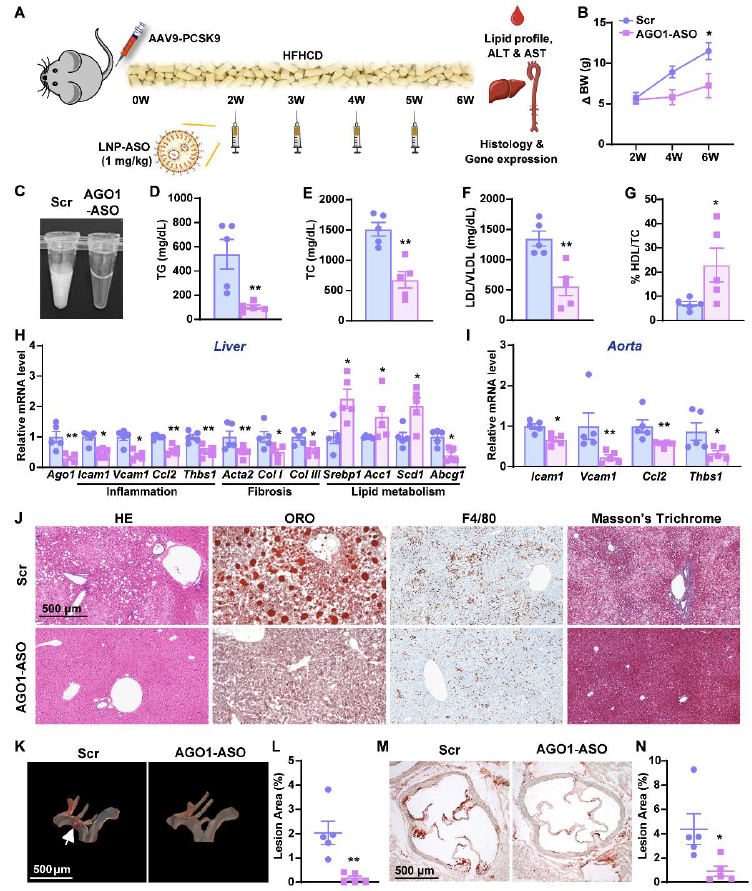
Abstract Body: Background Endothelial dysfunction is a central driver of vascular inflammation and cardiometabolic disease, yet the molecular mechanisms linking endothelial inflammation to systemic lipid dysregulation remain poorly defined. Argonaute 1 (AGO1) is classically recognized for its role in RNA interference; however, its non-canonical functions in vascular disease are unknown. Here, we identify endothelial AGO1 as a previously unrecognized nuclear regulator of inflammatory transcription and demonstrate that its targeted inhibition confers robust vascular and metabolic protection in atherosclerosis. Methods Endothelial cell–specific AGO1 knockout (EC-AGO1-KO) and wild-type mice were subjected to pro-atherosclerotic models induced by AAV9-PCSK9 with western diet or partial carotid ligation. Vascular and metabolic phenotyping was performed. In human aortic and liver sinusoidal endothelial cells, AGO1 was silenced using antisense oligonucleotides (ASO), followed by assessment of inflammatory activation, monocyte adhesion, and transcriptomic changes. Mechanistic studies included CUT&Tag and chromatin immunoprecipitation assays. Therapeutic targeting of AGO1 in vivo was achieved using lipid nanoparticles (LNPs) and a monocyte membrane–coated nanoparticle (MoNP) engineered to selectively deliver ASO to inflamed endothelium. Results EC-AGO1-KO mice exhibited reduced atherosclerotic plaque burden, improved plasma lipid profiles, and attenuated hepatic steatosis, inflammation, and fibrosis. AGO1 silencing in endothelial cells suppressed inflammatory gene programs and monocyte recruitment while enhancing hepatocyte lipid metabolism via paracrine signaling. Mechanistically, nuclear AGO1 interacted with NF-κB p65 to promote transcription of pro-inflammatory mediators, including ICAM1 and THBS1. Systemic delivery of AGO1-ASO using LNPs significantly reduced hyperlipidemia and atherosclerosis without overt toxicity. Notably, MoNP-mediated, endothelium-targeted delivery of AGO1-ASO phenocopied these therapeutic effects, providing direct evidence for an endothelial-specific mechanism of action. Conclusions These findings establish endothelial AGO1 as a non-canonical nuclear driver of inflammatory transcription and lipid dysregulation in atherosclerosis and highlight inflamed endothelium–targeted AGO1 inhibition as a promising therapeutic strategy for cardiometabolic disease.
Chen, Zhen
(
CITY OF HOPE
, Duarte , California , United States )
Liu, Xuejing
(
City of Hope
, Pasadena , California , United States )
Yuan, Dongqiang
(
City of Hope
, Pasadena , California , United States )
Luo, Yingjun
(
City of Hope
, Duarte , California , United States )
Tang, Xiaofang
(
City of Hope
, Pasadena , California , United States )
Tapia, Alonso
(
City of Hope
, Duarte , California , United States )
Malhi, Naseeb
(
City of Hope
, Duarte , California , United States )
Wang, Mark Kuei-chun
(
Arizona State University
, Tempe , Arizona , United States )
Author Disclosures:
Zhen Chen:DO NOT have relevant financial relationships
| Xuejing Liu:No Answer
| Dongqiang Yuan:No Answer
| Yingjun Luo:No Answer
| Xiaofang Tang:No Answer
| Alonso Tapia:No Answer
| Naseeb Malhi:DO NOT have relevant financial relationships
| Mark Kuei-Chun Wang:DO NOT have relevant financial relationships