
Logo

American Heart Association

  2
  0


Final ID: Wed135

Plaque-Associated Transcriptional Programs are Detectable in Circulating CD14+ Mononuclear Phagocytes in Patients with Peripheral Arterial Disease

Abstract Body: Background
Peripheral arterial disease (PAD) is a manifestation of systemic atherosclerosis characterized by chronic inflammation and immune dysregulation. Single-cell RNA sequencing (scRNA-seq) studies of human atherosclerotic plaques have identified distinct transcriptional programs within plaque-associated immune cells. We sought to determine whether transcriptional features described within these plaque-resident cells can be identified in peripheral blood mononuclear cells (PBMCs).

Methods
PBMCs from patients with PAD (n = 4) and healthy controls (HC) (n = 5) were profiled using scRNA-seq using the Parse Biosciences platform, yielding approximately 135,000 high-quality cells. Data analysis was conducted in R, using Seurat for quality control, dimensionality reduction and clustering. Cell-type annotation was performed using Azimuth reference-based mapping. Plaque-associated inflammatory and metabolic gene programs were curated from published human plaque single-cell atlases.

Results
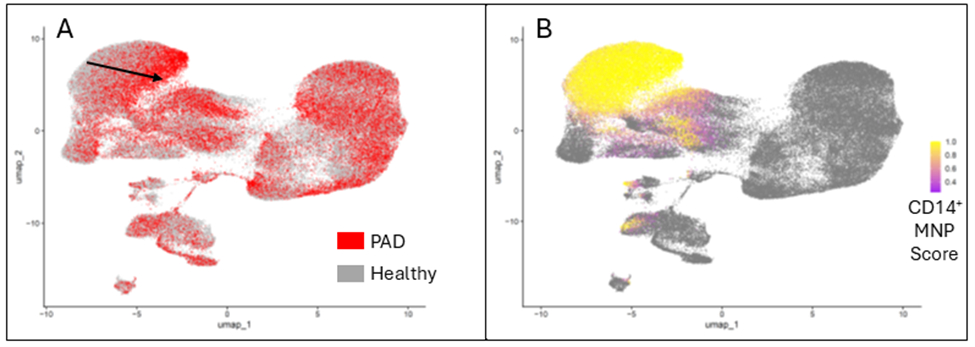
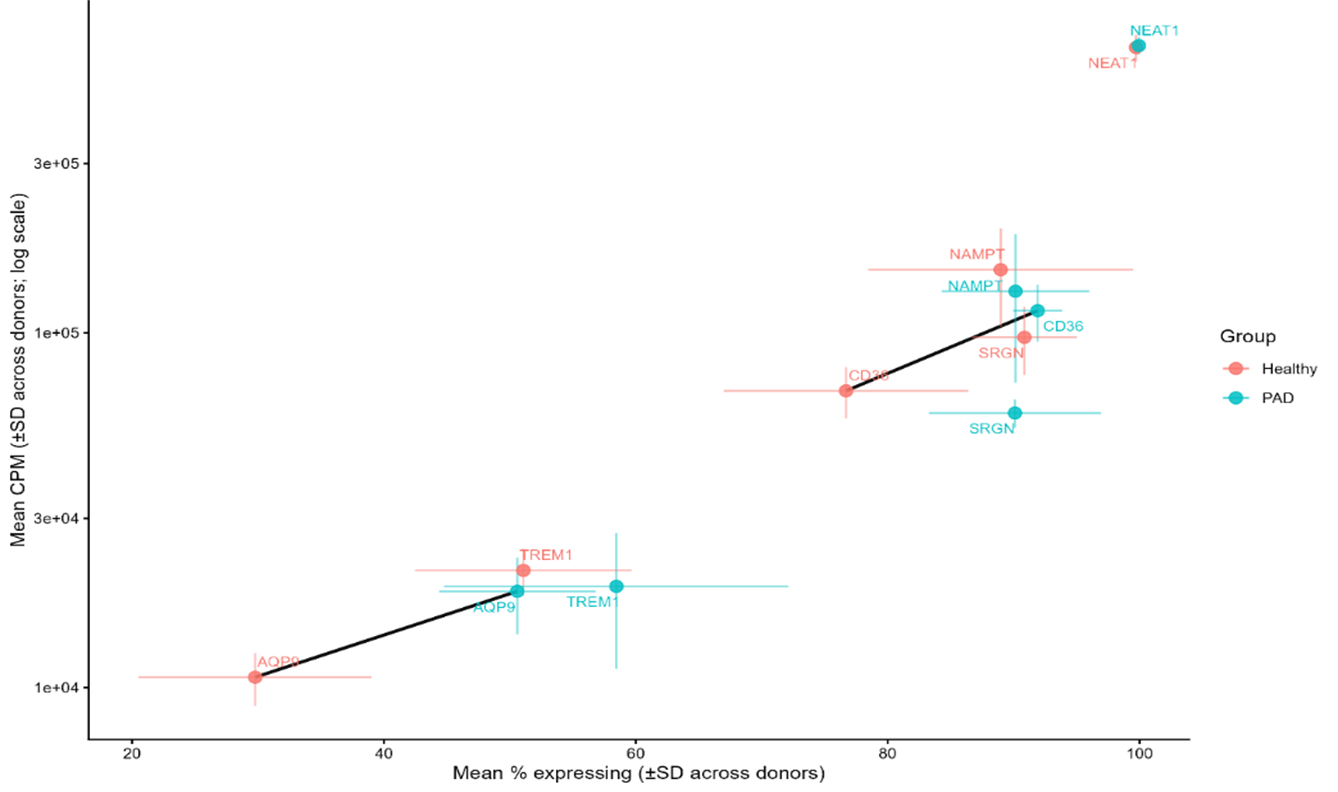
Gene expression differences between HC and PAD cells were visualized using UMAP plots. CD14+ mononuclear phagocytes (MNPs) exhibited the most prominent and consistent transcriptional differences between HC and PAD samples (Figure 1). Within CD14+ MNPs, genes involved in lipid handling and macrophage metabolic function demonstrated a higher median percentage of expressing cells in PAD compared with HC (Figure 2). Further analysis of AQP9 and CD36, genes implicated in macrophage metabolic activation and lipid uptake in atherosclerotic plaques, with z-score normalization and subject-level averaging revealed modest but consistent increases in relative expression in PAD across subjects. These findings support the relevance of these circulating transcriptional shifts to PAD pathophysiology.

Conclusions
Circulating CD14+ MNPs in PAD have detectable transcriptional features consistent with potential engagement of plaque-associated myeloid activation programs. In PAD, increased expression of CD36, which encodes the immune cell scavenger receptor for oxidized LDL, and AQP9, associated with unstable plaques and the endothelial-to-mesenchymal transition, suggest altered immunometabolism states in circulating MNPs. Although effect sizes are modest, they are consistent across subjects and statistically robust. These findings highlight PBMC scRNA-seq as a minimally invasive approach to interrogate systemic immune programs relevant to PAD pathobiology.
  • Esper, Ronda  ( Mayo Clinic , Rochester , Minnesota , United States )
  • Cai, Junming  ( Mayo Clinic , Rochester , Minnesota , United States )
  • Sawhney, Amitoj Singh  ( Mayo Clinic , Rochester , Minnesota , United States )
  • Brownfield, Douglas  ( Mayo Clinic , Rochester , Minnesota , United States )
  • Schaller, Melinda  ( Mayo Clinic , Rochester , Minnesota , United States )
  • Author Disclosures:
    Ronda Esper: DO NOT have relevant financial relationships | Junming Cai: No Answer | Amitoj Singh Sawhney: DO NOT have relevant financial relationships | Douglas Brownfield: No Answer | Melinda Schaller: No Answer
Meeting Info:
Session Info:

01. Poster Session 1 & Reception

Wednesday, 05/13/2026 , 06:00PM - 08:00PM

Poster

More abstracts on this topic:
More abstracts from these authors:
CD14+ Mononuclear Phagocyte Gene Expression is Altered in Peripheral Arterial Disease

Sawhney Amitoj Singh, Cai Jimmy, Brownfield Douglas, Schaller Melinda

You have to be authorized to contact abstract author. Please, Login
Not Available