
Logo

American Heart Association

  95
  0


Final ID: Tu0077

CD14+ Mononuclear Phagocyte Gene Expression is Altered in Peripheral Arterial Disease

Abstract Body: Introduction: Atherosclerotic arterial disease is the leading cause of death throughout the world. One of the most advanced forms of atherosclerosis, peripheral arterial disease (PAD), affects over 8.5 million people in the United States and over 230 million globally. This disease begins from an inflammatory lesion, known as the fatty streak, formed by mononuclear phagocytes (MNPs), a broad cell type classification that includes monocytes, dendritic cells, and macrophages. Development of more efficacious treatments for PAD requires that we better understand the cellular and molecular processes by which MNPs form these inflammatory lesions.
Methods: To compare gene expression of MNPs, we performed scRNAseq on PBMCs from an initial cohort of 4 patients with PAD, mild claudicants to minor tissue loss (Rutherford 1-5), and 5 healthy individuals, defined as those without any chronic diseases and a hsCRP <2.0 mg/L. We conducted single cell RNA library generation using Parse Bio and sequenced to a depth of 70k reads per cell and downstream bioinformatic and differentially gene expression analysis via R and Seurat.
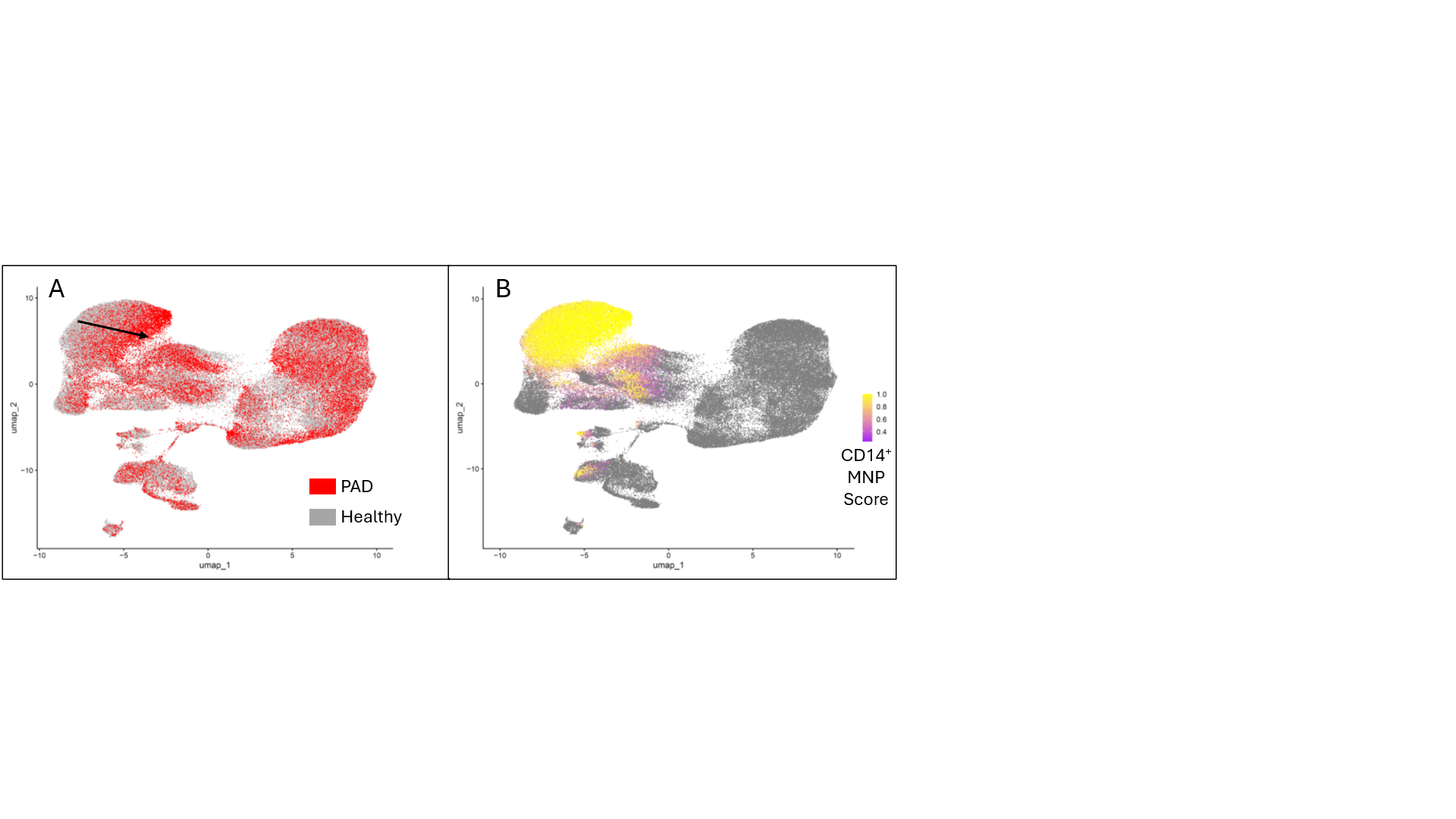
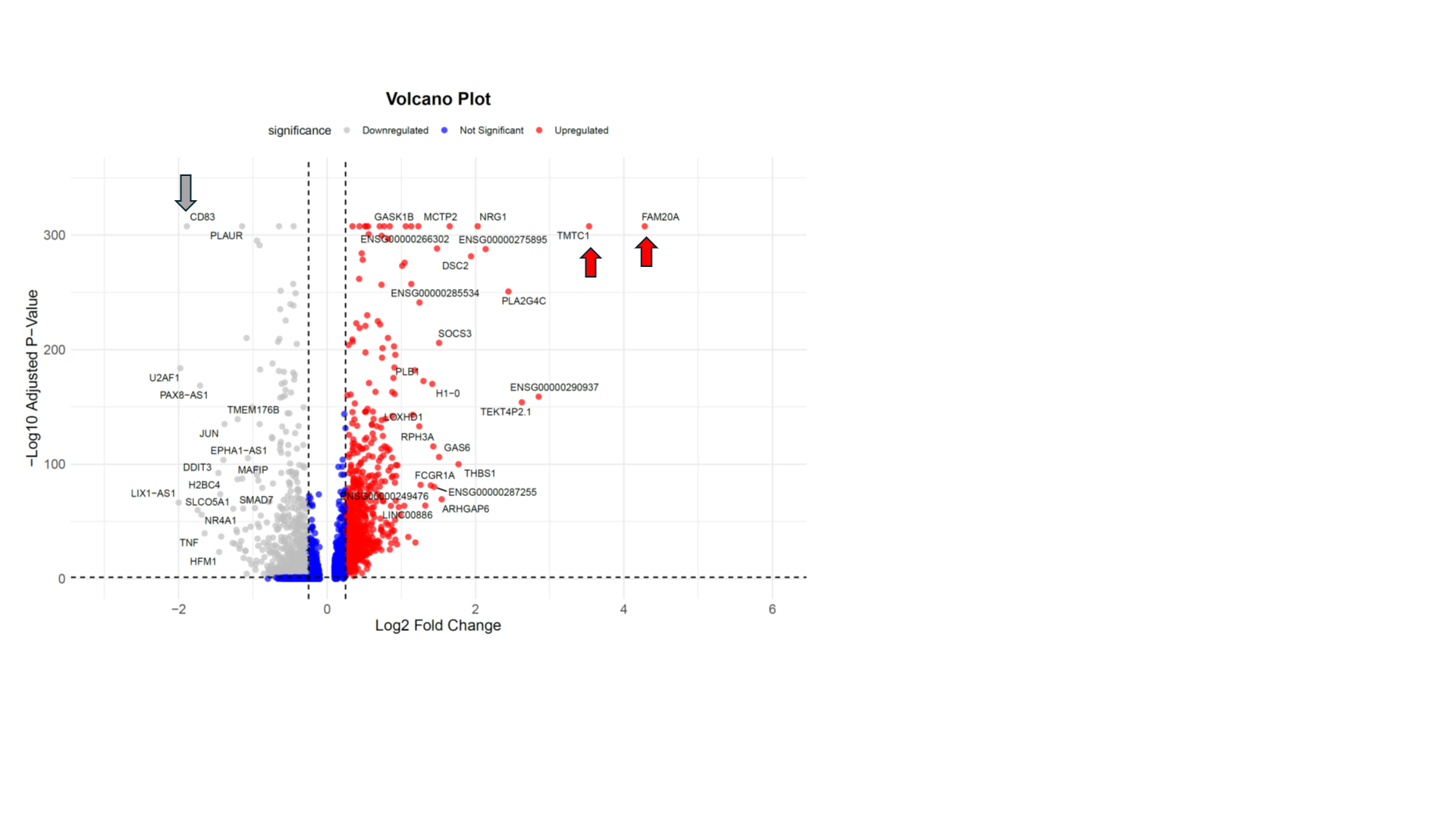
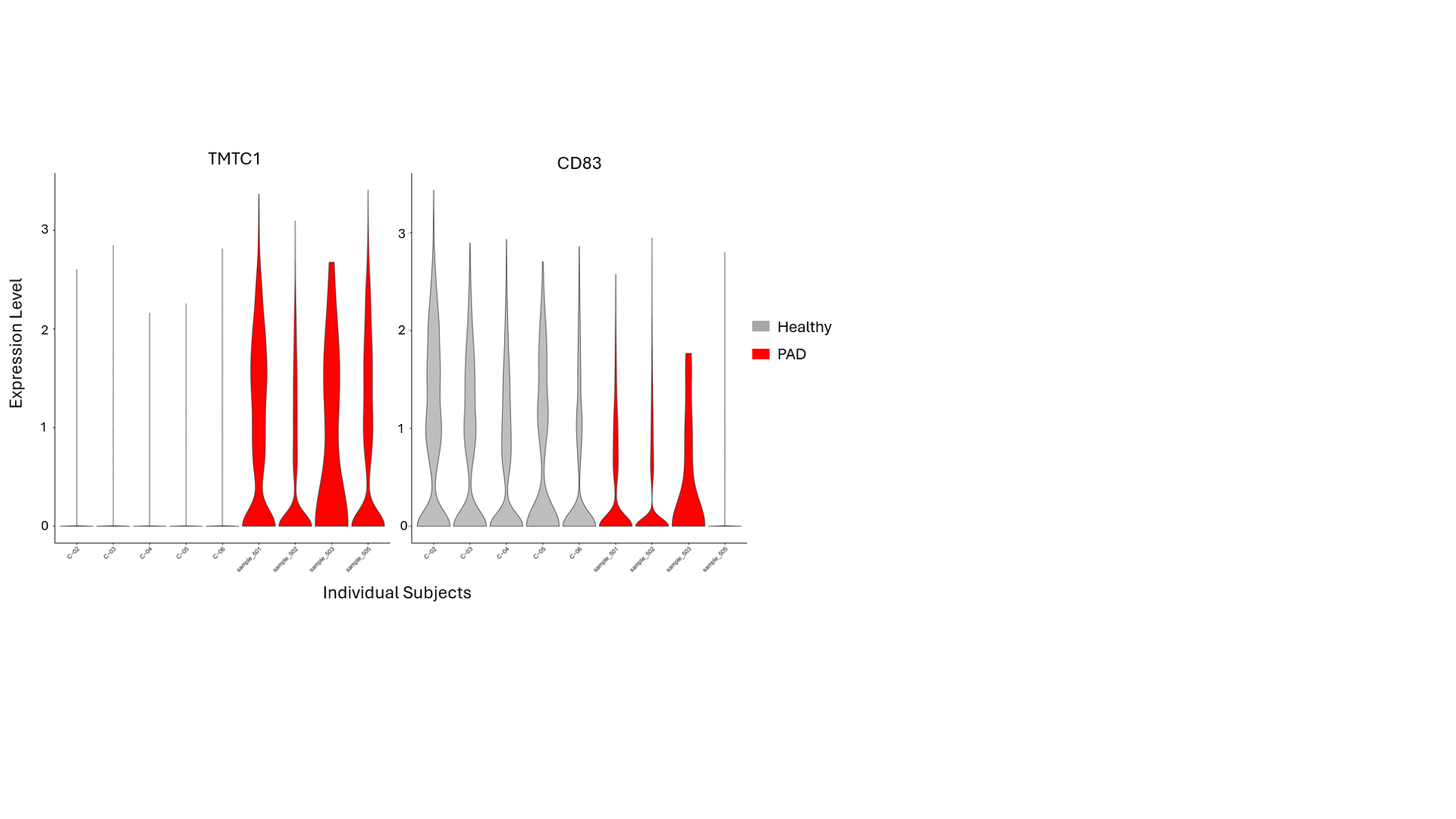
Results: Gene expression differences in healthy versus PAD cells were visualized on a UMAP plot. Aligning our cells to the human PBMC Cell Atlas, we found that the cell type with the greatest transcriptional change (healthy vs. PAD) was CD14+ MNPs. Next, we screened for differentially expressed genes within this CD14+ MNP cluster between healthy and PAD subjects and identified 854 upregulated and 730 downregulated genes (log2fold change ≥ 0.25 and p < 0.05, Welch’s t-test). Two of the most significantly upregulated genes in PAD CD14+ MNPs are FAM20A and TMTC1. FAM20A encodes a psuedokinase important in calcium homeostasis as well as bone mineralization and that is upregulated in advanced atherosclerotic plaques. TMTC1 encodes for an endoplasmic reticulum protein also involved in calcium homeostasis, vascular homeostasis, and endothelial cadherin egress. Finally, one gene we found downregulated in PAD is CD83, a molecule implicated in resolution of inflammation, that when downregulated promotes an inflammatory state.
Conclusion: Based on these findings we hypothesize that in PAD there exists a distinct transcriptional program along the CD14+ MNP cell type lineage that is pro-inflammatory and that may play a role in disease progression and response to intervention.
  • Sawhney, Amitoj Singh  ( Mayo Clinic , Rochester , Minnesota , United States )
  • Cai, Jimmy  ( Mayo Clinic , Rochester , Minnesota , United States )
  • Brownfield, Douglas  ( Mayo Clinic , Rochester , Minnesota , United States )
  • Schaller, Melinda  ( Mayo Clinic , Rochester , Minnesota , United States )
  • Author Disclosures:
    Amitoj Singh Sawhney: DO NOT have relevant financial relationships | Jimmy Cai: No Answer | Douglas Brownfield: No Answer | Melinda Schaller: DO NOT have relevant financial relationships
Meeting Info:
Session Info:

01. Poster Session 1 & Reception

Tuesday, 04/22/2025 , 06:00PM - 08:00PM

Poster

More abstracts on this topic:
3D spheroids composed by induced Skeletal Muscle Progenitor Cells and Mesenchymal Stem Cells derived from human Pluripotent Stem Cells can recapitulate embryonic niches in hindlimb ischemia model

Kim Jinju, Park Jae-hyun, Choi Yeon-jik, Park Hun

A Mast Cell-Specific Receptor Mediates Post-Stroke Brain Inflammation Via a Dural-Brain Axis

Kothari Ruchita, Caplan Justin, Gonzalez L. Fernando, Jackson Christopher, Bettegowda Chetan, Huang Judy, Koehler Raymond, Tamargo Rafael, Xu Risheng, Dong Xinzhong, Abdulrahim Mostafa, Oh Hyun Jong, Capuzzi Daniel, Nair Sumil, Zhang Yaowu, Limjunyawong Nathachit, Saini Sarbjit, Kim Jennifer

You have to be authorized to contact abstract author. Please, Login
Not Available