Logo

American Heart Association

  4
  0


Final ID: Thu017

Novel Adaptation of the Rat Carotid Injury Model to Investigate Nanoplastics in Vessel Walls

Abstract Body: Introduction: Exponentially increasing production of plastics has yielded a novel toxicant in the natural environment. Plastics degrade into nano (<1000 nm) plastics (NP) which integrate into living organisms. Numerous NP polymers have been found in human blood and arteries and have been implicated in atherosclerotic disease, but mechanisms remain obscure. The rat carotid balloon injury model is widely used to study vessel physiology after endothelial disruption. Understanding how NPs affect vessel inflammation and smooth muscle cell response will be key to unlocking future mechanistic insights.
Hypothesis: In vivo carotid endothelial injury will permit durable adherence of nanoplastics to vessel walls.
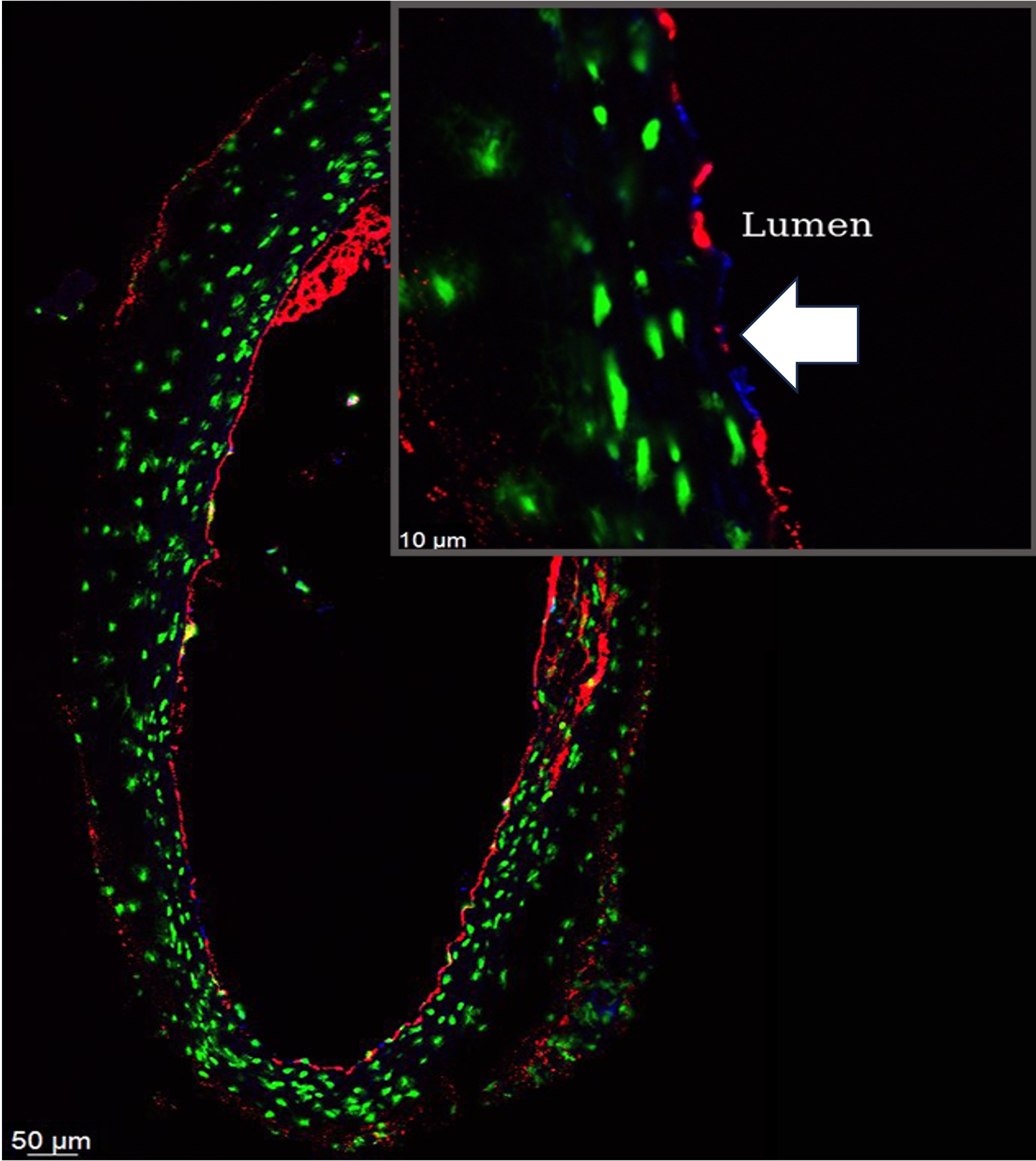
Methods: Sprague-Dawley rats underwent common carotid artery (CCA) exposure and branch vessel isolation. The CCA endothelium was injured by serially passing blunt PE10 tubing (outer diameter 0.6 mm) retrograde through the CCA via an external carotid artery arteriotomy which is ligated at the conclusion of the procedure. The isolated CCA segment is exposed to a 0.1 g/mL solution of 200 nm polystyrene fluorescent nanospheres or vehicle and dwelled for 5 mins. Control vessels were uninjured but particle-exposed. Animals were sacrificed after 0 (n=4) or 48 (n=4) hours and the CCA segment flash frozen and sectioned for histology. Staining for CD31 and CD68 was performed to observe endothelial disruption and macrophage infiltration, respectively.
Results: At 0 hours, CD31 staining revealed efficient denudation of the endothelium in injured vessels compared to control with 90% of CD31+ cells removed after catheter passage. Nanoparticles were widely adherent to both denuded and intact endothelium at 0 hours by confocal microscopy. At 48 hours, nanoparticles persisted in both injured and uninjured arteries. CD31 confirmed continued endothelial absence in the injured group. Nearly 3-fold greater fluorescent nanospheres were observed in the injured group (1.29% of section, ± 1.7) compared to the uninjured group (0.45% ± 0.63). CD68+ cells were 2-fold greater in the injured group (mean 12 cells/section, ± 0) compared to the uninjured group (mean 5 cells/section, ± 5.67).
Conclusions: This novel model showed persistence of polystyrene nanoparticles in uninjured and injured rat carotid arteries up to 48 hours after direct exposure. Endothelial injury leads to more efficient particle adherence and greater macrophage infiltration.
  • Massie, Pierce  ( University of New Mexico , Albuquerque , New Mexico , United States )
  • Garcia, Marcus  ( University of New Mexico , Albuquerque , New Mexico , United States )
  • Risotto-urbanowicz, Erin  ( University of New Mexico , Albuquerque , New Mexico , United States )
  • Iturralde-carillo, Andrea  ( University of New Mexico , Albuquerque , New Mexico , United States )
  • Justus, Matthew  ( University of New Mexico , Albuquerque , New Mexico , United States )
  • Abrums, Avalon  ( University of New Mexico , Albuquerque , New Mexico , United States )
  • Le, Que  ( University of New Mexico , Albuquerque , New Mexico , United States )
  • Marek, Jenna  ( University of New Mexico , Albuquerque , New Mexico , United States )
  • Pace, Carolyn  ( University of New Mexico , Albuquerque , New Mexico , United States )
  • Rumma, Rowza  ( University of New Mexico , Albuquerque , New Mexico , United States )
  • Campen, Matthew  ( UNIVERSITY OF NEW MEXICO , Albuquerque , New Mexico , United States )
  • Clark, Ross  ( University of New Mexico , Albuquerque , New Mexico , United States )
  • Author Disclosures:
    Pierce Massie: No Answer | Rowza Rumma: No Answer | Matthew Campen: No Answer | Ross Clark: DO NOT have relevant financial relationships | Marcus Garcia: DO NOT have relevant financial relationships | Erin Risotto-Urbanowicz: DO NOT have relevant financial relationships | Andrea Iturralde-Carillo: No Answer | Matthew Justus: No Answer | Avalon Abrums: DO NOT have relevant financial relationships | Que Le: DO NOT have relevant financial relationships | Jenna Marek: No Answer | Carolyn Pace: No Answer
Meeting Info:
Session Info:

08. Poster Session 2 & Reception-Sponsored by the ATVB Journal

Thursday, 05/14/2026 , 05:00PM - 07:00PM

Poster

More abstracts on this topic:
Association Between Kidney Function and Severity of White Matter Hyperintensity: The Atherosclerosis Risk in Communities Study

Littig Lauren, Krothapalli Neeharika, Wong Ka-ho, Kim Yvonne, Smith Harper, De Havenon Adam

Acute Left Ventricular Thrombosis and Systemic Embolism Following Testosterone Therapy

Rasheed Ahmed Daniyaal, Naseer Ahmed, Nadig Vidya

More abstracts from these authors:
Vascular Smooth Muscle Cell Phenotyping After Commercial and Natural-Derived Nanoplastics Exposure

Abrums Avalon, Justus Matthew, Rumma Rowza, Clark Ross, Le Que, Marek Jenna, Risotto-urbanowicz Erin, Massie Pierce, Pace Carolyn, Iturralde-carillo Andrea, Garcia Marcus, Campen Matthew

Dietary Ocean Nanoplastics Atherogenesis and Organ Accumulation Varies by Time and Diet Type in ApoE-/- Mice

Risotto-urbanowicz Erin, Le Que, Marek Jenna, Rumma Rowza, Pace Carolyn, Campen Matthew, Clark Ross, Massie Pierce, Garcia Marcus, Friberg Lunden, Sabouri Mostafa, Machin Daniel, Justus Matthew, Iturralde-carillo Andrea, Abrums Avalon

You have to be authorized to contact abstract author. Please, Login
Not Available