
Logo

American Heart Association

  3
  0


Final ID: Fri091

Dietary Ocean Nanoplastics Atherogenesis and Organ Accumulation Varies by Time and Diet Type in ApoE-/- Mice

Abstract Body: Introduction: Micronanoplastics (MNPs) are a ubiquitous environmental contaminant linked to cardiovascular disease in humans. Mechanisms by which MNPs affect atherosclerosis remain obscure. Animal models of atherosclerosis permit the study of MNP-atheroma interactions in a controlled setting. MNPs derived from natural ocean sources are a novel model, better mimicking human environmental exposure compared to commercial nanospheres. Prior data suggests diet type may influence the efficiency of MNP uptake.
Hypothesis: Dietary ocean-derived MNPs influence atherosclerosis development and solid organ MNP accumulation in a diet-dependent manner.
Methods: Adult ApoE-/- mice (n=5-7/group) were fed Standard (SD) or Western diet (WD) ± 1% (w/w) ocean MNPs (<20 µm) milled into chow. After 6 or 12 weeks of exposure, animals underwent atherogenic measures including aortic pulse wave velocity (PWV), aortic Oil Red O (ORO), aortic root histologic analysis, and pin myography (5 mm aortic rings) for wall stiffness. Bulk RNAseq of aortic tissue was performed. Brain, liver and kidney underwent pyrolysis-gas chromatography/mass spectroscopy (Py-GC/MS) to measure the concentration of MNPs by polymer.
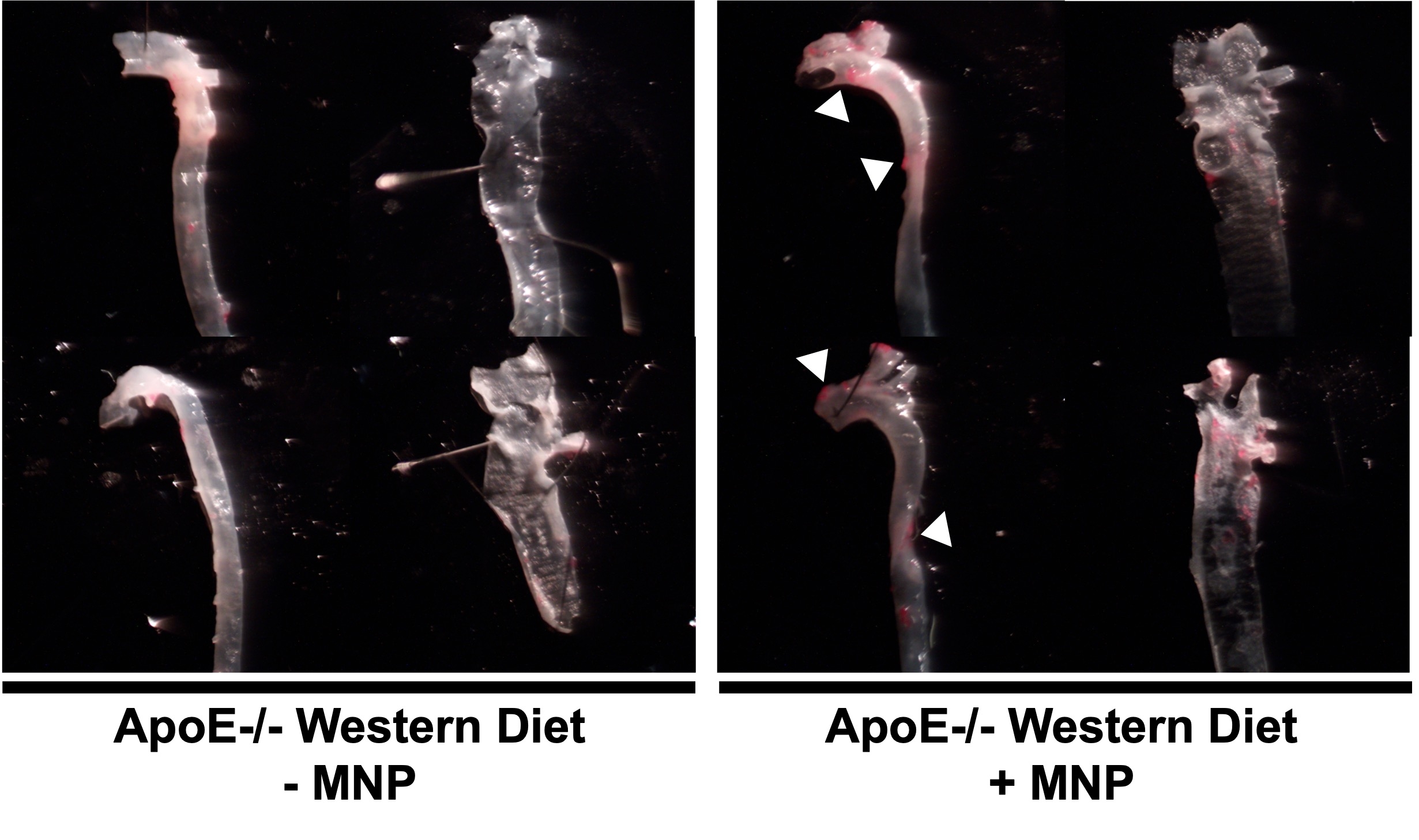
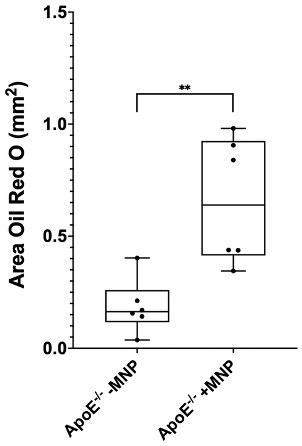
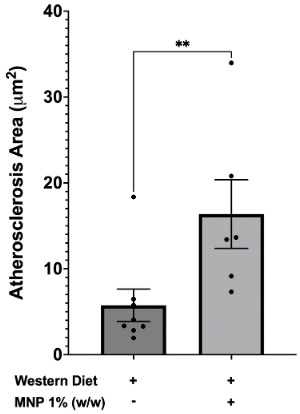
Results: At 6 weeks, PWV shows greater vessel stiffness in WD+MNP (307 cm/s) compared WD only (263 cm/s, P=0.01) animals. At 12 weeks, vessel stiffening was greater in SD+MNP compared to SD (271 vs 247.8, P=0.016). ORO disclosed 3-fold greater aortic atheroma area in MNP-fed animals eating WD (0.66 mm2) versus non-MNP (0.19 mm2, P<0.01). Aortic root atherosclerotic area was 2.8-fold greater in MNP-fed animals (16.4 mm2) versus control (5.8 mm2, P<0.01). Myography confirmed greater elastin modulus in MNP-fed animals (660 vs 587 AU, P<0.05)) at 6 weeks. Bulk RNAseq shows upregulation of pro-atherogenic genes commonly expressed in vascular smooth muscle cells and macrophages including Slc2a5 (10.6 fold), Acly (3.6 fold), and Lep (2 fold) (all P<0.01). At 6 weeks, liver MNP concentrations in the WD+MNP animals were greater than control (132.8 vs 335.5 µg/g tissue, P=0.02). At 12 weeks, SD+MNP mice had higher levels of plastics in the brain (1503 vs 612 ug/g tissue, P=0.016), and the WD+MNP-fed mice had higher levels in the liver (609.0 vs 112.8 µg/g tissue, P<0.01).
Conclusions: Exposure time and diet type have strong effects on aortic atherogenesis and nanoplastics accumulation in solid organs. Additional study regarding mechanisms of MNP impacts on atherosclerosis is warranted.
  • Risotto-urbanowicz, Erin  ( University of New Mexico , Albuquerque , New Mexico , United States )
  • Massie, Pierce  ( University of New Mexico , Albuquerque , New Mexico , United States )
  • Garcia, Marcus  ( University of New Mexico , Albuquerque , New Mexico , United States )
  • Friberg, Lunden  ( University of New Mexico , Albuquerque , New Mexico , United States )
  • Sabouri, Mostafa  ( University of New Mexico , Albuquerque , New Mexico , United States )
  • Machin, Daniel  ( University of New Mexico Health Sciences Center , Albuquerque , New Mexico , United States )
  • Justus, Matthew  ( University of New Mexico , Albuquerque , New Mexico , United States )
  • Iturralde-carillo, Andrea  ( University of New Mexico , Albuquerque , New Mexico , United States )
  • Abrums, Avalon  ( University of New Mexico , Albuquerque , New Mexico , United States )
  • Le, Que  ( University of New Mexico , Albuquerque , New Mexico , United States )
  • Marek, Jenna  ( University of New Mexico , Albuquerque , New Mexico , United States )
  • Rumma, Rowza  ( University of New Mexico , Albuquerque , New Mexico , United States )
  • Pace, Carolyn  ( University of New Mexico , Albuquerque , New Mexico , United States )
  • Campen, Matthew  ( UNIVERSITY OF NEW MEXICO , Albuquerque , New Mexico , United States )
  • Clark, Ross  ( University of New Mexico , Albuquerque , New Mexico , United States )
  • Author Disclosures:
    Erin Risotto-Urbanowicz: DO NOT have relevant financial relationships | Que Le: DO NOT have relevant financial relationships | Jenna Marek: No Answer | Rowza Rumma: No Answer | Carolyn Pace: No Answer | Matthew Campen: No Answer | Ross Clark: DO NOT have relevant financial relationships | Pierce Massie: No Answer | Marcus Garcia: DO NOT have relevant financial relationships | Lunden Friberg: No Answer | Mostafa Sabouri: No Answer | Daniel Machin: No Answer | Matthew Justus: No Answer | Andrea Iturralde-Carillo: No Answer | Avalon Abrums: DO NOT have relevant financial relationships
Meeting Info:
Session Info:

15. Poster Session 3 & Reception

Friday, 05/15/2026 , 05:00PM - 07:00PM

Poster

More abstracts on this topic:
Novel Adaptation of the Rat Carotid Injury Model to Investigate Nanoplastics in Vessel Walls

Massie Pierce, Rumma Rowza, Campen Matthew, Clark Ross, Garcia Marcus, Risotto-urbanowicz Erin, Iturralde-carillo Andrea, Justus Matthew, Abrums Avalon, Le Que, Marek Jenna, Pace Carolyn

3D spheroids composed by induced Skeletal Muscle Progenitor Cells and Mesenchymal Stem Cells derived from human Pluripotent Stem Cells can recapitulate embryonic niches in hindlimb ischemia model

Kim Jinju, Park Jae-hyun, Choi Yeon-jik, Park Hun

More abstracts from these authors:
Novel Adaptation of the Rat Carotid Injury Model to Investigate Nanoplastics in Vessel Walls

Massie Pierce, Rumma Rowza, Campen Matthew, Clark Ross, Garcia Marcus, Risotto-urbanowicz Erin, Iturralde-carillo Andrea, Justus Matthew, Abrums Avalon, Le Que, Marek Jenna, Pace Carolyn

Vascular Smooth Muscle Cell Phenotyping After Commercial and Natural-Derived Nanoplastics Exposure

Abrums Avalon, Justus Matthew, Rumma Rowza, Clark Ross, Le Que, Marek Jenna, Risotto-urbanowicz Erin, Massie Pierce, Pace Carolyn, Iturralde-carillo Andrea, Garcia Marcus, Campen Matthew

You have to be authorized to contact abstract author. Please, Login
Not Available