Resolvin D2 Administration After Murine Thoracic Aortic Aneurysm Formation Attenuates Further Development
Abstract Body: Objective: Inflammatory signaling and extracellular matrix remodeling play crucial roles in the formation of thoracic aortic aneurysms (TAAs). D-series Resolvins, including Resolvin D2 (RvD2), are endogenous pro-resolving mediators that promote anti-inflammatory signaling and effectively decrease the formation and progression of abdominal aortic aneurysms. No studies have investigated whether this holds for TAA.
Methods: Genetically hypertensive 13-16-week-old BPH/2J mice underwent TAA induction via two previously established murine models using porcine pancreatic elastase (PPE) and calcium chloride (CaCl). Treatment with 400 ng RvD2 or vehicle (1% DMSO only) by intraperitoneal injections was started 3 and 7 days after TAA induction, respectively, and every 3 days thereafter until terminal surgery, during which the aorta was again exposed, images obtained, and aortic diameters measured within both native and induced regions. Aortic dilation was normalized to the native diameter. Aortic tissue was obtained for multiplex protein analysis of cytokine/chemokine and MMP levels, measured as integrated density and compared using independent samples t-tests.
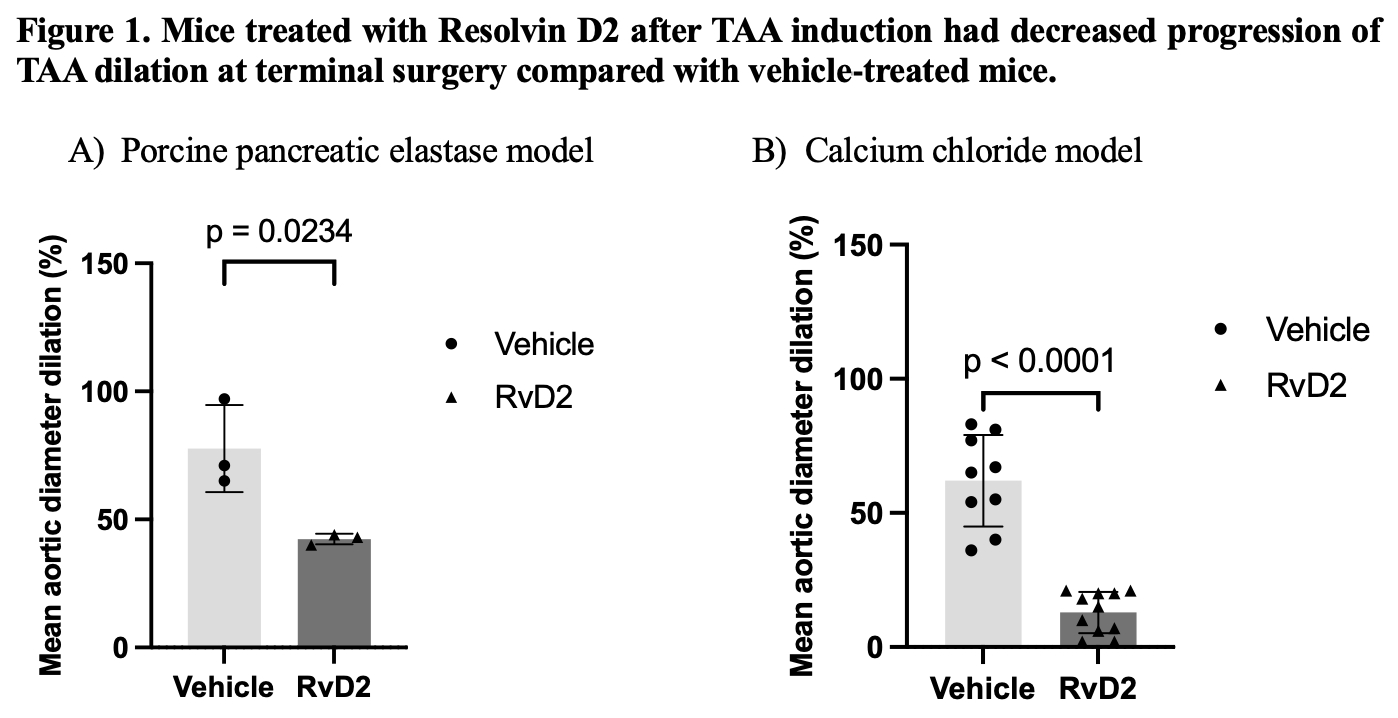
Results: In the PPE model, TAA progression was attenuated by 35.4% at 2 weeks after induction (p=0.02). Mean aortic dilation was 77.7±17.0% for control (n=3) and 42.3±2.1% for RvD2-treated mice (n=3) (Figure 1A). In the CaCl model, RvD2 attenuates TAA progression by 48.7% at 4 weeks (p<0.0001). Mean aortic dilation was 61.6±18.2% for control (n=8) and 12.9±7.7% for RvD2-treated mice (n=11) (Figure 1B). RvD2 significantly decreases aneurysmal aortic tissue concentrations of MCP-1 (p=0.02) and IL-12p70 (p=0.04) in RvD2-treated mice (n=5), compared to control mice (n=5). It also significantly decreased MMP-2 (p=0.04) and MMP-9 levels (p=0.0009) in RvD2-treated mice (n=4), compared to control mice (n=2).
Conclusions: RvD2 exhibits a potent protective effect against the further development of an already existing experimental murine TAA, as demonstrated by two induction models, with clinical relevance to human patients. Treatment with RvD2 significantly decreases pro-inflammatory MCP-1, IL-12p70, MMP-2, and MMP-9 levels. Therefore, RvD2 may attenuate TAA progression by inhibiting the recruitment of monocytes/macrophages at localized sites of inflammation, differentiation of T cells, and cytotoxic activity and proliferation of NK and T cells.
Do-nguyen, Chi Chi
(
Medical University of South Carolina
, Charleston , South Carolina , United States )
Xiong, Ying
(
Medical University of South Carolina
, Charleston , South Carolina , United States )
Jones, Jeffrey
(
Medical University of South Carolina
, Charleston , South Carolina , United States )
Ruddy, Jean Marie
(
Medical University of South Carolina
, Charleston , South Carolina , United States )
Pope, Nicolas
(
Medical University of South Carolina
, Charleston , South Carolina , United States )
Author Disclosures:
Chi Chi Do-Nguyen:DO NOT have relevant financial relationships
| Ying xiong:DO NOT have relevant financial relationships
| Jeffrey Jones:DO NOT have relevant financial relationships
| Jean Marie Ruddy:DO have relevant financial relationships
;
Speaker:CVRx:Active (exists now)
| Nicolas Pope:No Answer