
Logo

American Heart Association

  21
  0


Final ID: MP2576

Aortic Length Indexed to Body Surface Area Predicts Mortality in Veterans with Ascending Thoracic Aortic Aneurysm

Abstract Body (Do not enter title and authors here):
Background:
Aortic diameter is the most consistently referenced index in guidelines for ascending thoracic aortic aneurysm (aTAA) repair. However, studies have shown that diameter alone may not be an optimal predictor of mortality. Growing evidence suggests aortic length may improve risk prediction, particularly for patients with smaller aortic diameters. However, the clinical relevance of aortic length remains unclear. Furthermore, while prior studies suggest that indexing aortic diameter to body size or height improves mortality risk prediction, there is limited evidence evaluating whether the same holds true for aortic length. To address this gap, this study investigates the association between mortality and raw aortic length as well as length indexed to patient height and body surface area (BSA).

Methods:
449 veterans with ≥4.0cm aTAA and contrast computed tomography imaging underwent patient-specific three-dimensional reconstruction and retrospective medical record review. Aortic length was measured along the centerline between the aortic annulus and innominate artery. All-cause and aortic-related mortality were assessed using Fine-Gray competing risk regression for raw aortic length, aortic length indexed to height (cm), and aortic length indexed to BSA (using DuBois formula), adjusting for age, aortic diameter, and common aTAA risk factors. Optimal binary cutoffs for length/BSA were identified using maximally selected rank statistics and time-dependent receiver operating characteristic analysis.

Results:
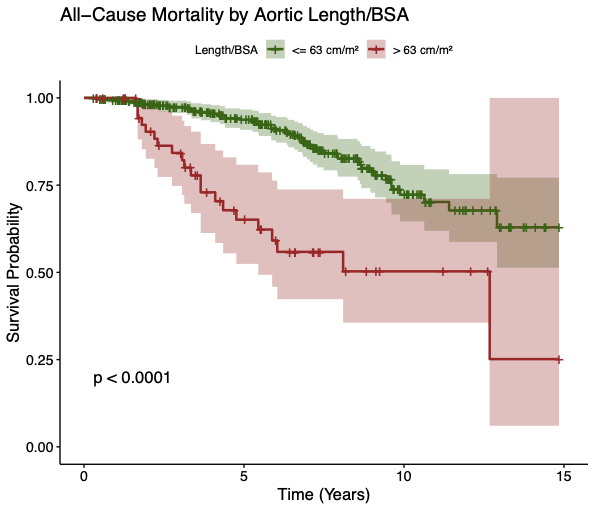
Neither raw aortic length nor length indexed to height was associated with all-cause or aortic-related mortality. In contrast, length/BSA was significantly associated with all-cause mortality in univariate (p = 0.0014) and multivariate analysis (p = 0.023). Optimal thresholds for length/BSA were 63 cm/m2 overall, 61 cm/m2 for five-year mortality, and 67 cm/m2 for ten-year mortality. Patients above 63 cm/m2 had significantly reduced survival (p < 0.0001).

Conclusion:
Aortic length indexed to BSA was an independent predictor of all-cause mortality in this veteran aTAA cohort. These findings suggest that a BSA-based length index may enhance risk stratification when compared to aortic length alone. However, BSA involves weight, which varies over time and may not directly reflect intrinsic aortic pathology. Further clinical and biomechanical study of indexed aortic length values is needed to clarify their role in disease progression and mortality.
  • Dave, Amartya  ( UCSF , San Francisco , California , United States )
  • Kiran, Shreyas  ( UCSF , San Francisco , California , United States )
  • Li, Yimeng  ( UCSF , San Francisco , California , United States )
  • Huang, Yixuan  ( UCSF , San Francisco , California , United States )
  • Gomez, Axel  ( UCSF and SFVA , San Francisco , California , United States )
  • Carroway, William  ( UCSF and SFVA , San Francisco , California , United States )
  • Boskovski, Marko  ( UCSF and SFVA , San Francisco , California , United States )
  • Ge, Liang  ( UCSF and SFVA , San Francisco , California , United States )
  • Tseng, Elaine  ( UCSF and SFVA , San Francisco , California , United States )
  • Author Disclosures:
    Amartya Dave: DO NOT have relevant financial relationships | Shreyas Kiran: DO NOT have relevant financial relationships | Yimeng Li: DO NOT have relevant financial relationships | Yixuan Huang: DO NOT have relevant financial relationships | Axel Gomez: DO NOT have relevant financial relationships | William Carroway: DO NOT have relevant financial relationships | Marko Boskovski: DO have relevant financial relationships ; Consultant:Edwards Lifesciences:Active (exists now) | Liang Ge: DO have relevant financial relationships ; Ownership Interest:ReValve Inc.:Active (exists now) | Elaine Tseng: DO have relevant financial relationships ; Research Funding (PI or named investigator):Amgen:Past (completed) ; Research Funding (PI or named investigator):Portrero Med:Past (completed) ; Research Funding (PI or named investigator):Cellphire:Past (completed)
Meeting Info:

Scientific Sessions 2025

2025

New Orleans, Louisiana

Session Info:

Best of Vascular Imaging

Monday, 11/10/2025 , 10:45AM - 12:00PM

Moderated Digital Poster Session

More abstracts on this topic:
Ascending Thoracic Aortic Aneurysms in a Veterans Affairs Health System: Longitudinal Outcomes and Risk Factors

Gomez Axel, Carroway William, Ge Liang, Boskovski Marko, Tseng Elaine

Aortic Growth Mapping to Examine Genotype-Phenotype Correlations in Heritable Thoracic Aortic Disease and Variants of Unknown Significance

Campello Carlos Alberto, Ramesh Vedika, Marway Prabhvir, Hofmann Bowman Marion, Aatre Rajani, Burris Nicholas

More abstracts from these authors:
Aspirin Use in Men is Independently Associated with Slower Growth Rate of Ascending Thoracic Aortic Aneurysms

Tu Sally, Kailash Vidur, Gomez Axel, Pace William, Huang Yixuan, Boskovski Marko, Ge Liang, Tseng Elaine

Ascending Thoracic Aortic Aneurysms in a Veterans Affairs Health System: Longitudinal Outcomes and Risk Factors

Gomez Axel, Carroway William, Ge Liang, Boskovski Marko, Tseng Elaine

You have to be authorized to contact abstract author. Please, Login
Not Available