
Imaging-Guided Photoactivatable Rapamycin Delivery Drives Potent Plaque Regression and Inflammation Ablation Assessed by Serial Intravital Imaging
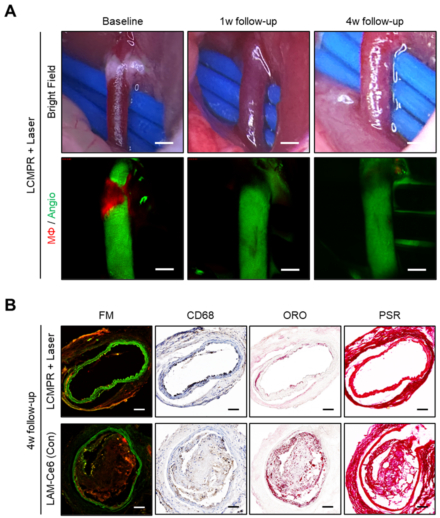
Abstract Body: Introduction: Atherosclerosis remains a predominant contributor to cardiovascular mortality, primarily driven by chronic inflammation within the arterial wall. While photoactivation is a promising theranostic strategy to deplete inflammatory cells and promote healing, its superficial penetration still hampers the therapeutic efficacy, particularly in the advanced plaque. We hypothesized that a combined drug delivery system with photoactivation could not only eradicate pro-inflammatory macrophages but also promote plaque regression beyond stabilization. Method and results: We synthesized a macrophage-targeted, photoactivatable agent [Laminarin-chlorin e6 (LAM-Ce6)/manganese dioxide (MnO2)/methoxy-polyethylene glycol-1,2-dipalmitoyl-sn-glycero-3-phosphoethanolamine (mPEG-DSPE)/Rapamycin; LCMPR] consisting of a mPEG-DSPE core encapsulating rapamycin for sustained drug release and MnO2 interlayer that serves as an in-situ catalyst to convert endogenous hydrogen peroxide into molecular oxygen. Each component was encapsulated within a LAM-Ce6 shell, which leverages laminarin-mediated targeting of Dectin-1 expressing macrophages and incorporates Ce6 for both NIRF imaging and photoactivation. In atherosclerotic murine models, LCMPR was intravenously administered at a Ce6-equivalent dose of 4 mg/kg, demonstrating high colloidal stability and selective accumulation in carotid plaques. By a customized multiplexed serial intravital imaging, the photoactivation with LCMPR Tx group exhibited a remarkable and progressive reduction in both plaque burden and inflammatory activity at 4 weeks post-treatment, as compared to controls (p < 0.01) (Figure A). Comprehensive histological analysis well corroborated the in vivo findings (Figure B). Collectively, these findings demonstrate a potent synergistic interaction between dual-action photoactivation and rapamycin-mediated mechanisms, resulting in robust anti-atherosclerotic effects. Conclusion: A macrophage-targeted theranostic photoactivation integrating rapamycin local delivery achieved marked plaque regression and inflammation resolution. This novel dual-action approach provides a new theranostic avenue for high-risk atherosclerotic lesions, with particular potential to facilitate coronary intervention.
Kim, Jin Hyuk
(
Korea University Guro Hospital
, Seoul , Korea (the Republic of) )
Lim, Yong Geun
(
Chung-Ang University
, Anseong , Korea (the Republic of) )
Jang, Minseok
(
KAIST
, Daejeon , Korea (the Republic of) )
Kim, Yeon Hoon
(
KAIST
, Daejeon , Korea (the Republic of) )
Kim, Ryeong Hyun
(
Korea University Guro Hospital
, Seoul , Korea (the Republic of) )
Park, Ye Hee
(
Korea University Guro Hospital
, Seoul , Korea (the Republic of) )
Shin, Seung Ho
(
Korea University Guro Hospital
, Seoul , Korea (the Republic of) )
Yoo, Hongki
(
KAIST
, Daejeon , Korea (the Republic of) )
Park, Kyeongsoon
(
Chung-Ang University
, Anseong , Korea (the Republic of) )
Kim, Jin Won
(
Korea University Guro Hospital
, Seoul , Korea (the Republic of) )