
Logo

American Heart Association

  2
  0


Final ID: Wed117

Spatial Transcriptomic Mapping of a Total Human Thoracic Aortic Dissection Ring

Abstract Body: Introduction: Type A thoracic aortic dissection (TAD) is a surgical emergency, and hypertension (HTN) remains the most frequent risk factor associated with TAD. Although radiologic studies show variability in TAD false lumen patterns and extent, circumferential insight at the cellular level remains lacking.

Hypothesis: Our spatial transcriptomic analyses on HTN-associated type A TAD have demonstrated consistent VSMC de-differentiation and weakening in the outer third of the media, while the plane of propagation occurs in a thin outer medial transition zone. We hypothesized that circumferential assessment of aortic architecture and remodeling would provide critical spatial context for dissection development and propagation.

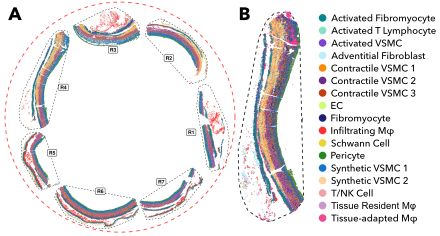
Methods: A formalin-fixed human aortic ring was obtained from a patient undergoing TAD repair and was segmented into seven contiguous segments prior to paraffin embedding. Spatial profiling was performed with a custom 480-gene panel on the 10x Genomics Xenium platform. We reconstructed the global ring architecture using a computational pipeline that integrated CellPose and Baysor for segmentation and BANKSY and Harmony for clustering and multi-sample integration, thereby delineating circumferentially heterogeneous vascular cell niches.

Results: Seventeen cell clusters were identified, including eight VSMC-derived niches arranged in concentric medial layers, with stress-modulated expression increasing toward the outer media (Fig 1A). VSMC proliferation and medial thickening is most notable in outer-curve segment 4 (Fig 1B), where activated, contractile, and synthetic VSMCs layers are nearly double that of diametrically opposing segments. These regions are also associated with a loss of luminal PECAM1+ endothelial cells (ECs), with a corresponding EC increase within the proliferative outer media. In contrast, the cleavage plane is circumferentially consistent, within a thin outer medial transition zone, bounded on both sides by VSMC-derived niches.

Conclusions: Medial remodeling in HTN-associated TAD is circumferentially asymmetric, with outer-curve regions showing expanded de-differentiated VSMC niches, loss of luminal ECs, and increased outer medial ECs. These features suggest disease initiation in the outer third of the media, where hypoxemic stress drives VSMC de-differentiation, angiogenesis, and interlamellar weakening. In contrast, a distinct and consistent cleavage plane indicates propagation along a discrete zone of weakness.
  • Gajera, Krishnaben  ( Washington University in St. Louis , Saint Louis , Missouri , United States )
  • Siki, Mary  ( Washington University in St. Louis , Saint Louis , Missouri , United States )
  • Dabek, Patryk  ( Washington University in St. Louis , Saint Louis , Missouri , United States )
  • Freeman, Michael G  ( Washington University in St. Louis , Saint Louis , Missouri , United States )
  • Brescia, Alexander  ( Washington University in St. Louis , Saint Louis , Missouri , United States )
  • Humphreys, Benjamin  ( Washington University in St. Louis , Saint Louis , Missouri , United States )
  • Holzem, Katherine  ( Washington University in St. Louis , Saint Louis , Missouri , United States )
  • Author Disclosures:
    Krishnaben Gajera: DO NOT have relevant financial relationships | Mary Siki: DO NOT have relevant financial relationships | Patryk Dabek: No Answer | Michael G Freeman: DO NOT have relevant financial relationships | Alexander Brescia: No Answer | Benjamin Humphreys: No Answer | Katherine Holzem: No Answer
Meeting Info:
Session Info:

01. Poster Session 1 & Reception

Wednesday, 05/13/2026 , 06:00PM - 08:00PM

Poster

More abstracts on this topic:
A Mechanistic Insight Into The Connection Between Metabolism And Differentiation In ACTA2 P. R179 Smooth Muscle Cells

Esparza Pinelo Jose, Krenz Hannah, Chen Jessica, Kaw Anita, Milewicz Dianna, Kwartler Callie

A Murine Model of Mid-Thoracic Aortic Coarctation

Lauver Adam, Garver Hannah, Rendon Javier, Fink Gregory, Krieger-burke Teresa, Contreras Andres, Watts Stephanie

You have to be authorized to contact abstract author. Please, Login
Not Available