
Logo

American Heart Association

  1
  0


Final ID: Fri010

Surgical Repair of Patent Ductus Arteriosus Lesions in Multisystemic Smooth Muscle Dysfunction Syndrome

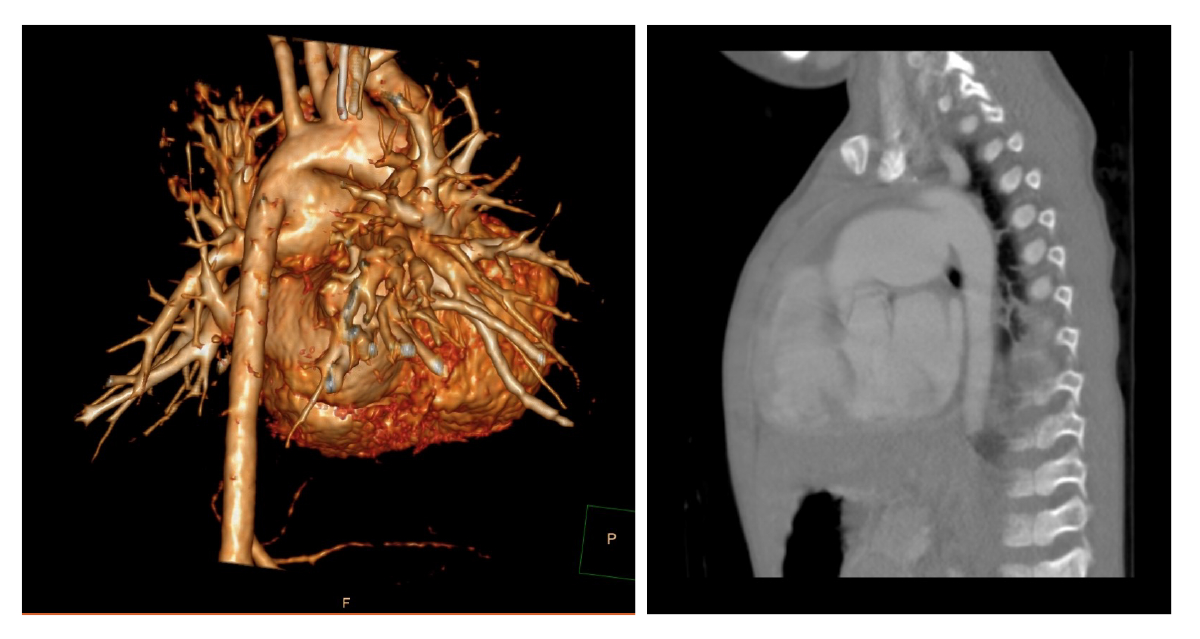
Abstract Body: Introduction: ACTA2 gene mutations are associated with Multisystemic Smooth Muscle Dysfunction Syndrome (MSMDS), an ultra-rare syndrome with premature morbidity and mortality. Infants with MSMDS commonly have patent ductus arteriosus (PDA) with atypical anatomy and congenital mydriasis, however, these PDA lesions have not been well characterized.
Hypothesis: Patients with MSMDS have large and complex PDA lesions that are addressed with varied surgical techniques.
Methods: Patients with ACTA2 arginine 179 mutations were enrolled in a prospective and retrospective natural history study from April 2024 to December 2025. Medical records were reviewed and data were extracted on PDA characteristics, surgical management, complications, and subsequent aortic interventions.
Results: Among 36 patients with ACTA2 arginine 179 mutations, 34 underwent PDA repair at 32 global centers. Two patients did not have available records. Median age at repair was 51 days (IQR 30-110 days) but was over 6 months for 5/34 patients (15%). Most PDAs were large and aortopulmonary window-like with friable, thin, or aneurysmal tissue. 28/34 patients (82%) had evidence of increased pulmonary vascular resistance. Only 2/34 patients (6%) had an ACTA2 mutation diagnosed before surgery. 15 patients (44%) underwent patch repair, 11 (32%) underwent ligation, and 5 (15%) underwent coarctation repair with end-to-end anastomosis at the time of PDA repair. None had primary device repair. The type of repair was unknown for 3 patients (9%). 13/34 patients (38%) had serious post-operative complications including PDA recanalization, pulmonary artery injury or stenosis, bronchial compression, aneurysmal PDA rupture, or stroke. Two patients (6%) required repeat PDA interventions with transcatheter closure devices. Of 5 patients with concomitant PDA and coarctation repair, 3 (60%) developed left bronchial compression versus none with PDA repair alone. 9/34 patients (26%) underwent subsequent aortic procedures at a median age of 14.4 years (IQR 13.5-18.5 years), most often aortic replacement.
Conclusions: Type B (window-like) PDA is a nearly universal finding in MSMDS and its treatment has a high complication rate. PDA alongside coarctation repair in MSMDS may be associated with left bronchial stenosis. Infants with PDA and congenital mydriasis should undergo early genetic testing, as preoperative diagnosis of MSMDS may prompt consideration of alternative surgical approaches and neuroprotective anesthesia.
  • Wittenberg, Rachel  ( Massachusetts General Hospital , Boston , Massachusetts , United States )
  • Gower, Oliver  ( Massachusetts General Hospital , Boston , Massachusetts , United States )
  • Ondeck, Benjamin  ( Massachusetts General Hospital , Boston , Massachusetts , United States )
  • Tambala, Diana  ( Massachusetts General Hospital , Boston , Massachusetts , United States )
  • Da Cruz, Emily  ( Massachusetts General Hospital , Boston , Massachusetts , United States )
  • Podias, Erika  ( Massachusetts General Hospital , Boston , Massachusetts , United States )
  • Balaguru, Duraisamy  ( Massachusetts General Hospital , Boston , Massachusetts , United States )
  • Bloom, Jordan  ( Massachusetts General Hospital , Boston , Massachusetts , United States )
  • Musolino, Patricia  ( Massachusetts General Hospital , Boston , Massachusetts , United States )
  • Lindsay, Mark  ( Massachusetts General Hospital , Boston , Massachusetts , United States )
  • Author Disclosures:
    Rachel Wittenberg: DO NOT have relevant financial relationships | Mark Lindsay: No Answer | Oliver Gower: DO NOT have relevant financial relationships | Benjamin Ondeck: DO NOT have relevant financial relationships | Diana Tambala: DO NOT have relevant financial relationships | Emily Da Cruz: DO NOT have relevant financial relationships | Erika Podias: DO NOT have relevant financial relationships | Duraisamy Balaguru: DO NOT have relevant financial relationships | Jordan Bloom: DO NOT have relevant financial relationships | Patricia Musolino: No Answer
Meeting Info:
Session Info:

15. Poster Session 3 & Reception

Friday, 05/15/2026 , 05:00PM - 07:00PM

Poster

More abstracts on this topic:
Acceptability and Feasibility Of A Digital Health Intervention For Adults with Congenital Heart Disease

Valente Joseph, Reardon Leigh, Moons Philip, Okumura Megumi, Gurvitz Michelle, Agarwal Anushree, Banala Keerthana, Buenrostro Karina, Alano Lindsay, Duan Rong, Parang Kim, Manyan Karina, Bravo-jaimes Katia, Norris Mark

Adult Congenital Heart Disease and Atrial Fibrillation: A Double Burden on Cardiovascular Outcomes

Menassa Yara, Nahle Tarek, Lim Chanho, Hassan Abboud, Liu Yingshuo, Assaf Ala', El Hajjar Abdel Hadi, Noujaim Charbel, Dagher Lilas, Mekhael Mario, Rao Swati, Bsoul Mayana, Kreidieh Omar, Pandey Amitabh, Borgi Jamil, Marrouche Nassir, Atasi Mohammad Montaser, Jia Yishi, Feng Han, Abou Khalil Michel, Massad Christian, Bidaoui Ghassan, Younes Hadi

More abstracts from these authors:
Genetic Testing Yield and Associations with Disease Phenotype for Thoracic, Coronary, Abdominal, and Cervical Aneurysms and Dissections

Wittenberg Rachel, Gwynne Courtney, Wong Eugene, Harris Stephanie, Wang Sarah, Spinks Catherine, Jeong Minseo, Newton-cheh Christopher, Lindsay Mark

Microvascular and Blood Brain Barrier dysfunction in COL4A1-related cSVD can be identified by MR DSC perfusion imaging

Tambala Diana, Snow John, Balentine Daniel, Helmer Karl, Alhadid Kenda, Musolino Patricia, Lauer Arne

You have to be authorized to contact abstract author. Please, Login
Not Available