Genetic Testing Yield and Associations with Disease Phenotype for Thoracic, Coronary, Abdominal, and Cervical Aneurysms and Dissections
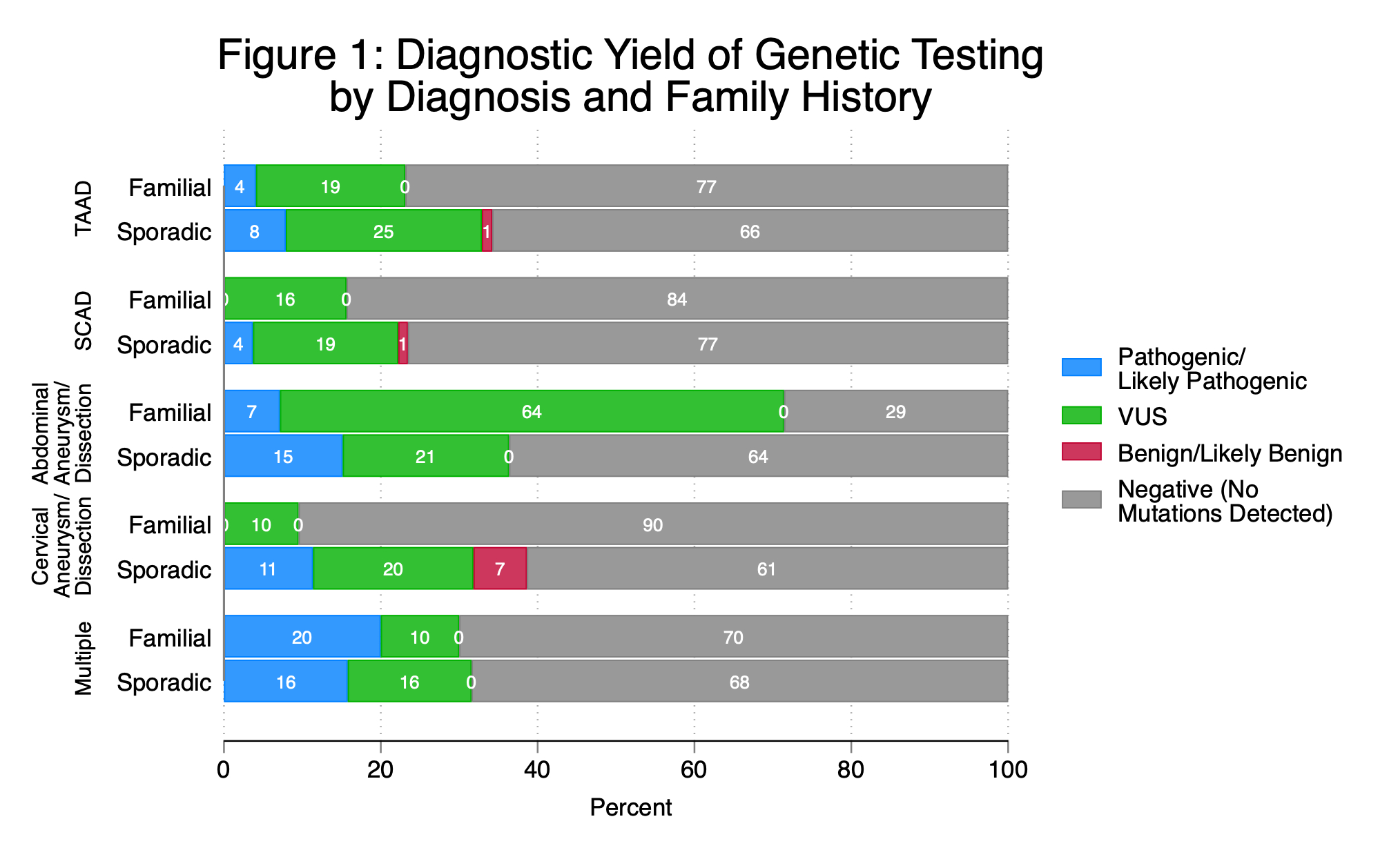
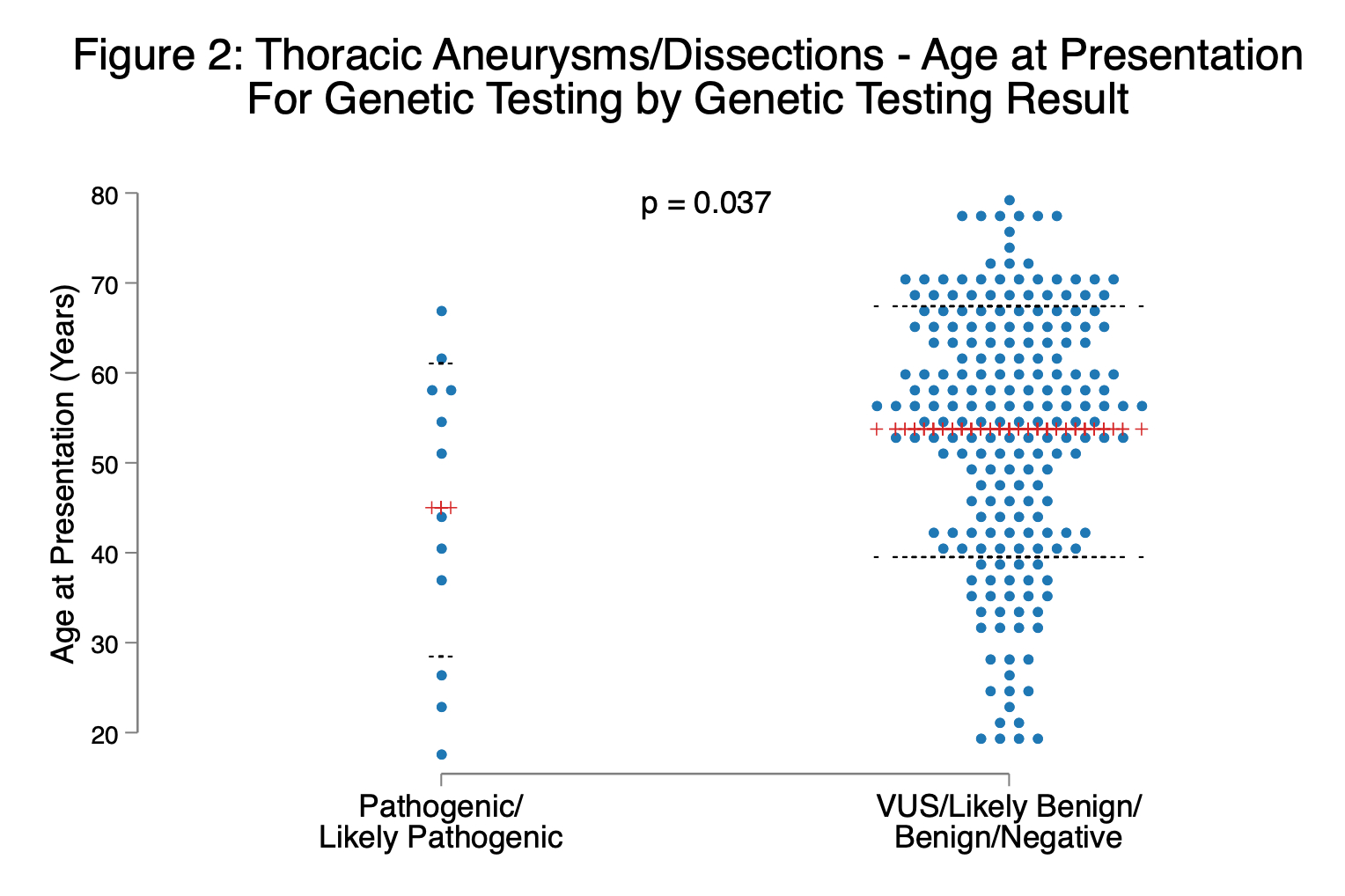
Abstract Body (Do not enter title and authors here): Background: Clinical genetic testing is an increasingly important component of cardiovascular care and has direct impacts on the medical and surgical management of patients and relatives. A better understanding of genetic testing yield and correlations with vascular phenotypes is needed. Methods: We identified all adult patients referred to a large genetic cardiovascular clinic January 2019 - April 2025 for thoracic aortic aneurysm/dissection (TAAD), spontaneous coronary artery dissection (SCAD), abdominal aneurysm/dissection (AAD), or cervical aneurysm/dissection (CeAD). We assessed the diagnostic yield of a multigene panel testing in identifying pathologic/likely pathogenic variants and variants of unknown significance among patients with both sporadic and familial disease (≥1 affected first-degree relative). We used Fisher’s exact and two-tailed T-tests to determine whether positive genetic testing was associated with family history, age at diagnosis, and phenotype severity. Results: Among 699 affected patients, 477 (68.2%) completed genetic testing. This included 223/333 (67.0%) patients with TAAD, 116/187 (62.0%) with SCAD, 109/149 (73.2%) with AAD/CeAD, and 29/30 (96.7%) with aneurysms/dissections in multiple categories. Pathogenic variants were detected in 12/223 (5.4%) of patients with TAAD, 3/113 (2.7%) with SCAD, 6/47 (12.8%) with AAD, 5/65 (2.7%) with CeAD, and 5/29 (17.2%) with multiple. FBN1 variants were the most common pathogenic variants for TAAD, while COL3A1 were most common for AAD and CeAD. TAAD was more likely to be familial (65.9%) than SCAD (28.3%), AAD (29.8%), or CeAD (32.3%) but familial disease was not significantly associated with positive genetic testing. For TAAD, AAD, and CeAD, positive genetic testing was associated with a five- to eight-year younger mean age at diagnosis, although this was only statistically significant for TAAD (45.0 versus 53.8 years, p=0.037). Among patients with TAAD, there was a trend between positive genetic testing and larger mean aortic root (4.5 versus 4.2 cm, p=0.10) and ascending aorta (4.5 versus 4.3 cm, p=0.26). Conclusion: Genetic testing yield was low for a large group of patients presenting with vascular aneurysms and dissections, suggesting polygenic or undescribed monogenic etiologies. Pathogenic mutations were more common in patients with multiple categories of disease and early presentation, suggesting that these populations may particularly benefit from expanded access to genetic testing.
Wittenberg, Rachel
(
Massachusetts General Hospital
, Boston , Massachusetts , United States )
Gwynne, Courtney
(
Massachusetts General Hospital
, Boston , Massachusetts , United States )
Wong, Eugene
(
UCLA Health
, Los Angeles , California , United States )
Harris, Stephanie
(
Massachusetts General Hospital
, Boston , Massachusetts , United States )
Wang, Sarah
(
Massachusetts General Hospital
, Boston , Massachusetts , United States )
Spinks, Catherine
(
Massachusetts General Hospital
, Boston , Massachusetts , United States )
Jeong, Minseo
(
Massachusetts General Hospital
, Boston , Massachusetts , United States )
Newton-cheh, Christopher
(
MASSACHUSETTS GENERAL HOSP
, Lexington , Massachusetts , United States )
Lindsay, Mark
(
MASSACHUSETTS GENERAL HOSPITAL
, Boston , Massachusetts , United States )
Author Disclosures:
Rachel Wittenberg:DO NOT have relevant financial relationships
| Courtney Gwynne:DO NOT have relevant financial relationships
| Eugene Wong:No Answer
| Stephanie Harris:No Answer
| Sarah Wang:No Answer
| Catherine Spinks:DO NOT have relevant financial relationships
| Minseo Jeong:No Answer
| Christopher Newton-Cheh:No Answer
| Mark Lindsay:No Answer